Monday, June 3, 2019

L'Atelier des Lumieres

While it is hard to describe exactly what L'Atelier des Lumieres is, we'll try. Essentially it's an immersive art-and-music exhibit inside an old foundry in Paris. The building is 35,000 square feet with walls 30 feet high. Using 140 laser video projectors, works of art are projected onto the walls. However, these works of art are not static, they move and change. And the visitor can move throughout the exhibit as well, constantly changing perspectives. Overall, the affect is incredible.

When we were there, there were three exhibits, which played sequentially: one of Van Gogh's works, including Starry Night, a second of Japanese art, and a third called Verse, which appeared to be stars forming or exploding - the beginning or the end of the universe - depending on your point of view.

Here are four pictures each of the Van Gogh and the "Dreamed Japan, Images of the Floating World" exhibit:


Looking at these pictures, we realize that they do a rather poor job of transmitting how amazing the exhibition is, but you can see how large the crowds were and everyone from young to old was amazed by it. We will be returning to L'Atelier des Lumieres in August to see an exhibit focused on Klimt, and if you find yourself in Paris, we highly recommend a visit (you can check out their website at https://www.atelier-lumieres.com/en).

Hasta pronto,

Jeff and Shana

Thursday, May 30, 2019

Roland Garros

We spent the last couple of weeks in France with my parents visiting Normandy and Paris. We will have a couple of posts about our adventures coming up, but first a quick post about our last two days in Paris attending the French Open.

Although we attended one day of the US Open in 2000, this definitely felt like more of an event. Roland Garros is not technically in Paris, it's just outside the city and was an easy 35 minute ride on the metro. The days we attended were the first two days of the tournament and our tickets gave us access to the 12 outer courts, and the third-largest of the named courts, Court Simonne-Mathieu. We arrived before play even started on the first day. So early, in fact, they hadn't even written all the names on the men's and women's brackets (128 names each):
Here is part of the same board on the morning of the second day with the previous day's results already noted:
The first match we watched was a women's match between Taylor Townsend of the US and 19th-seeded Gabine Muguruza of Spain. It was difficult to decide who to root for, especially because Muguruza's father is Basque (her mother is from Venezuela), so we were just looking for a good match. While it wasn't a great match, Townsend took the first set 7-5, which meant we got to see three sets, which Muguruza won fairly easily 5-7, 6-2. 6-2.
Our second match was a men's match between 37-year-old Nicholas Mahut of France and 26-year-old (and 16th seeded) Marco Checchinato of Italy. Even though it seemed like an easy win for the Italian, we were looking forward to this match because we expected the crowd to be really into supporting the home-country player. When the match started, it looked like it would go as expected. It took about 10 minutes for Cecchinato to go up 4-1 and he easily won the first set 6-2. In the second set, Mahut played much better, and the crowd really started to get behind him with frequent chants of NIC-O, but neither player could get a service break and Cecchinato won the tiebreak (8-6) to go up two sets to love. Mahut continued to play well, and finally got a break late in the third set to go up 5-3. But, serving for the set, he was immediately broken himself, and we expected that the wheels might come off, but instead he broke again and won the third set 6-4.

From there, Mahut really seemed to take control, and with the crowd very vocally behind him, completed his comeback from two sets down to win 2-6, 6-7, 6-4, 6-2, 6-4! Definitely the match of the day and a very exciting three hours of tennis.
By the way, Mahut, who qualified as a wildcard entry, has already won his second round match over 35-year-old Phillipp Kohlschreiber of Germany (6-3, 6-3, 6-3). His third round opponent will be Leonardo Mayer, an unseeded 32-year-old from Argentina so maybe his run can continue for another round.

After that, we were excited to watch Venus Williams play against the number 9 seed Elina Svitolina of Ukraine, but after a few minutes, it was really hard to watch because Venus is suffering from a medical condition and other than when the ball is in play, moves on the court like she is 68 (78?) not 38. Since we had already watched over five-and-a-half hours of tennis, we decided to call it a day.
Back the next day, we saw another Frenchman, Richard Gasquet, defeat Mischa Zverev (both unseeded) in straight sets, 6-3, 6-4, 6-3. We then watched a decent men's match between 24th-seeded Stan Warwinka of Switzerland and Jozef Kovalik of Slovakia. Warwinka has won a couple of majors and clearly expected this to be an easy match. He won the first set very easily (6-1), but Kovalik showed a lot of poise in the second set and won a tiebreaker (7-3) during which Warwinka was warned for "racquet abuse." Unlike Mahut the previous day, however, Kovalik could not keep it up and fell pretty easily 6-1, 6-7, 6-2, 6-3.
After that match, we decided to go check out a match on the outer courts. Those courts, which are numbered 1 and 4-14 are open to everyone, and range in size from pretty large to tiny (literally like 100 seats). We went to one of the latter and got a close up view of an American qualifier Tennys Sandgren and his Moldovan opponent, Radu Albot:
First, I have no idea if the American pronounces his name "tennis," but it is a pretty funny name for a tennis player. Second, it was interesting to watch Sandgren talk to himself (and berate himself) between points. While we only saw the first-set tiebreak and second set, both of which Albot won, it was clear that Sandgren was a bit out of his depth (he ultimately lost 7-6, 7-6, 3-6, 6-1).

And, that was it for our French Open experience. It was really fun, and we would consider doing it again, but would definitely not go without tickets to one of the three main courts. From what we saw, the people who only had access to to the outer courts spent a lot of time standing in line waiting for a change-over (and a seat to be open) so they could get into a match, and even now we lack the patience to do that all day.

Hasta pronto,

Jeff and Shana

Saturday, May 25, 2019

San Juan de Gaztelugatxe – aka Dragonstone

We finally made it out to San Juan de Gaztelugatxe, one of the most beautiful spots in the Basque Country. It is much easier to get there with a car, so my brother’s visit created the perfect opportunity to visit this amazing site. We rented a car in Bilbao and spent the day driving along the gorgeous coast to San Sebastian. Less than an hour from Bilbao, and past the charming town of Bakio, you come to this stunning place:
It’s a 10-minute walk to the lookout point where that photo was taken, and a 25-minute walk to the island.
San Juan de Gaztelugatxe is an island - the path is man-made. The building at the top is a small church that dates from the 10th century, and it has been an important historical site since. However, what has made the site really famous is that it was used as the site of Dragonstone in Game of Thrones. Since the release of Season 7, the popularity of San Juan de Gaztelugatxe has soared. Luckily, we were there early morning and mid-week and enjoyed this pilgrimage site in an uncrowded state. To their credit, the local government has chosen not to charge an admission fee to visit the area.
It’s 241 stairs to the top, where you’ll find the chapel (not a giant dragon fortress, which is a CGI creation). Legend says it is good luck to ring the bell 3 times and you can hear the bell often during your ascent to the top.
This is truly a special place. Fisherman still come to ask for blessings in the chapel in advance of their voyages as the season begins.

Hasta luego,

Shana & Jeff

Monday, May 20, 2019

A Walk Above A River – Our Return to the Puente Vizcaya

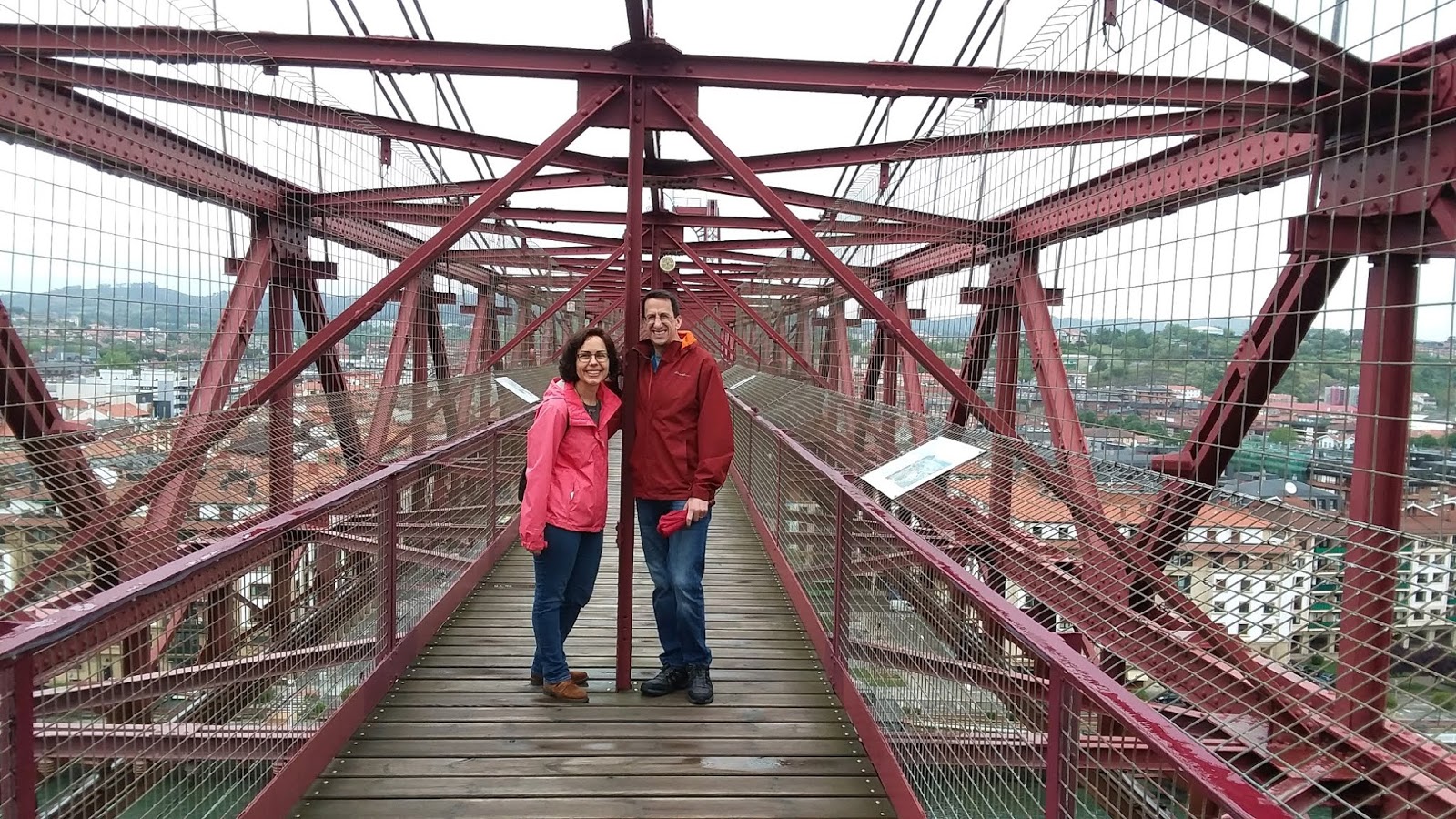
In January 2018 we visited the Vizcaya Bridge, the first transporter bridge inaugurated in 1893, but were only able to take the gondola across because the foot bridge was closed. We returned with my brother (May 8) and were delighted to have the opportunity to ascend to the top and take in the views.
The bridge straddles the river and allows boat traffic to pass without the need of a drawbridge:
The hanging white gondola car transports people and cars across the river approximately every 4 minutes. Here’s a view of the gondola from above:
Standing on the bridge nearly 50 m above the river the crossing gondola creates a strong vibration. This is not for the faint of heart. But after a few minutes you do get used to it and don’t notice it as much. There are numerous panels showing the history and design of the bridge. And even a marker regarding its designation as a world heritage site:
But the best part are the views:
We had the bridge almost entirely to ourselves and found it to be quite a tranquil place:
After we descended, we took the gondola to the other side of the river. The price had gone up five centimos to 45 since January – still a bargain at about 50 cents. We then took the metro back into Bilbao to visit the Guggenheim Museum – where the bridges just don’t compare even if you get to watch rowing practice.
It was worth the wait to revisit and experience this exceptional bridge from another angle.
Hasta pronto,
Shana & Jeff

Wednesday, May 15, 2019

Up Close with the Flysch

We're back after a short vacation from blogging due to the normal ups and downs of everyday life. The next few posts will be about the many fun things we did during Shana's brother's recent visit . We had a great time showing him around the Pais Vasco. As we always remind you -- all visitors are welcome.

In October of 2017, we wrote about our adventure hiking the Flysch Route from Deba to Zumaia. Last Sunday (May 12), we returned to Zumaia for a boat tour of the flysch, which allowed us to learn a lot more about what flysch is and to get some fantastic views from the sea:
As you can see, it was a beautiful day to be on the water. Here is Adam enjoying the scenery:
After the one-hour boat tour, we took some time to enjoy the flysch from the shore as well:
And, for you Game of Thrones fans, Itzurun beach in Zumaia is the setting for Daenerys Targaryen's arrival in Westeros:
Two further GoT fun facts from the Basque region: (1) Zumaia is actually not close to San Juan de Gaztelugatxe where Dragonstone is set (ah, the magic of film), and (2) Daenerys's throne is designed to look like flysch. So, if you want to come see the places that inspired part of the show, we will be happy to show you around.

So, what did we learn about flysch? (Anyone who doesn't care about science stuff can safely skip this paragraph and the next.) We learned that flysch is layers of sediment that was turned on its side when the Iberian Peninsula collided with the rest of the European continent sometime between 20 and 80 million years ago (this collision also formed the Pyrenees Mountains). Before that, the Basque region was under water, and the layers of sediment were at the bottom of the ocean. However, the collision and formation of the flysch allows scientists to read the geological record like a book. Now, instead of layers of sediment getting older from top to bottom, they get older from east to west, allowing for easier research about the history of the planet.

For me, the most interesting thing is how the flysch supports the theory that a meteor striking earth led to worldwide climate change and the extinction of the dinosaurs (along with 75% of other species 66 million years ago). You can actually see in the flysch the line that marks the K/Pg (Cretaceous/Paleogene) boundary. This layer contains a large amount of iridium, an element that is very rare on earth, but very common in meteorites. Pretty cool.

Overall, it was a very fun and educational day, capped off by Shana making a new friend. This is Kaia, and she is only two months old:
Hasta pronto,

Jeff and Shana

Sunday, April 28, 2019

Spanish Election Day - 28A

We live in interesting times in an interesting place – especially in terms of politics. Since we arrived here, Spain has experienced a constitutional crisis with the Rajoy government suspending Catalunya’s autonomy in October 2017; and then in June 2018 with Rajoy’s government succumbing to the first ever no-confidence vote after a massive corruption scandal. Today is a “snap election” called by Prime Minister Pedro Sanchez after his Socialist party led government could not get majority support for the proposed budget. Spain’s political situation is extremely fragmented like everywhere else. We’ve been following the campaign and thought we’d share a few observations about how the system works here.
First some basics: Spain has a parliamentary system like many democracies. There are several different political parties. Initially, the two biggest political parties dominated the post-Franco democracy – (1) Partido Popular (PP), the more conservative party, and (2) Partido Socialista Obrero Espanol (PSOE), the more liberal party. But more recently, neither party has been able to achieve a majority in the Legislature and therefore must seek to form a coalition.
Second, the concept of a “campaign” here is entirely different. Unlike in the US, where the 2020 campaign for President is underway, there was only a one-month period of actual campaign activity. And overall, the amount of in-your-face campaigning was quite limited. A few bus-stop and other posters. Some newspaper and nightly news coverage, but nothing like the US.
Today, I went to observe the voting process. Once again, I relied on the kindness of our friend, neighbor, and former teacher Begona. I asked if I could tag along to witness first-hand how the Spaniards cast their votes. We walked over to the local school where their designated polling station was set up. Rather than receiving a ballot and entering a voting booth, voters selected the slip of their preferred political party to place in an envelope for the main Congressional vote. (This is the vote that will decide who gets the opportunity to form the government.) It reminded me of the Israeli election process, which I witnessed with my first-cousin 2 decades ago. Here are 4 samples of many of the slips used:
Voters also completed the ballot for the Senate, the upper house, in which you can select up to three candidates who do not have to belong to the same party. Each province elects four senators, and this is the only time that Spaniards vote for individuals instead of a party list. Once marked the ballot is put into a separate envelope. This ballot sheet shows that there were candidates from 12 different political parties here in Gipuzkoa:
So, the first thing that’s interesting is that I easily picked up these voting materials even though I have no right to vote here. In California, where we voted for most of our lives, to get your ballot when voting in person, a poll worker confirms your name and address. In Washington, where everyone votes by mail, you received your ballot by mail. Here, you take your envelopes to your designated table (based on mailing address) and present your identification. Once they confirm that you are on the voter list, and cross you off the list, you place your envelopes in the designated ballot boxes. It was quick and easy.
Most interesting to me is that the entire process is manual. There are no machines involved – either in the marking or counting of the ballots. When the polls close at 8 p.m., each table’s designated team of three people will count the votes from the two ballot boxes by hand.
Also, of note, each table’s officials are citizens who have been randomly selected and have an obligation to serve as electoral officials. It is similar to jury duty in the US, but there are very few acceptable excuses. In addition, officials from the various political parties have the right to be present during the day and during the counting process.
As I write this post, the level of participation in this election has been high - at least 10% higher than the 2016 election. For the first time, a far-right party, Vox, is going to earn seats in the Legislature.
The good news is that this evening we have been able to understand the reporting on the election results as they are being provided. Big points for our Spanish language education.
We’ll see where this all ends up in the coming days. But overall, democracy is a messy process. 
Hasta pronto, 
Shana and Jeff

Friday, April 19, 2019

Definitely not the NBA

While we knew from reading the newspaper that there was a professional basketball (baloncesto) team in San Sebastian, we really did not know much else about the team or the league. That changed  Saturday night (April 6) when we used tickets given to us by Shana's friend Isabel to attend the game between our local team, Delteco GBC (Gipuzkoa Baloncesto Club), and the visiting Movistar Estudiantes (Madrid). Because basketball is not a huge sport here, in many cases the teams are actually named after their sponsors. A little weird.

Another difference is that, like in soccer, there are multiple leagues (or at least two). Each year, the worst two teams in the top league, which has 18 teams, are relegated (i.e. demoted) to the lower league, while the top two teams from that league are promoted. It seems that GBC has been about the 18th or 19th best team in Spain the last few years because in 2017 they finished at the bottom of the league and were relegated, but in 2018 they won the lower league and were promoted. This year, they are currently in last place and in danger of relegation again.

And, on Saturday night, they showed why. Playing the 15th place team, they looked terrible in the first half (the game consists of four 10-minute quarters). After being down by seven at the end of the first quarter, they did not play any perimeter defense in the second, and Movistar rained threes to take a 22-point halftime lead. We are not sure exactly what the coach said in the locker room, but it worked.  They looked like a completely different team in the second half. They actually looked good and proceeded to cut the lead to eight by the end of the third quarter, and then took a two point lead with about four minutes left in the game. What was much more exciting than basketball in the US (college and pro) is that the coaches let their players play coming down the stretch without calling an interminable string of timeouts. And, with GBC leading 93-92, they needed one last stop to cap an amazing comeback. Playing some of the best defense we had seen all day, they did it:
It was actually one of the best comebacks in basketball we have ever seen live, and the few fans that were there were really into it:
The stadium, which is about a 30-minute walk from our apartment, seats 11,000 people, but those white curtains cover much of the upper bowl, and we suspect there were about 3,000 people at the game, but at least we all got to see a good show.

Overall, the game looked more like a US college game than the NBA. GBC's roster even includes two Americans who played at the college level. There was a lot of screening and passing, and not a lot of isolation and single-player dominated play. The level of play seemed to be low-division 1-A or maybe division 1-AA. These teams would get destroyed by the top level teams in college (Duke, NC, etc.), but might hold their own against weaker teams. Obviously, we don't know how good the better teams in the league are.

All-in-all, we really enjoyed the game. The fans, including a ton of kids of all ages, really got into the home team's comeback and left the arena jubilant. I am not sure if we will be going back any time soon, but there are definitely worse ways to spend a couple of hours on a Saturday evening.

Hasta luego,

Jeff and Shana