Friday, July 28, 2023

Baden-Baden, the Black Forest, and Heidelberg

We headed across the border (something you don’t even notice) to Germany. What you do notice immediately is that people drive fast, really fast (there truly is no speed limit on the famous German Autobahn). Why did we choose this area to explore? Because it was easy to get to, has famous spas, and is quite scenic.

Baden Baden is an upscale town that has been a spa resort since the 19th century. Our time at Friedrichsbad, the Roman-Irish Bath, which opened in 1877, was a highlight of the trip. It is a naked, co-ed spa. Cori and David are close friends, and now they are even closer.

At the spa you pass through various stations, starting with dry heat, transitioning to wet heat – getting hotter in each place – then transitioning to soak in various pools that gradually get cooler, including the ultimate cold plunge. After drying off with warm towels and moisturizing with lotion, you get wrapped up like a burrito and nap/relax in a quiet room, before lounging with a cup of tea. It was fabulous! So fabulous we went back again the next day.

We explored the town sights, observing the quiet elegance, and hiked up to a biergarten for dinner. After dinner schnapps were included.

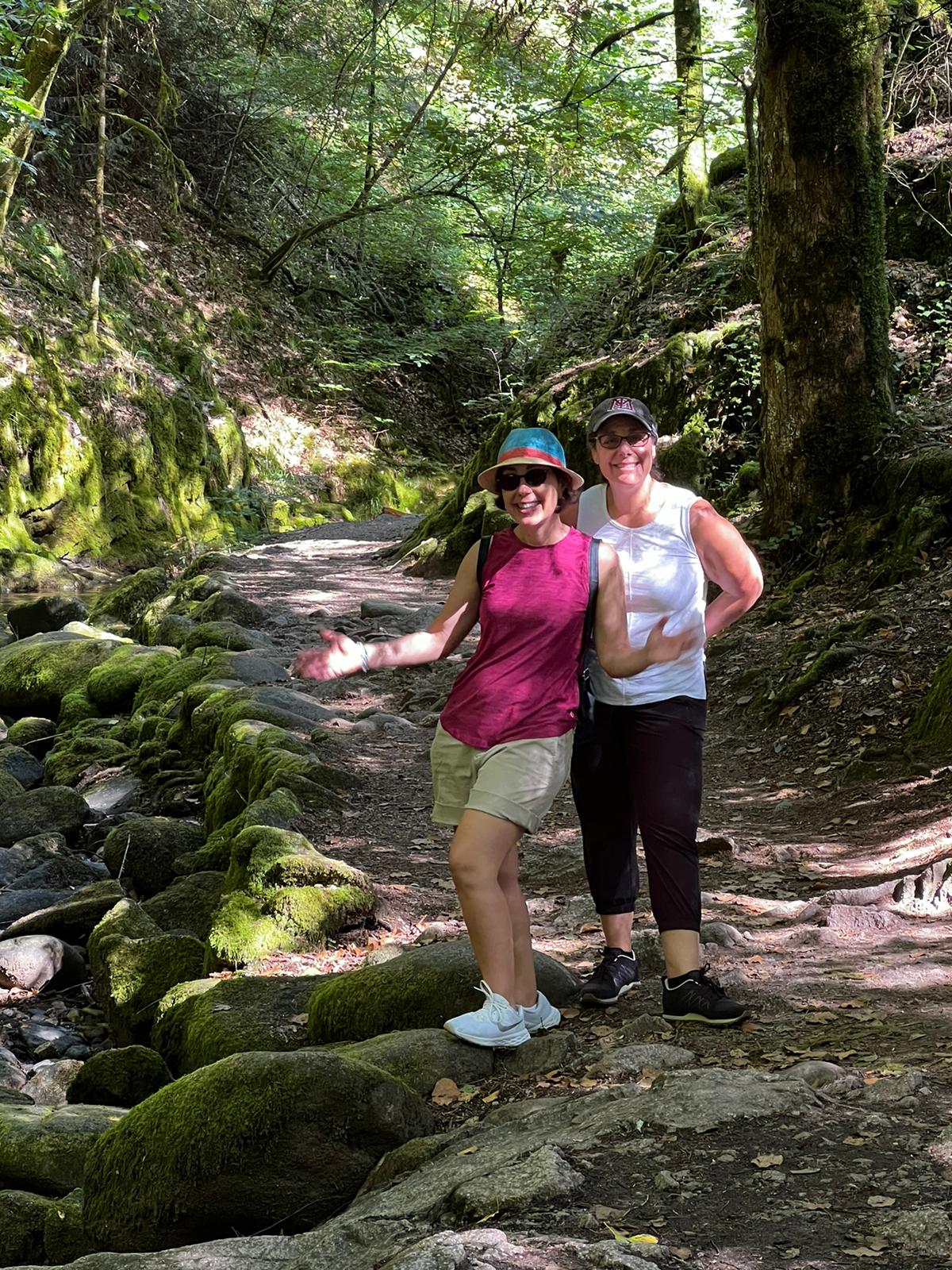
We enjoyed some outdoor time in the Black Forest, which has lots of pleasant trails. We did three short hikes as stops along the High Road drive. One hike was along a river to a waterfall, another was a walk around Mummelsee lake, and the last was the Lothar Trail, which is an area hit by a hurricane in 1999 that has been allowed to recover naturally. 


Our final day with Cori and David was spent in Heidelberg, our first and only experience with very large crowds in Germany. Heidelberg has a charming old town and a semi-restored Renaissance castle. It was a hot day, and we sweated our way up to visit the castle, which provided great views.

We had a lot of laughs during our time with Cori and David. It is always amazing to reconnect and seemingly pick up where you left off with long-time friends that you haven’t seen for far too long. As they headed home to pick their kids up from camp, we continued our journey to visit the Rhine and Mosel valleys.

More soon,

Shana & Jeff  

Tuesday, July 25, 2023

Biking through Alsatian Vineyards and Villages


Six years ago, we did our first bike tour. We took the ferry to one of the San Juan Islands near Seattle and had a great day exploring. Since then, as readers know, we’ve done more rides, both guided and self-guided tours (e.g., Versailles, Amsterdam, and Waiheke Island) and have enjoyed them all. But we may have had the best day biking yet exploring the Route des Vins d’Alsace. What made this ride so special? The scenery, the wine tasting, and doing it with friends, of course!

We found a terrific rental company, Alsa Cyclo Tours, with a rental office in Kayserberg, one of the cute towns on the north end of the route and near where we were staying. Their staff had our e-bikes ready to go and they were super helpful in getting us started. While Jeff is a strong biker, he’s not the best navigator – that’s my job. Since I’m not the strongest biker, thankfully Cori had the skills to ride and navigate our self-guided route south to Eguisheim and back, for a total of over 40 kilometers (25 miles).

Leaving Kayserberg we had a chance to survey the scenery – it was stunning:

Nearly the entire route is paved bike lanes through seemingly never-ending rows of vines planted at all angles. Nestled among the vines are countless small villages, each more picturesque than the last. Fortunately, the day was overcast and cool – perfect weather for a day-long ride. We stopped in Eguisheim for lunch and for a walk through the picturesque medieval town – our bums needed a break!

Built in a circle, the village is quintessential Alsace, with half-timbered houses, ramparts, flowers, stork nests, and cobble stone streets. In the center is the Chapel of St. Leo IX, the only Alsatian pope (elected in 1048).


On our return we stopped in Wettolsheim at Jean Louis Schoepfer for a wine tasting. We hadn’t selected a winery in advance, so when Cori proposed a stop there, we had no idea that she had picked the most fabulous winery. Our host was Christophe, the 13th generation winemaker who happily answered our many questions while generously pouring 9 different wines for us to try.

We selected 6 bottles to bring back to Spain, which he graciously allowed us to pick up the next day – carrying them back on the bikes seemed risky after the extensive tasting.

The scenery along the return was just as pleasant and we had an opportunity to use our e-bike power assist on a hill or two. We rewarded ourselves with a kougelhopf – a local cake – which we felt we earned.

Our last morning in the area we stopped in Riquewihr, another attractive village, for breakfast and a stroll:

We were sorry to leave the charms of the Alsace but knew that the German side of the border had much to offer as well.

A conclusion on bike tours – our favorites include wine tasting! Considering the name of our blog, you can’t be surprised.

Adieu,

Shana & Jeff 

Saturday, July 22, 2023

Alsace -- The Next Trip Begins

After four months of not traveling post the Big Trip, we finally set off on July 1 for a trip that would take us technically to four countries: Switzerland and Luxembourg (both very briefly), but primarily the Alsace region of France and the Black Forrest, Rhine and Mosel Valleys in western Germany. We travelled for the first half of the trip with our friends Corrine and David, whom we hadn't seen in some 10 years (!), and we spent a great deal of time driving, as these areas are much easier to get around by car than by train.

The Alsace region is bordered by the Vosges Mountains to the west, and the Rhine River to the east. The historical problem is that the Germans believe the border between the two countries should be the mountains, while the French think it should be the river. Hence, this region has passed back and forth between the two multiple times over the centuries including four times between 1870 and 1945 (from France to Germany in the War of 1870, back to France in WWI, back to Germany in 1940 and finally (for now) back to France in 1945). As a result, the area has a bunch of adorable villages with an interesting mix of French and German cuisine.

Given the history of the region, it was appropriate that our first stop (after picking up Corrine and David in Basel and lunch in Guebwiller, a small Alsatian town) was the Hartmannswillerkopf  -- Vieil Armand Memorial, an area where significant WWI battles took place.

Up the hill in front of Corrine and me is a hike in an area where many of the trenches from WWI have been preserved with lots of detailed information about the battles there. It was extremely interesting, but also sobering to see exactly how small and cramped the conditions for the soldiers were (the movies do not really do it justice).

As you can see, the area around the trenches has been allowed to return to nature and it is absolutely beautiful with stunning views. A little over a hundred years ago, this whole area was trenches, barbed wire and mud.

After our hike, we headed to our VRBO in the extremely small town of Beblenheim (population about 1,000). Our VRBO was very close to the town's adorable little church, which included one of the ever- present stork nests seen throughout the area.

The church became important the next morning when its bells not only started to chime the time at 6 am, they loudly played an entire tune for 4 minutes! We were somewhat amused, but more annoyed as we were on vacation and did not need the early wake-up call, which we decided was some kind of Calvinist work-ethic thing. This happens 7 days a week in most local towns apparently.

That first day, after coffee and pastries at the local bakery, we visited the nearby town of Colmar, home to the Unterlinden Museum, which houses the Isenheim Alterpiece (no photos were allowed in the museum, but it is worth checking out Wikipedia if you have any interest in Medieval art, and I mean who doesn't?). 

In Colmar, we discovered that because people were generally not able to read in the middle ages, the buildings had elegant picture signs to show what they were:

Colmar also has an area they call little Venice where boats (but not gondolas) ply the canals:
Lunch that day was several Alsatian specialties, and (of course) a crisp Alsatian white wine -- there are so many types to try.
We also visited the largest city in the Alsace region: Strasbourg (population around 300.000), home of the European Union Parliament and other EU organizations. But, what the city is really known for is its impressive Gothic Cathedral with its famous astronomical clock.
We have been in many cathedrals and churches throughout Europe, but this one is particularly impressive (and it had a huge number of tourists to prove it).

The city itself, which sits on the Ill river, is beautiful, and we mostly enjoyed ourselves by walking around and looking at the architecture and views of the city.
We very much enjoyed the cities of the Alsace, but the countryside was even better, and we did a great biking adventure along la Route des Vins d'Alsace. But more about that soon.

Hasta pronto,

Jeff and Shana


Sunday, June 25, 2023

June Happenings


While May was filled with daytrips, June has been relaxed and easygoing. The weather has improved, although we’ve still had a good amount of rain. Considering 40% of Spain is experiencing drought conditions, we won’t complain about the big storms that have come through recently. We’ll have more to report in July as we head out on our first trip since returning, but in the meantime, we thought we’d catch you up on June happenings.

In between all the typical stuff like cooking, seeing friends, gym and yoga classes, watching baseball, trip planning, and walks through the city, we went to see Bob Dylan (June 20). When I saw Dylan was giving two concerts here, I figured we ought to go. After all, the man is a legend and Nobel prize winner. While neither of us is a fan, we thought we should check it out. Since he is 82, it’s not like we’ll get another opportunity. Plus, big names like Dylan don’t make it to San Sebastian very often. (Although over the decades he’s played here twice before.)

The concert was probably the most unusual concert we’ve ever been to. And not just because you were obligated to place any electronic devices in secured pouches. (We just left ours at home. Besides this was a positive – no interruptions to your vision or enjoyment.) Dylan is not the most social person. He is notorious for being elusive, reclusive, and quiet. He said “thank you” twice and introduced his band – who were amazing musicians – and that was it. He still has a strong voice. Honestly, we could understand only about 50% of what he sang. He was either perfectly clear, garbled by mumbling or whining, or sounded like he’s had a stroke. Sometimes the music overwhelmed the lyrics. I’m not sure how the Spaniards understood much. As native English speakers we struggled. Still, his recent bluesy-style music was enjoyable, and we’re glad we had the experience.

The concert was a great birthday “appetizer.” We continued the celebration the next day with a mini-spa afternoon and dinner at one of our favorite Basque restaurants.

The summer season is getting busy here. We were invaded by more than 50,000 French rugby fans when the city hosted the semi-finals of the French rugby league. It was a very noisy weekend.

Next week the region will host the first three legs of the Tour de France, with the second leg finishing right here in San Sebastian. There are yellow and bike-themed decorations being put up already. We’ll be out of town for this chaos.

While out on a walk this weekend I came across a foot volley tournament taking place on Zurriola beach.

We’re looking forward to more fun summer events – Jazzaldia, Bilbao’s Blues Festival, and Semana Grande.

Hasta pronto,

Shana & Jeff

Saturday, June 3, 2023

Day Trip to Bayonne

Last week we took a day trip to a city we have never visited before: Bayonne, France. Bayonne is considered the capital of the French Basque Country, and one of the things we did was visit the city's well-regarded Basque Museum. 

Bayonne sits at the confluence of two rivers: the Ardour and the Nive. We crossed both to get from the train station to the museum. The museum itself is in an old building on the edge of the Nive River. We watched a movie that showed the growth (and decline) of various governments in what is now Spain and France from pre-Roman times through the present day. It was a very interesting way to see the numerous politcal forces that have impacted the Basque people over the last 2500 years. Much of the rest of the museum was about the lives of the Basque people, most of which we knew. There was also a small exhibit about the Jews of Bayonne, where some settled after being driven out of Spain and Portugal in the late-15th century (and brought the art of chocolate-making to the city). The museum's displays were in French, Basque, and Spanish -- English was not an option.

After the museum we walked around a bit before heading to lunch. We stepped into Saint Andrew's Church, a neo-Gothic style church built in the 19th century along the way:

We also saw this fantastic whale mural, referencing the history of whaling in the area, which we learned later (thanks, Google) was done by a couple of Barcelona-based artists. 

Our lunch was really fantastic, and very sophisticated. Of course, we drank French wine, and enjoyed two fish dishes, both of which were delicious. We had a lively debate about whether French food might be better than Italian. 

After lunch, we did a bit more walking around the city, including a visit to Bayonne's cathedral, Sainte-Marie, which is visible from most points in the city:
The inside of the cathedral was actually quite impressive, but even better was the adjacent cloister:
In our wandering through Bayonne, we also came accross the city's war memorial:
Note that the huge number of names in the center of the memorial are  those lost in WWI, while the smaller number of names on the two sides are  those lost in WWII, which is something we tend to see in France, given its relatively-limited participation in the battles of WWII. Also, note the representation of the Basque person on the left with his buey (ox), a traditional method of transportation in the Basque region.

We had a very nice day in Bayonne, but don't think we like it as much as San Jean de Luz or Biarritz, the other cities we have visited in the French Basque region.

More soon.

Jeff and Shana


Thursday, May 25, 2023

Day Trip to Vitoria-Gasteiz


We last visited Vitoria-Gasteiz, the capital of Alava and the Basque Autonomous Community in 2018. Since then, a new museum opened in 2021, the Center / Memorial to the Victims of Terrorism. We’ve been wanting to visit, and we finally made it there last week (May 18).

Like Bilbao, Vitoria is an hour and 15-minute bus ride away. Unlike Bilbao and San Sebastian, Vitoria is inland and has a reputation for being chilly, especially during the winter when Basque locals joke its name is “Siberia-Gasteiz.” Fortunately, we had decent spring weather for our visit. The center of Vitoria has numerous attractive older buildings, squares, and churches.

After stopping for coffee, we headed to the museum, which is in the former Bank of Spain building.

The museum is about and the impact of terrorism on society, democracy, and human rights, highlighting victims and their families. The focus is on terrorist groups and acts of terrorism in Spain, but it also incorporates terrorist events from around the world, including 9-11.

Living in Spain, and in the Basque region, we felt visiting this museum was an important part of our political and cultural education. Most of the terrorist acts in Spain were perpetrated by ETA, an armed Basque separatist group that operated between 1959 and 2018. ETA killed 829 people, including 340 civilians, and injured more than 2,200. There are small plaques on the sidewalk in San Sebastian memorializing the assassinations that happened here. (I highly recommend the movie Maixabel, which should be available on Netflix, if you are curious about this part of Spanish/Basque history.) Our interest was vindicated as we gained a broader understanding of terrorism’s power and how governments respond. Spain has also experienced right-wing and “jihadist” terrorism. (Another Netflix recommendation is a documentary about the Madrid train bombings on March 11, 2004, 11M:Terror in Madrid.) We had the entire museum to ourselves, which made it easy to “enjoy.”

We explored the city a bit more before heading to eat at Waska, where we enjoyed a 3-course lunch. We had a cold gazpacho made with berries that was vibrant and delicious.

We are now looking forward to our third planned day trip next week: Bayonne, France.

Hasta pronto,

Shana & Jeff 

Tuesday, May 9, 2023

Day Trip to Bilbao

Last week, we took a day trip to Bilbao to see a Miro exhibit at the Guggenheim Museum. We started with coffee and a pastry at a very nice pasteleria near the museum. We were surpised to find that the person serving us was from Hawaii (!). This young women had moved to Bilboa two years ago and spoke very good Spanish, probably due to her Basque mother. She was impressed with our Spanish, but we all agreed that Euskera is just much too hard to learn.

At the museum, we started with the Miro exhibit. We have been to the Miro Foundation in Barcelona several times, and it is a museum that we really like. But this exhibit, which contained many works we had never seen before, both from private collections and museums we have never visited, did not impress us much. This was the most interesting piece, both for its form and for its inclusion of many elements that Miro used often:

Fortunately, as is often the case, the other temporary exhibits at the museum were better than the one we went to see. First we saw a work by a Japanese artist named Yayoi Kusama whose work tends to be immersive. The piece we saw was just that: a small room (only 4 people admitted at a time) with mirrors all around and hanging lights. We were not certain exactly what it was supposed to signify, but it was pretty cool.
Next, we saw an exhibit of a black British artist named Lynette Yiadom-Boakye. The exhibit was of both paintings and charcol drawings of black people done between 2020 and 2023. I was particularly impressed by the pieces done in charcol.  I am not  sure why exactly, but there was something about the almost causualness of the drawings that I really liked. Even better, the artist is also a writer, and our favorite part of her exhibit was reading one of her short stories.

The third exhibit was of a 20th century Viennese artist named Oskar Kokoschka. Kokoschka has a style that was controversial from the beginning, especially his portraits. And, after the Nazi's came to power in Germany nine pieces of his work was included in an exhibition of "degenerate artists." Well, Kokoschka didn't like the Nazis any more than they liked him, and his designation as a degenerate artist led him to paint "Self Portrait of a Degenerate Artist" in 1937:
Kokoschka was active in movements against the Nazis throughout the war (he fled from his native Vienna to Prague in 1934 and later to the UK where he spent the war years). He even painted posters calling for aid to Basque children after the Gernika bombing.

Overall, we had a very nice time at the museum, and were happy to have such beautiful weather in Bilbao. Here is Shana with one of two Chilida statues newly located on the terraza of the museum with the "bull bridge" in the background.
After the museum, we took a walk to the restaurant where we had a late Spanish lunch (of course). Lunch was very good, especially the cold avacado soup that was my appetizer (sorry, no pictures - too busy eating). After lunch, it was back to the bus station for our return to San Sebastian. 

We have more one-day outings planned in May, so be sure to check back for more culture from the Basque region.

Hasta pronto,

Jeff and Shana