Thursday, April 15, 2021

Team Placebo


To put it politely, Europe is struggling to get its population vaccinated. So, when the opportunity to participate in a vaccine study came along at the end of January, I thought it might be worth pursuing. If you had asked me six months before that to participate in such a study, I would had said “no way, Jose!” But with the success of the Pfizer-BioNTech and Moderna vaccines, I figured that this could be one way to get vaccinated before I might otherwise, and well, “for the science,” and all that.

I signed up for the trial and initially didn’t hear anything. It turns out that many people were willing to participate, and they had more than 1,500 volunteers for 1,000 spots here. In the end, everyone was invited to participate because enough people were disqualified or chose to not to enroll after all. The study will last for two years and requires five in-person appointments, plus three telephonic follow-up calls within the first year, and four more the following year. Participants who receive the placebo will be entitled to receive the vaccine if it is approved. I knew going in that the proposed vaccine is an mRNA project (like Pfizer and Moderna) by a German company called Curevac.

I was excited, and then I was a bit intimidated. First, because I had never done anything remotely similar, and second because I would be doing this all in Spanish. I admit I was nervous, but I was lucky that my friend Carol had her first appointment the day before mine, so her description of what would happen and where to be was super helpful. I carefully reviewed the 15-page informed consent and description of the study, which took a long time to review in Spanish!

At the first appointment (February 24), I checked in and was promptly asked to take a pregnancy test because pregnant women are excluded from the trial. While I explained that I knew with absolute certainty that I was not and could not be pregnant, I still had to take the test. It was negative. I then met with a doctor who reviewed the consent form with me, which we then signed. The next step was a blood draw. After that, a nurse took my vital signs, and I received an injection. As this is a “gold standard,” stage three, double-blind study, no one knew what I received. I then had to wait 30 minutes to see if I had any adverse reaction, after which I met with the nurse and had my vital signs taken again. While I was waiting, I was given instructions on how to use the study’s “app” and provided an oral thermometer as we need to monitor our temperature and report it, along with any symptoms, twice a week. After all that, which took about two hours, I was free to go.

I had no symptoms or adverse effects from my first shot, not even a sore arm. This was disappointing, but not unexpected since everyone had a 50% chance of receiving the placebo or vaccine. But since many people have no effects after a first vaccine shot, I could not be sure what I had received. I dutifully recorded my lack of symptoms and my temperature using the app twice a week. I have now taken my temperature more times in the past several weeks than I have in my lifetime. It is somewhat interesting how it varies from day to day.

The second appointment (March 25) was practically identical to the first, only there was no blood draw. The physician meeting focused on my lack of any reaction to the injection and lack of any COVID symptoms. I received my second injection, dutifully waited, and went home hoping I would soon feel like I got hit by a truck – a sure sign that I got the vaccine. Only I felt fine – perfectly fine. Again, not even a sore arm. Thus, I’m nearly certain that I am on “Team Placebo.” How disappointing. But that was obviously possible and is part of the process.

My third appointment (April 8) was a quick and easy follow up in which a nurse took my vitals, I again explained to a doctor that I had no adverse effects after the second shot and no COVID symptoms, and had my blood drawn. The next follow-ups will be in June and September. In the interim, I’ll keep monitoring for symptoms and taking my temperature twice a week.

Since my first appointment I’ve done a bit of research on Curevac and am keeping track of its progress in the approval process as much as possible. The good news is that so far things are looking promising and that the company has been submitting data on a rolling basis to the European approval authorities to speed things up. It is unclear when the approval process will finish, but this week they confirmed that they hope to be approved by May or June. If you’re curious about the company, which happens to be the one that Trump supposedly wanted to buy, here’s a link to the best article I’ve read so far:  https://www.irishtimes.com/business/health-pharma/how-vaccine-laggard-curevac-hopes-to-come-out-on-top-1.4493799

While it is possible that we could be “eligible” to be vaccinated before the vaccine is approved, perhaps at the earliest late May (although there seem to be new delays on a daily basis), my plan is to stick with the study. Because we are not part of the Spanish national health system, getting vaccinated is going to be one of those “fun” challenges as the regional health services are responsible for administering the entire vaccination program and we are not on their radar. I’ve checked with our private insurance carrier, which is a Spanish company, who confirmed that are not involved and have no control over the vaccination process. We’ll be figuring it out for Jeff when the time comes. I’m sure it will make for an interesting future blog post.

Hasta luego,

Shana


Saturday, April 3, 2021

La Copa Del Rey

European soccer (futbol) is weird. Each country has multiple leagues with the top teams in lower leagues moving up (promotion) and bottom teams moving down (relegation) each year. In addition, there are European-wide leagues (Europa League and Champions League) that teams in the top national leagues qualify for each year. For example, each year Spain's top league, La Liga, sends its best four finishers to the Champions League, while its fifth and sixth place finishers go to the Europa League. In essence its wall-to-wall futbol.

In Spain (and perhaps in other countries as well), there is also a national tournament, El Campeonato de Espana-Copa de Su Majestad El Rey or La Copa del Rey. This tournament allows all of the professional teams in Spain (all 126 of them) to compete regardless of the level of their league. Of course, the teams from La Liga dominate the tournament, but there can be interesting upsets by teams from lower-ranked leagues.

So, why are we writing about this now? Well, tonight is the final of La Copa 2020, which was delayed a year due to Covid, and not only is the team from San Sebastian, La Real Sociedad, in the final, but they will be playing their arch rivals Athletico Bilbao in the first-ever final meeting for these teams in almost 120 years of La Copa.

To say this is a big deal in the Basque Region would be an understatement. News coverage has been extensive for several weeks, but the last few days have been crazy. In yesterday's paper (no paper today because of Semana Santa (holy week)), the first 40 pages were dedicated to the game, with additional articles in each major section of the paper -- politics, economics, culture. And, this was the day after they published a 62-page (!) special insert. It is like the Super Bowl on steroids.

Frankly, we really did not understand why this was such a big deal. And, since we are not huge soccer fans we had not been following the build-up closely, although we were aware that Real was in the final. But then, yesterday, The Guardian newspaper out of England published an article that explained why this is such a big deal, so we decided to write about it.

It turns out that the Basque Derby (which is what the Real-Athletico rivalry is called), is more than just a rivalry. Up until 1989, both teams maintained an unwritten policy of not signing non-Basque players. Athletico continues that policy to today. Of the 25 players to appear in La Liga for Athletico this year, 21 are Basque and four are from Navarre, which was historically a Basque territory although not part of the modern Basque Region of Spain. The numbers for Real are 17 Basque players and two from Navarre of 28 who have appeared. In essence, this final is like a civil war. However, it turns out, it is a very friendly civil war with fans of the two teams mixing both in the stadium (normally) and among the population. In the end, the people put their Basque identity above the rivalry.

At the 1976 final, which took place less than one year after the death of the dictator Francisco Franco, and during a time when the Basque flag was still illegal, the captains of Real and Athletico (which won the game against a team from Sevilla) carried the flag into the stadium:


As you can imagine, this relationship goes well beyond futbol.

Given the nature of this rivalry, both teams agree that having their fans present for the game is of utmost importance. So, when the final was first delayed because of Covid, the teams agreed that they wanted to wait to play the game until they could do so in front of their fans (the game is played at a pre-determined site, this one in Sevilla). Unfortunately, the final for the 2021 Copa is scheduled for two weeks from today (Athletico is in that one as well against Barcelona, the most successful Copa team of all time with 30 titles), and the people who organize the tournament said they would not allow the 2021 final to happen before the 2020 final. So, the game will have to go on without fans in the stadium. But, you can bet that almost every TV in the Basque Region, including ours, will be tuned in to the game at 9:30 pm tonight.

We can't wait to see what the post-game news coverage looks like. Especially if Real Sociedad wins!

Hasta pronto,

Jeff and Shana

Saturday, March 20, 2021

The New York Times and San Sebastian


Twice in the past few months funny little stories that highlight a little nugget about life in San Sebastian have appeared in The New York Times – well, funny to us at least. How is it that our small corner of the world has had such odd luck? Is it coincidence? Random circumstance? Or perhaps something more? Before attempting to answer, let me tell you about the stories.

The first story, published in December, featured “Basque Burnt Cheesecake” from La Viña, a beloved restaurant/pintxo bar in the Old City of San Sebastian, as the “Flavor of the Year.” This cheesecake is world-renowned, from Turkey to Japan to the US. We understand that this local wonder has become a pandemic trend in cities like San Francisco, and we can vouch for its tastiness. We take everyone who visits us to La Viña for a slice of heaven and a glass of Pedro Ximénez sherry. It is so popular that it often sells out. Being generous, the chef has not kept the recipe a secret, so if you’re looking for something delicious to make, here’s the recipe. A very good friend who visited and had the original has confirmed its magic can be duplicated at home. We look forward to getting back to La Viña when it is safe to be back in a packed bar.

The second story, published this week, introduced us to the “Rocket Man of San Sebastian,” the man who shoots off rockets when a goal is scored in the city’s soccer stadium. One rocket for an opponent’s goal, two rockets for a goal by Real Sociedad, the local La Liga team. No joke, an actual feature on this local tradition that started in 1960. We’ve heard the rockets many times, both at a game and if we happen to be in the neighborhood. You must listen carefully to make sure there’s a second “boom” before getting excited for the team, which makes it fun. We’re not that into the team but we follow its trials and tribulations from a distance. They are a typical underdog always trying to overachieve, i.e., “wait until next year” is the proverbial refrain.

What makes these stories amusing is that they result in a feature in our local paper. A “Wow, this is such a big deal that the NYT mentioned us, we must celebrate” kind of piece. San Sebastian is a small town after all. Yet it rates world-class attention on many levels. You do know that we also have the best city beach in all of Europe, right?

When we picked San Sebastian, we knew it offered a lot and it really has delivered. We hope that we’ll have more visitors sometime in the “near” future when all this pandemic chaos is at least partially resolved by mass vaccination.

Take care and stay healthy,

Shana & Jeff


Sunday, February 28, 2021

February 2021 Update: Adopting and Adapting to Spanish Habits, Customs & Lifestyle


We’ve lived in Spain now for more than 3 and a half years. While we miss the opportunity to travel a lot, the pandemic has given us a deeper opportunity to appreciate what it is like to live here on a day-to-day basis. While many of these observations aren’t necessarily “new,” they reflect our updated perspective.

Here are some habits that we have whole heartedly embraced:

·         Shopping at small local businesses for most of our groceries. We go to at least 3 different butchers, a fishmonger, and multiple produce stands. Many of the purveyors recognize us and know what we like best. It’s a fun way to shop. It is so easy to support a “kilometer 0” approach here and to have a better idea of where things are coming from.

·         We eat lunch and dinner later here than we did in the US. While we haven’t gone full Spaniard – it makes no sense to eat dinner at 10 p.m.! – we have shifted our schedule later.

·         We used to avoid getting coffee to go. Spaniards drink and enjoy their coffee at a café/bar. Sadly, COVID has made coffee a “to go” item.

·         WhatsApp is essential. No one uses text messaging because it is not included in mobile phone plans like it is in the US. Plus, WA is much more versatile.

·         We like the style of healthcare delivery. Most physicians have an exam room within their office with more equipment available. It is more efficient.

·         Public transportation is efficient. We don’t miss having a car at all.


 And a few customs we haven’t accepted:


·         Primetime television starts at 10 p.m., after the 9 p.m. news, not at 8 p.m. like in the US. No thanks!

·         While we’ve adjusted our dinner time at home, we still take the first reservation available for dinner – 8:30 p.m. in most restaurants. We are often the first diners, but that’s fine with us. You get better service that way!


And then there are the things we are still figuring out. The biggest one is the political system, both locally and nationally. We understand the basic principles behind a parliamentary system, but each region has different political parties, and it is difficult to know which one stands for what. The recent elections in Catalunya required some research to appreciate the results, but we are still novices in this area. We are more familiar with the parties in the Basque region but aren’t exactly sure which party we would support, if we could vote. We’ll keep reading the newspaper to broaden our knowledge.


In the end, our lives are not that different from before. People are people after all. And now that we are proficient at and comfortable with Spanish, the intimidation factor has been eliminated to a large extent. We’ve even managed the pandemic and all the chaos that has brought so far, which confirms we are where we’re supposed to be.


Hasta pronto,


Shana & Jeff 

Thursday, January 28, 2021

Visa Renewal Done (FINALLY!)

On January 22, we were finally able to collect our new Spanish ID (NIE) cards, which completed the process of renewing our residency visa for the second time. After taking about three months to complete the process the first time (2018), this time it took over six months. So, what was different?

Of course, there were delays caused by Covid-19 and the related shutdowns. But, this was not really the major issue. Although, Covid did make getting Shana's passport renewed from here while the embassy was essentially shutdown, instead of during a planned but later cancelled trip to the US, presented its own complications. Surprisingly, or perhaps shockingly, we got the best customer service ever from the US embassy folks, which was terrific because Shana's prior passport did not have the full one year of validity remaining as required by the Spanish government to renew our residency.

In fact, it was the introduction of new technology that slowed the process by months. Two years ago, we collected all of the documents we needed and took them in late May to an office where we presented the documents to a person. That person reviewed the documents to make sure we had everything in order and we paid the necessary fee. About 6 weeks later our application was approved and we went to the police station with our approval, had our fingerprints taken and paid another fee. About five weeks later we had our IDs. Easy.

This time, we learned that the documents could not be submitted in person, but had to be submitted by computer. But, in order to do that, you had to have a special key card that allows the system to identify you before you submit any documents. Unfortunately, we did not have such a card, and because of Covid we could not get an appointment at the office that provides them. Fortunately, our friend Carlos does have the necessary card, and was able to submit the documents on our behalf. So, on July 10 we went to his apartment with all of our documents. After a bit of frustration with the on-line submission process, we collectively figured out how to do it. However, we could not pay the fee on line, but had to go to the bank the next workday to pay it. We then submitted the proof of payment by e-mail because at this point the on-line system would not accept additional documents. We thought we were good at that point.

But, no, not yet. About eight (!) weeks later we received an email that we had a message from the office where we submitted our documents last time. However, we could not access this document without a pin code. So, we made an appointment and went to the office that enrolls you into the system that distributes these codes. Unfortunately, we learned afterward that we could not use the code because now our ID cards had expired (on July 23) and a valid ID is required to use the code. Once again, Carlos came to our rescue by writing emails and calling the office on our behalf to explain that we needed to access this document, but could not. After some doing, and several days later, he got someone to send us the letter by email. And, it is a good thing he did so because the message stated that we needed to submit additional documents to complete our application. Two points to note about this: (1) we had the required documents at the time we originally submitted our documents, and if we had met with a person we could have taken care of it immediately; and (2) the hard copy of the letter came well after the 15-day limit that the letter gave us to respond. YEA technology! (Not.)

We submitted the final documents by e-mail, and then it was just a waiting game. Shana checked the system regularly only to find that our applications were still "pending/in progress." During this time, our right to be in the country expired (3 months after the expiration of our visa), so we were technically subject to deportation. Fortunately for us, no letter telling us to leave the country ever arrived and our application was finally approved on November 10 -- four months after our original submission.

Then, after paying another fee on-line, we made a quick trip to the police station to be fingerprinted and provide new photos (made easier because Covid-19 led the government to grant and require appointments in advance). Then, we waited another five weeks to return for our IDs, which were then not available because of additional Covid-caused delays, before finally returning to pick them up two weeks later. 

Whew!

In any event, we are now renewed for "two" more years (through July 23, 2022), although all of the delays mean that we will start this process again in a short 16 months from now. Fortunately, at that point we will be able to seek permanent residency, which will allow us to stay in Spain indefinitely subject only to ID renewal every five years. Now, we have to find the office for getting the computer card needed to submit documents to the government. Ah, it never ends.

Hasta luego,

Jeff and Shana


Wednesday, January 20, 2021

January 2021 Update: A Tamborrada-less January


We haven’t had much to write about lately and we expect that will continue for the foreseeable future as we continue to live with coronavirus restrictions. Let’s face it, like all of you, we’re not going anywhere far anytime soon. And although we sure would like to get back on the road and travel, go to a movie theater, concert, or well, anywhere really, we are grateful that we are healthy, safe and comfortable in our apartment here. So, at the very least, we’ll try to post once a month with some updates and thoughts on what life is like in San Sebastian, even if the posts are brief.

We weren’t able to do much to celebrate Jeff’s birthday other than enjoy a lovely bottle of wine. Even more disappointing than mundane birthday commemorations though is the fact that there will be no Tamborrada this year on January 20 for the first time since 1906. Tamborrada is considered the noisiest festival in all of Spain, and our readers know that it is everyone’s favorite day in San Sebastian. A 24-hour drumming festival celebrating the city’s patron saint (Sebastian) and the city’s history and spirit. We are incredibly sad that it will be so quiet this year and that we will not hear the “March of San Sebastian” over, and over, and over. Here are some excerpted lyrics:

We are always merry, always happy!

There is a Sebastian in the sky

one unique San Sebastian in the world

that is the saint, and this is the town.

That is what our San Sebastian is!

Of course, it is sung in Euskara (Basque), which is terribly difficult to learn and pronounce. But if you’re curious, here’s a version done by several local famous singers especially for this year’s virtual celebration: https://tamborrada.diariovasco.com/cantantes-donostiarras-tamborrada-20210118185043-nt.html

We have many fond memories of the past three Tamborradas. You can always check out the past year’s posts to see how fun and special it is. In the meantime, we will try to take advantage of any good weather that comes our way to enjoy walks on the beautiful La Concha beach, like we did yesterday.

Here’s to 2021 bringing new memories and better times than 2020.

Be safe and healthy,

Shana & Jeff 

Wednesday, December 23, 2020

Thanksgiving for the “Locals”

I know it’s nearly Christmas but indulge us with this delayed Turkey Day post.

Believe it or not, Thanksgiving seems to generate a lot of interest among non-Americans. Since we’ve been here, every year people we know ask us how and if we are celebrating. We don’t get this question about Christmas. So, there is something about Thanksgiving that apparently is intriguing. Whether it is the movies or television that has provoked this interest, this year we decided to share the traditions of American Thanksgiving with our friends here. They were practically begging us to host, so we agreed to do the whole shebang for the first time since we moved here. We haven’t done it before because we were either in the US or didn’t care enough, plus until this year we didn’t have a good oven.

Our friends Carlos & Ploy and Isra & Valeria came over on Thanksgiving Day. Carlos and Isra are Spaniards, Ploy is from Thailand, and Valeria is from Russia. None of them had ever experienced Thanksgiving before. So, we did the best we could to give them the full experience.

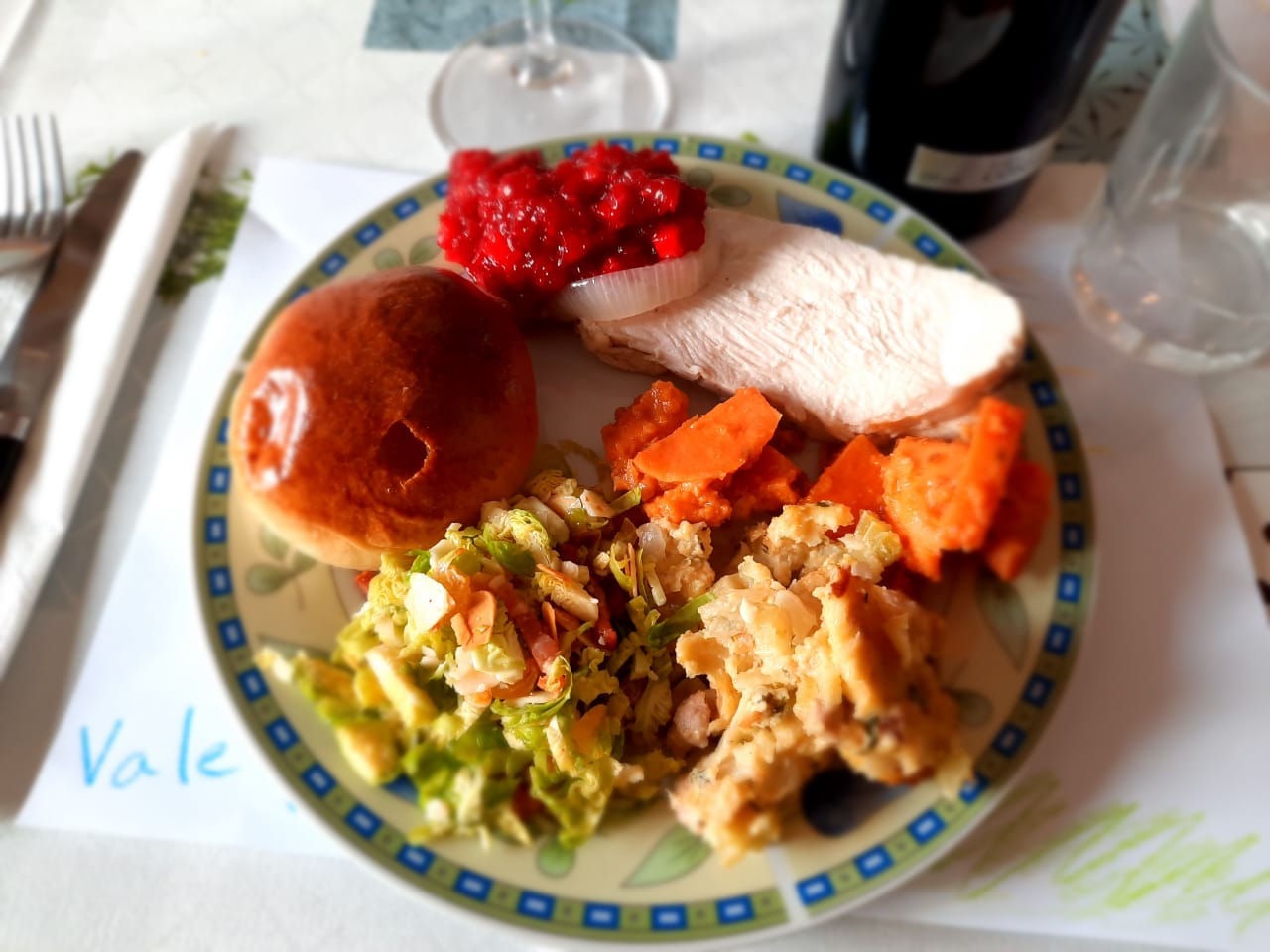
In addition to cooking the customary meal, we taught them how to draw a Turkey, the way all American school children learn to do – using your hand. So, everyone made their own turkey placemat. Jeff thought this was silly, but they loved it!


We put on some video of an NFL game, explaining that this is often the background noise for many Thanksgiving gatherings. We learned that Isra knows a good amount about American football and the NFL, and while the boys talked football, somehow the girls ended up chatting in the kitchen – some cultural norms are universal. We also explained how the US President pardons a turkey every year. They found this tradition to be strange, which it is.

After explanations and appetizers, we sat down to eat – turkey breast, stuffing, sweet potatoes, brussel sprout salad, cranberry relish, and dinner rolls (which were the only item that was store bought).

Everyone enjoyed seconds, and some even had a third plate, which to us signals it was a success. And, we even sent them home with leftovers – another excellent tradition followed.

While it was a lot of work, putting the feast together was a pleasant way to pass the time considering the COVID restrictions still in place. Home gatherings were and still are limited to 6 people, so we complied with that limitation and everyone left before the 10 p.m. curfew.

Sadly, there won’t be much to post about as we hunker down for the winter. The festivities for Santo Tomas (December 21) and La Tamborrada (January 20), the annual drum festival, were cancelled, and the options for celebrating Christmas, New Year’s and Tres Reyes have been severely restricted. Still, we hope to find small ways to celebrate and enjoy.

Sending our warmest wishes for a healthy and joyful holiday season,

Shana & Jeff