Tuesday, April 8, 2025

Arrival in Budapest and the History of Hungary

We arrived in Budapest via an easy train ride from Bratislava, and that night we attended a dinner hosted by a wine shop that included a six-course menu with wine pairings. The dinner was limited to 12 people, but there were only 10 of us: me, Shana and eight friends from Malta. We had never met anyone from Malta before, and these guys were from Gozo, which is the smaller (about the size of Manhattan), northern island of Malta. Super interesting and friendly people, several of whom had lived in the US at some point.

The meal was led by Thomas (the chef, checked shirt) and Thomas (the sommelier, white shirt in front). We really enjoyed both the dishes driven by local ingredients and the Hungarian wines: sparkling, white, rose, red and dessert. It was a fantastic meal and a lot of fun. And, now Malta has moved up on our travel destination list.

On our first days in Hungary, we had very nice weather, and so we did a lot of walking, including climbing up the hills on the Buda side of the river: Gellert Hill and the Buda Castle Hill. Both provided great views of the city.

Within Buda Castle, is a museum that focuses on the history of Budapest, while on the Pest side is a museum dedicated to the history of Hungary. Between the two we learned a great deal about the history of of the Hungarians, which essentially dates from the crowning of (Saint) Stephen I as the first King of Hungary in around the year 1000. Stephen is (obviously) an important figure, and he has his own Basilica in Budapest, where you can see the remains of his hand. Relics are strange things; we took a pass.
Hungary's history is very interesting, especially because much of it involves wars with the Ottoman Turks, including a period of about 140 years when the Turks controlled Hungary, giving it a bit of Muslim history similar to what we have explored in the Southern part of Spain (although not as extensive given that Moors ruled parts of Spain for over 700 years).

For me, one of the most interesting parts of Hungarian history to learn about is the period from the lead-up to WWII until the fall of the Soviet Union (1930's-1991). It was fascinating to see how the Hungarians attempt to finesse (not well, in our opinion) the fact that they chose to ally with Nazi Germany, and how they discuss the years under a Communist government in the shadow of the USSR. We were particularly interested in learning about the country's 1956 uprising seeking democracy and freedom, which failed due to the intervention of the Soviet Army, and led to the execution of several leaders of the revolution including Imre Nagy. 

Imre Nagy had been the de facto leader of Hungry's Communist government from 1953-1955, and was made the Prime Minister at the demand of the 1956 revolutionaries whereupon he dissolved the secret police, promised democratic reforms, and pulled Hungary from the Warsaw Pact military alliance. Unfortunately, when the USSR intervened to put down the revolution, Nagy was sentenced to death and executed two years later. However, when the Eastern European countries finally broke from the USSR in 1989, Nagy and other leaders of the 1956 revolution were rehabilitated, and there is now an impressive monument to him in Budapest. 
We are very much enjoying our time in Budapest, which looks a bit like Paris, with few tall buildings, and many bridges over the river running through the city (the Danube in this case). The food is fantastic and we are enjoying the variety that is somewhat lacking in San Sebastian. Also, the city has a very good public transportation system, which became more important as the weather turned cold and we had more reason to use it.

More from Budapest soon.

Jeff and Shana

Saturday, April 5, 2025

Two Days in Bratislava

Our first stop on our current trip was Bratislava, the capital of Slovakia, a country that came into existence in 1993 with the (peaceful) separation of Czechslovaki into Czechia and Slovakia. We flew from Bilbao to Vienna, and from there it is only an hour train ride to Bratislava.

Bratislava is a relatively small city (population around 475,000), and has that type of a feel. We did think the city had very good public transport including trams and buses, which we used extensively. On our first full day in town, we did a walking tour of the city that gave us a good introduction to the overall layout and some of the history.

So, what did we learn? First, during the Hungarian Empire, when Buda (the capital) was taken by the Ottoman Turks, for hundreds of years, Hungarian kings were crowned in St. Martin's Cathedral in Bratislava (then known by its German name, Pressburg).

Although not vert visible in the picture, at the very top of the steeple is a gold crown on a pillow representing the use of the Cathedral as a coronation church.

We also learned that during the Napoleanic Wars of the early 19th Century, French troops attacked the city with cannons from the other side of the Danube river destroying many buildings, but never entered the city. As a result, the statue of the French soldier in the main square has his eyes covered since he never saw the city. Cheekily, the statue was installed in front of the French embassy.

Finally, we learned that one of the main synagogues of the city (among other buildings) was destroyed in 1967 by the Communist government to build a bridge over the Danube. Many people tried to stop the destruction of this beautiful and historic building, but in the end "city planning" won out over history. Today, the city's Holocaust Memorial stands near the site of the old synagogue.

After the tour, we walked up to Bratislava Castle, which sits on an elevated spot above the city and the Danube.

We did not feel that the castle did a very good job presenting the history of Slovakia, but recognized that Slovakia may be stuggling to describe its own history separate from Hungary and later Czechia, which leads to a less than coherent narrative.

The next day, we hopped on a bus near our hotel, and in 15 minutes were in Devin, which is home to the ruins of Devin Castle. Fortunately, compared to the cold  weather of the day before, we had a beautiful day to explore the  castle grounds.

The elevated site on which Devin Castle was built overlooking the confluence of the Morava and Danube rivers has been settled since the Bronze Age. Later, the Celts and Romans were here, and there was some form of castle/church here from at least the year 1000. Over time, it was an important part of the Hungarian kingdom as it was a border site with the Germanic kingdoms to the north/west.

The grounds of the castle are very beautiful, and there are parts of some buildings remaining, but as we have noticed with so many castles we have visited, we found it difficult to picture what the castle might have looked like in its heyday.

One of the most interesting things at the castle was an exhibition about Devin's role as part of the Iron Curtain during the Cold War. At this location, the Danube is the border between Slovakia and Austria, which was part of the west. Therefore, during the Cold War there was a strong effort to keep people from attempting to leave Czechoslovakia, which included physical barriers such as barbed wire fences, but also put the town of Devin (at times) in a restricted zone prohibiting anyone from visiting without permission from the government. As time went on, Devin Castle was opened to tourists, which made the job of the Border Patrol more difficult. There were numerous attempts of escape in the Devin area between 1948 and 1989, some of which were successful, but which also led to at least 42 deaths.

After returning to Bratislava, we went to the City Museum, which is in the old City Hall building. Among other things, this allowed us to climb up in the tower we saw on our tour, and learn a bit more about the city and its history.
And that was our visit to Bratislava as we caught a train the next morning to Budapest (about a 2.5 hour ride). Much more on that soon.

Hasta pronto.

Jeff and Shana


Sunday, March 30, 2025

“The Routine” vs. “On the Road”


Having spent the past 3+ months in San Sebastian, we’ve had the chance to reflect on what it means to be at home and in our routine, as opposed to on the road and living moment to moment. Clearly there are benefits and advantages to both. If we had to choose, seeing as we love to travel, being on the move would likely win out.

Our routine here is simple – we’re at the gym 6 days a week, at yoga 4 or 5 days a week (Shana), cooking and eating most meals at home, reading a lot, keeping in touch with family and friends, going out with friends here, enjoying local events, planning next trips, and watching whatever might catch our fancy, which for the next several months will be baseball. Sleeping in your own bed and being in your own space are a pleasure.

But the road is calling. We are about to embark on a 17-day trip to Bratislava, Budapest, two smaller destinations in Hungary, and La Rioja, Spain. And then I’ll be going to Galicia for a 4-day art and architecture tour with the Guggenheim Museum. April will be full of adventure, and we are looking forward to it. While there will be several long travel days involved, the planning process has made us excited and hungry. (Budapest is quite the foodie destination.) There will be lots of posts coming about what we encounter.

In the meantime, March was not dull. I was in Bilbao for an introductory meeting for the Galicia trip and saw two exhibits that were interesting. The first was “Master Works on Paper from Budapest,” an assembly of drawings, etchings, etc. from the extensive collection at the Fine Arts Museum in Budapest, which we will be visiting. It included works by da Vinci and Raphael, as well as Van Gogh and Degas (seen below).

The exhibit detailed the history and evolution of drawing through several centuries. Drawings can be a final product but may be a draft for a future work. There were some reals gems, and I enjoyed the lavender display background, which was an unusual choice but worked for me.

The second exhibit, “Tarsila do Amaral. Painting Modern Brazil,” featured a female artist who is considered one of Brazil’s finest artists. She led an interesting life, partially in exile during the Brazilian dictatorship, and is beloved. Her works were colorful – a nice contrast to the drawings.

I also went to a Real Sociedad game, our local La Liga team. Their season has been a bit frustrating, but at least they won. Of course they were playing the last place team. Still, there are certain invitations that should not be declined.

Finally, we had the pleasure of meeting and hosting Oliva, a very cute dachshund, one evening. She will be spending a few days with us in April. We can’t wait to enjoy her company.

Hasta pronto,

Shana & Jeff

Friday, February 28, 2025

Local “Winter” Fun


We’ve had a mild winter thus far, which has allowed us to be outside a lot. And since we love walking on the beach, especially off-season when dogs are allowed, it has been an enjoyable few weeks. Short sleeves, bare feet, and sunscreen during February are a real treat.

We did a bike ride to Pasaia on a beautiful sunny day, through which we confirmed you can bike there as quickly as the bus trip. When we returned to town, we sat in the sun at a bar enjoying a well-deserved beer, as if it were summer. The surfers were enjoying the day as well.

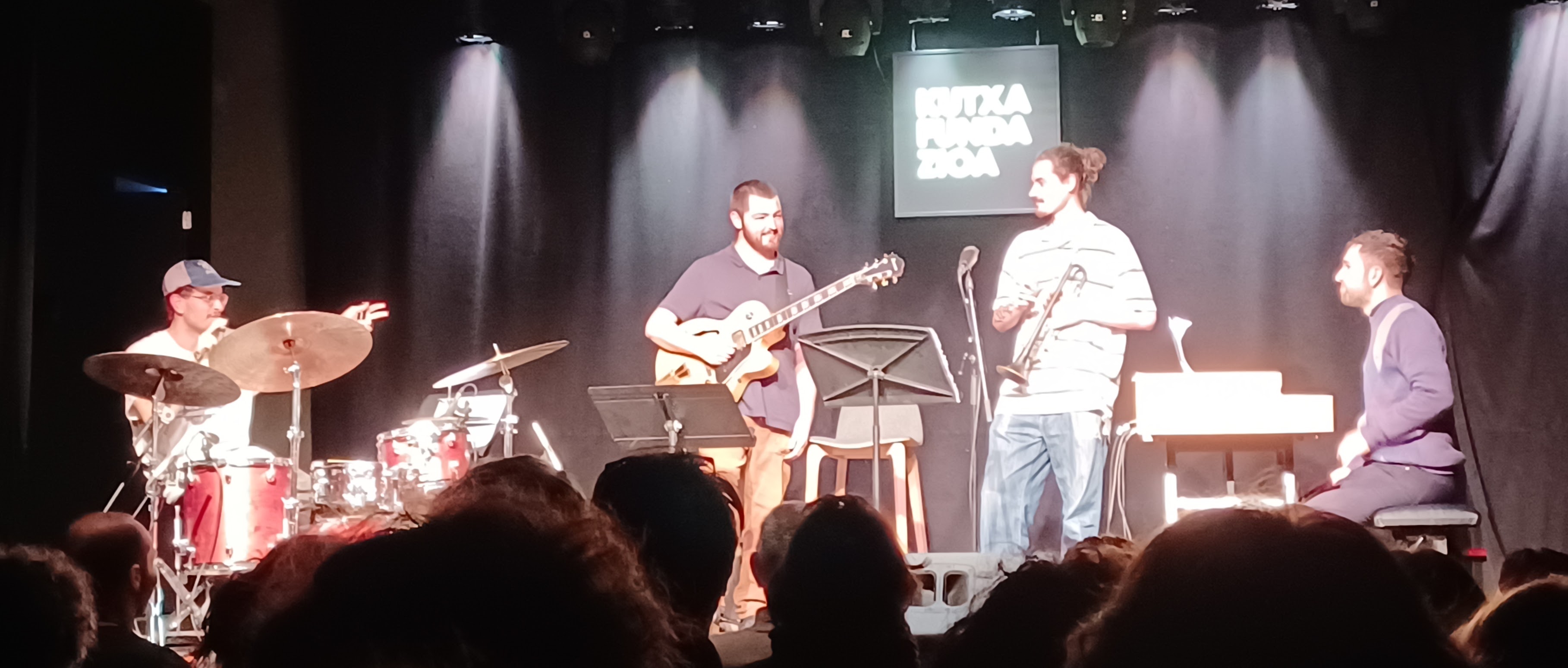
One Friday evening we went and saw a jazz group, Soul Cream, that was essentially auditioning to perform at this summer's Jazzaldia. We gave them two thumbs up and perhaps we’ll see them again come July.

On a Wednesday afternoon we headed to Bilbao to enjoy a pintxo tasting experience at Nerua Guggenheim Bilbao, the one-star Michelin restaurant located at the museum. This event for museum members was a chance to enjoy the haute cuisine and local wines at a bargain price. It was a casual event that included the chef and winemaker discussing their creations.

We loved having the museum practically to ourselves during the late afternoon before the tasting. We found the “Paul Pfeiffer: Prologue to the Story of the Birth of Freedom” exhibition to be interesting, especially since his style is not something we typically enjoy. His unique choices were compelling, especially in the sports themed pieces. The museum recently moved the giant sculpture, Soft Shuttlecock, to a new location. This presentation is more whimsical, but perhaps less elegant.

Finally, we visited the San Telmo Museum here to see “Ipuscua, 1000 years. From Ipuscua to Gipuzkoa, 1025-2025,” an exhibition examining how Gipuzkoa (the province where we live) evolved geographically, culturally, and in name. We learned a lot and were pleased that we understood everything as the exhibit was presented only in Basque and Spanish.

Jeff is standing where San Sebastian sits on the large terrain map. The stone sculpture is the Olazabal family coat of arms from circa 1600. Golf fans may be familiar with this Basque name, whose family is thought to be one of the earliest settlers in the province.

As March arrives, we’ll see if the weather holds, giving us more opportunities to be out and about exploring locally.

Hasta pronto,

Shana & Jeff

Sunday, February 9, 2025

Sidra and The San Juan

Another winter tradition in the Basque region is cider (sidra) and the cider house (sidreria) meal, which includes unlimited sidra. Last week, we went to lunch with our friend Maje at a nearby sidreria. As usual, we went by public transportation, which included about an hour of walking each way, which was very beneficial given how much we ate (and drank).

The sidreria we went to was very traditional with long shared tables and large vats and barrels of sidra. The room filled up completely as the afternoon went on.

One thing that was different about this sidreria, compared to those that we have been to before, is that the meal included spider crab (centollo) as one of its dishes. Although Shana did try the crab, she did not appreciate it the way that I did.

On the other hand, we all enjoyed the steak (txuleta) so much that we actually ordered a second one, although that may have been overdoing it a bit.

Note that all of the other people at our long table were part of a large group of 13 or 14 people, which is very common at sidrerias. The whole experience is communal, especially the line up to fill your glass.

Continuing with the subject of sidra, we learned this week on our visit to the Albaola Istas Kultur Faktoria museum in Pasaia that the tradition of sidra goes back a very long way in the history and culture of the Basque region. The museum is dedicated to the San Juan, a Basque whaling ship that sunk in a storm off the coast of Canada in 1565! So, what did we learn, and how does this relate to the sidra tradition?

The Albaola museum has a great exhibit on the building of the San Juan, including where and how the various parts were made; but also on how the San Juan was found in Red Bay, Canada in 1978 and the process of the recovery and study of the ship after more than 400 years.
Also interesting were the exhibits discussing what was involved in the 16th century whaling industry, including the importance of sidra, which was the primary beverage on the voyage because water in barrels tended to become undrinkable. The need for large quantities of sidra for the whaling (and also cod-fishing) voyages led to the creation of a huge sidra industry in this area almost five centuries ago. And you can see it is still thriving today.

The most impressive part of the museum however is the reconstructed San Juan itself. Workers have been creating a full size recreation of this ship for over a decade, and it is expected to be finished this year. The plan is to sail the ship back to Red Bay (where hopefully it will not sink this time).
It was really very interesting to learn about the huge industry that was created around shipbuilding and whaling in the 16th century. Then, as now, the key was energy -- whale oil was used to light lamps all over Europe, and the Basques were some of the original and most successful whalers. 

We're not sure why it took us more than 7 years to get to this local and worthwhile museum, but we're glad we finally made it. We'll look forward to seeing the San Juan launched as planned one day soon and be sure to toast the voyage with a glass of sidra.

More to come soon.

Jeff and Shana