Tuesday, January 11, 2022

Dali at the L'atelier des Lumières

Although the L'atelier des Lumières is not a museum, it was another chance for us to see art on our trip to Paris. And, since the current show features one of my favorite artists, Salvador Dali, I was particularly excited to go. As the show began, I realized that the only possible music that could be used to present Dali's art would be Pink Floyd. Sure enough, all but one of the songs used during the show were from Pink Floyd, which made the show even better. Here are just a few photos, which as usual don't really do it justice.

This was definitely the best show we have seen at the L'atelier since the Van Gogh show, the first one we saw (see https://vinoconvino.blogspot.com/2019/06/latelier-des-lumieres.html for our post on that visit), but while we loved the Dali portion, and even watched it twice, the second section was a bit of a disappointment despite being about Gaudi, the Spanish architect, whose work we also really like. Maybe because it was too focused on the Sagrada Familia church to the exclusion of others of his works.

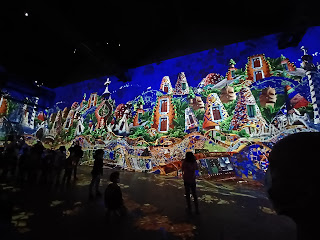
Once again, a very worthwhile and fun experience.

As usual, we really enjoyed our time in Paris. In addition to just walking around the city, we visited a number of the city's Christmas markets, which tended to include some booths selling various types of artisanal products, and some (sometimes a lot) selling various types of food, generally in large quantities. Although we enjoyed looking at the various options, we did not partake of the Christmas market food because the regular food in Paris is just too good. Also, most of the food was like food at a US fair -- over sized, over priced, and super bad for you. While mulled wine seemed enticing in theory, it wasn't that appealing in the end. We did buy a number of food products to take with us, including several things from the Alsatian market, which featured products with a German flair (not surprising given the history and geography of the region). 

Christmastime was a very fun time to visit Paris. The lights were pretty, but not as nice as the ones here in San Sebastian. We feel fortunate that the weather was not too cold, and we saw very little rain as well, allowing us to walk and enjoy Paris's beauty.

Hasta luego,

Jeff and Shana


Friday, January 7, 2022

Overdosing on Art in Paris: 5 Museums in 5 Days


We noticed a few months back that Paris was hosting an impressive exhibition, “The Morozov Collection. Icons of Modern Art.” It seemed the perfect excuse to get back to Paris. We decided to go the second week of December, which also gave us the opportunity to experience the City of Lights dressed up for the holidays, together with the Christmas markets. It turned out that there were a few other special art exhibitions going on as well.

Jeff was a bit hesitant about planning to see four art exhibits in four days, plus a return to the Atelier des Lumieres immersive art show. In the end we did five art exhibits in five days (plus the immersive show) thanks to a local train strike that meant an extra night in Paris. All in all, it was a terrific opportunity to enjoy some of our favorite artists.

First up was a trip out to the Foundation Louis Vuitton to see the Morozov Collection. The Morozov brothers were two Moscow art collectors who assembled a huge collection of French and Russian modern art in the late 19th and early 20th centuries.

This show was impressive for many reasons. First, it took over the entire building’s galleries and included 200 pieces. It wasn’t just the number of pieces, but also the quality of works displayed. There was an entire room of Cezanne paintings, another room for Matisse works, plus multiple pieces by Picasso, Monet, Rodin, Gauguin, and Van Gogh, to name just a few. Second, the collection’s history was fascinating because it was seized by the Russian government after the 1917 revolution and now sits in various state museums, including the Hermitage. It was fortunate to have survived Stalinist policies and WWII. Third, the political machinations and collaboration among museums that went into having all of these works displayed outside of Russia for the first time was remarkable. Finally, the personal story of the two brothers and their passion for art as told through the collection was fascinating.

As a bonus, the Foundation Louis Vuitton is a Frank Gehry designed building that is a work of art in and of itself and we enjoyed the features of the building, especially the rooftop terraces, as much as the art.

Our next museum stop was a return visit to the Musee d’Orsay to see “Signac the Collector.” Paul Signac was a lesser-known Neo-Impressionist artist who traded his own works for and bought numerous pieces by his contemporaries who happened to be some of the most famous painters of the late 19th century, e.g., Seurat, Van Gogh and Matisse. The records he kept of each acquisition allowed the exhibit to create a very personal story of his passion as a collector and friendship with the artists.

Next, the Picasso and Rodin museums had teamed up for a joint exhibit of the artists’ works showing how they worked with similar themes, materials, and had related influences. Both artists were so prolific that there were sufficient parallel works to display at both museums! So, while we debated whether we should go to one or the other, we went to both, which was the right choice. While I don’t believe in taking pictures of art (why do people do this??), I made an exception for the opportunity to photograph Picasso’s and Rodin’s “The Kiss” sitting next to each other.

Our final museum visit was not planned, but with the extra day in Paris, we went to the small Musee Jaquemart Andre to see “Botticelli, Artist & Designer,” an exhibition of some 40 works by the Florentine master in a 19th century palatial building known for its own collection of 15th to 18th century art. Botticelli’s Renaissance style was quite a contrast to the modern art we had witnessed the previous four days.

When all was said and done, we enjoyed “overdosing” on art in Paris. While we won’t necessarily repeat the 5 art museums in 5 days experience anytime soon, we now know it can be done.

Ciao,

Shana & Jeff

Friday, December 31, 2021

Closing out the Sicily Loop: Last Stop Palermo


Because the Palermo airport is located some distance away from the city center, we did something unusual to start our Sicily trip. Rather than land in Palermo and start our trip there, we decided to pick up the rental car and leave to explore the island. This allowed us to avoid a trip back to the airport to get a car or starting our road trip by picking up a car in the city. (We try to avoid driving in larger cities in Europe when possible ever since we nearly left a rental car on the sidewalk in Madrid in 2007 when we couldn’t find the car rental return location.) It turned out to be a good plan. By the time we got to Palermo, we were very comfortable with Sicily and the “big” city didn’t seem overwhelming.

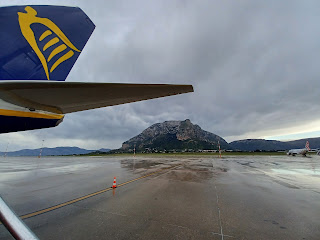
The Palermo airport has a nifty surprise – when you walk down the stairs from (or to) the plane you are greeted by terrific rock formations:

In Palermo, we stayed at a fabulous B&B right in the center of the city with a terrific rooftop terrace where we ate breakfast each morning. Palermo has taken a step many European cities are trying – it pedestrianized its two main cross streets, which makes the city easy to navigate.

Palermo is filled with churches, and we explored a few. The Church of Santa Caterina’s interior was overdone as one expects of a Baroque church, but its three-dimensional marble inlay decorations were intriguing. It was easy to recognize the story of Jonah and the whale, as well as Abraham’s near sacrifice of his son Isaac.

We took a city bus out to the Monreale Cathedral to see one of the most ornate churches you’ll find anywhere. The interior of the entire cathedral is covered in golden mosaics. Built by William II, Sicily’s last Norman king, between 1174 and 1189, the cathedral is a mix of Byzantine, Norman and Arab elements in a Romanesque building. The exterior bronze doors were made by Bonanno Pisano, the architect of the Leaning Tower of Pisa. Inside are more than 68,000 square feet of mosaics, with Christ at the center looking down on everything. For perspective, in this mosaic, his right hand is over six feet tall.

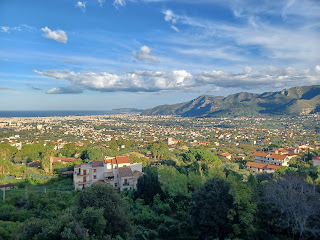
The view down to Palermo from Monreale is spectacular.

Since Sicily was ruled by Spain at the time of the 1492 expulsion of the Jews, there are few remnants from the Jewish history of the island. In Siracusa, there is an ancient Jewish ritual bath that sits 18 meters below the city streets. In Palermo we discovered an old street sign written in Italian, Hebrew, and Arabic (which was apparently the norm prior to the end of the 15th century):

Palermo was an excellent way to finish out the trip. It has good food, interesting sites, and the best gelato (Dolce Capo). Sicily was a fabulous destination. Although we feel we were able to cover nearly all of it, we would definitely consider going back again.

This will be our last post of the year. Wishing you all health and joy as we put 2021 behind us. We hope that 2022 brings an end to the pandemic and new opportunities for adventure.

Ciao,

Shana & Jeff

Friday, December 24, 2021

Taormina and Etna

After leaving Catania, we checked in to a resort hotel on the coast north of the city. This became our base for four days that included some of the wine tastings described earlier, but also a hike on Mount Etna, a visit to the city of Taormina, and a long walk along the beautiful Mediterranean coast near our hotel. 

We dealt with a lot of clouds and rain during this part of our trip, which made driving difficult (especially while driving on Mount Etna itself), and also essentially eliminated our views of the mountain. It was almost like Etna didn't exist because we couldn't see it, but we did get a flavor for it nonetheless,

Our long walk along the coast near our hotel brought us to an old Norman fortress built on a rock that juts out into the water.

Farther along, there was a great location for Shana to show how rough the Mediterranean can get in the winter.

Finally, toward the end of our walk we came upon a group of really interesting natural rock formations (they look set up, but are not):
And, just beyond those rocks, a really cute little village, that appeared to be a resort town that caters more to Italians than international visitors (of course, it was mostly deserted in November):
All-in-all a very pretty part of the country that clearly is busy during the summer tourist season.

To the north of where we were staying is the city of Taormina -- clinging high on a seaside cliff, which required navigating an extremely twisty road to reach the giant parking garage on the edge of town. Although not very busy when we visited in November, Taormina is a huge resort town, which also sees many visiting cruise tours.

Taormina is a really pretty place, with great views of the ocean and beautiful narrow alleys befitting a city that is built on the side of a hill. But, unfortunately, because we were there on a very cloudy day, we missed one of the best parts of the city: the view of the very-nearby Mount Etna:
The town's main square is particulary pretty:
Taormina seems like a place where you could spend enjoyable days just sitting and drinking wine and contemplating the views. Oh, well, maybe next trip.

Finally, we really wanted to visit the volcanic part of Mount Etna, which is the most active volcano in Europe. However, since the clouds did not want to go away during our days in the area, we weren't sure it even made sense to go. But, we did get a day of slightly better weather and decided to drive up to the mountain's "base camp", which is at 6,300 feet above sea level. There, we were able to see a couple of the inactive craters in that area. As you can see, you can walk right up to them:
Unfortunately, the clouds (and, frankly, the cold) prevented us from considering a trip up to higher altitudes of Etna, but we were glad to get an opportunity to see the volcanic landscape up close.

After four days on the northeast part of the island, we drove to Palermo, Sicily's capital, which will be the subject of our next -- and final -- post about Sicily.

Hasta luego,
Jeff and Shana

Wednesday, December 22, 2021

Siracusa & Catania


As we navigated our circuit around Sicily, we continued to be impressed by the region's history and archeology. Siracusa (aka Syracuse) was probably our favorite place, and more specifically the little island of Ortigia – the ancient center of the city. Ortigia oozes charm and romance. We stayed in the old postal building (now converted to a hotel) with views of the sea.

The cathedral was particularly interesting as its façade is Baroque, while the interior includes the original Doric (Greek) temple columns, Byzantine arches, and Norman and Spanish details. This potpourri reflects the many civilizations that have passed through Ortigia.


The Piazza Archimede’s fountain is a delight in the evening.

While in Siracusa, we visited the Neapolis Archeological Park, which was overpriced and overrated, but the ruins of the Greek and Roman theater were interesting. The Greek theater dates from the fifth century BC, when Siracusa was the dominant military and economic power in the Greek world. Its population rivaled Athens in size. The theater had an original seating capacity of 15,000.

In contrast, the Roman amphitheater dates from the first century AD and hosted gladiator style events as opposed to the more theatrical experiences the Greeks preferred. 

Note that these two ancient theaters, from two different cultures and centuries are only a few hundred yards apart. Sicily truly has an amazing cultural history.

We saw yet another Roman theater in Catania. This one hides right in the middle of the city. From the street, you’d never know it was there because it’s been incorporated into the more modern surrounding buildings. This venue would have held up to 7,000 people.

Note the dark stones. Catania sits at the foot of Mount Etna, thus lava stone is incorporated into much of its architecture. The buildings that surround the main square are built with black lava stone and trimmed in white limestone for a unique look.

Catania has a lively fish market and is filled with churches. The highlight for us was the best lunch of the trip at Da Antonio Trattoria, where the staff was super friendly, and the pasta was divine.

Ciao,

Shana & Jeff 

Monday, December 20, 2021

Sicily’s Southeastern Baroque Towns


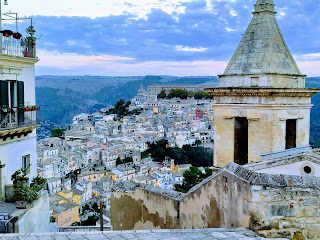
We enjoyed driving in the southeastern region of Sicily a lot. The smaller towns were connected by winding roads with beautiful scenery. This region experienced a catastrophic earthquake in 1693 that leveled everything. The cities in the area were rebuilt in the Baroque style that was popular at the time. We find Baroque to be a bit much, but when surrounded by a stunning landscape, it works.

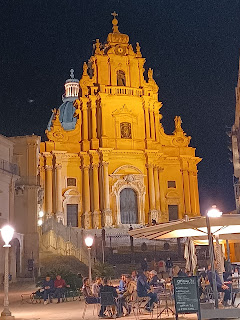
We stayed in Ragusa, a city with an upper and lower town that overlooks a gorge and includes lots of stairs between levels. Our hotel was built into a hill. The San Giorgio Cathedral is beautiful, especially when lit up at night. We even found a street seemingly named after Jeff’s Dad – in fact, Don Minzoni was a priest killed by fascists in 1923.

From Ragusa we did a driving tour to three nearby towns. Modica sits in a river valley and is credited with making some of the best old-style chocolate. (Sicily was under Spanish rule when explorers returned with many new foods including cocoa beans.) Of course, we stopped into the oldest producer in town where we met a biking tour group from North America enjoying some well-earned chocolate. Having driven the roads, we were impressed with their determination. Modica also had a Cathedral of San Giorgio, designed by the same architect who did the one in Ragusa.

From Ragusa we went to Scicli, a smaller town with plenty of churches. Next was Donnalucata, a small fishing village where we enjoyed a fabulous seafood lunch. We even ate a traditional dish made with “baby fish,” which look like eels. Afterwards we took in the coastline.

We stopped in Noto on the way to Syracuse. Noto is the most Baroque town of all. It was rebuilt with a master plan, the first in Italy. The city is striking.

Some say Noto has the best gelato in Sicily. We tried two different places, and although both were very good, we found the best gelato in Palermo.

More Sicily posts to come,

Shana & Jeff