Sunday, February 28, 2021

February 2021 Update: Adopting and Adapting to Spanish Habits, Customs & Lifestyle


We’ve lived in Spain now for more than 3 and a half years. While we miss the opportunity to travel a lot, the pandemic has given us a deeper opportunity to appreciate what it is like to live here on a day-to-day basis. While many of these observations aren’t necessarily “new,” they reflect our updated perspective.

Here are some habits that we have whole heartedly embraced:

·         Shopping at small local businesses for most of our groceries. We go to at least 3 different butchers, a fishmonger, and multiple produce stands. Many of the purveyors recognize us and know what we like best. It’s a fun way to shop. It is so easy to support a “kilometer 0” approach here and to have a better idea of where things are coming from.

·         We eat lunch and dinner later here than we did in the US. While we haven’t gone full Spaniard – it makes no sense to eat dinner at 10 p.m.! – we have shifted our schedule later.

·         We used to avoid getting coffee to go. Spaniards drink and enjoy their coffee at a cafĂ©/bar. Sadly, COVID has made coffee a “to go” item.

·         WhatsApp is essential. No one uses text messaging because it is not included in mobile phone plans like it is in the US. Plus, WA is much more versatile.

·         We like the style of healthcare delivery. Most physicians have an exam room within their office with more equipment available. It is more efficient.

·         Public transportation is efficient. We don’t miss having a car at all.


 And a few customs we haven’t accepted:


·         Primetime television starts at 10 p.m., after the 9 p.m. news, not at 8 p.m. like in the US. No thanks!

·         While we’ve adjusted our dinner time at home, we still take the first reservation available for dinner – 8:30 p.m. in most restaurants. We are often the first diners, but that’s fine with us. You get better service that way!


And then there are the things we are still figuring out. The biggest one is the political system, both locally and nationally. We understand the basic principles behind a parliamentary system, but each region has different political parties, and it is difficult to know which one stands for what. The recent elections in Catalunya required some research to appreciate the results, but we are still novices in this area. We are more familiar with the parties in the Basque region but aren’t exactly sure which party we would support, if we could vote. We’ll keep reading the newspaper to broaden our knowledge.


In the end, our lives are not that different from before. People are people after all. And now that we are proficient at and comfortable with Spanish, the intimidation factor has been eliminated to a large extent. We’ve even managed the pandemic and all the chaos that has brought so far, which confirms we are where we’re supposed to be.


Hasta pronto,


Shana & Jeff 

Thursday, January 28, 2021

Visa Renewal Done (FINALLY!)

On January 22, we were finally able to collect our new Spanish ID (NIE) cards, which completed the process of renewing our residency visa for the second time. After taking about three months to complete the process the first time (2018), this time it took over six months. So, what was different?

Of course, there were delays caused by Covid-19 and the related shutdowns. But, this was not really the major issue. Although, Covid did make getting Shana's passport renewed from here while the embassy was essentially shutdown, instead of during a planned but later cancelled trip to the US, presented its own complications. Surprisingly, or perhaps shockingly, we got the best customer service ever from the US embassy folks, which was terrific because Shana's prior passport did not have the full one year of validity remaining as required by the Spanish government to renew our residency.

In fact, it was the introduction of new technology that slowed the process by months. Two years ago, we collected all of the documents we needed and took them in late May to an office where we presented the documents to a person. That person reviewed the documents to make sure we had everything in order and we paid the necessary fee. About 6 weeks later our application was approved and we went to the police station with our approval, had our fingerprints taken and paid another fee. About five weeks later we had our IDs. Easy.

This time, we learned that the documents could not be submitted in person, but had to be submitted by computer. But, in order to do that, you had to have a special key card that allows the system to identify you before you submit any documents. Unfortunately, we did not have such a card, and because of Covid we could not get an appointment at the office that provides them. Fortunately, our friend Carlos does have the necessary card, and was able to submit the documents on our behalf. So, on July 10 we went to his apartment with all of our documents. After a bit of frustration with the on-line submission process, we collectively figured out how to do it. However, we could not pay the fee on line, but had to go to the bank the next workday to pay it. We then submitted the proof of payment by e-mail because at this point the on-line system would not accept additional documents. We thought we were good at that point.

But, no, not yet. About eight (!) weeks later we received an email that we had a message from the office where we submitted our documents last time. However, we could not access this document without a pin code. So, we made an appointment and went to the office that enrolls you into the system that distributes these codes. Unfortunately, we learned afterward that we could not use the code because now our ID cards had expired (on July 23) and a valid ID is required to use the code. Once again, Carlos came to our rescue by writing emails and calling the office on our behalf to explain that we needed to access this document, but could not. After some doing, and several days later, he got someone to send us the letter by email. And, it is a good thing he did so because the message stated that we needed to submit additional documents to complete our application. Two points to note about this: (1) we had the required documents at the time we originally submitted our documents, and if we had met with a person we could have taken care of it immediately; and (2) the hard copy of the letter came well after the 15-day limit that the letter gave us to respond. YEA technology! (Not.)

We submitted the final documents by e-mail, and then it was just a waiting game. Shana checked the system regularly only to find that our applications were still "pending/in progress." During this time, our right to be in the country expired (3 months after the expiration of our visa), so we were technically subject to deportation. Fortunately for us, no letter telling us to leave the country ever arrived and our application was finally approved on November 10 -- four months after our original submission.

Then, after paying another fee on-line, we made a quick trip to the police station to be fingerprinted and provide new photos (made easier because Covid-19 led the government to grant and require appointments in advance). Then, we waited another five weeks to return for our IDs, which were then not available because of additional Covid-caused delays, before finally returning to pick them up two weeks later. 

Whew!

In any event, we are now renewed for "two" more years (through July 23, 2022), although all of the delays mean that we will start this process again in a short 16 months from now. Fortunately, at that point we will be able to seek permanent residency, which will allow us to stay in Spain indefinitely subject only to ID renewal every five years. Now, we have to find the office for getting the computer card needed to submit documents to the government. Ah, it never ends.

Hasta luego,

Jeff and Shana


Wednesday, January 20, 2021

January 2021 Update: A Tamborrada-less January


We haven’t had much to write about lately and we expect that will continue for the foreseeable future as we continue to live with coronavirus restrictions. Let’s face it, like all of you, we’re not going anywhere far anytime soon. And although we sure would like to get back on the road and travel, go to a movie theater, concert, or well, anywhere really, we are grateful that we are healthy, safe and comfortable in our apartment here. So, at the very least, we’ll try to post once a month with some updates and thoughts on what life is like in San Sebastian, even if the posts are brief.

We weren’t able to do much to celebrate Jeff’s birthday other than enjoy a lovely bottle of wine. Even more disappointing than mundane birthday commemorations though is the fact that there will be no Tamborrada this year on January 20 for the first time since 1906. Tamborrada is considered the noisiest festival in all of Spain, and our readers know that it is everyone’s favorite day in San Sebastian. A 24-hour drumming festival celebrating the city’s patron saint (Sebastian) and the city’s history and spirit. We are incredibly sad that it will be so quiet this year and that we will not hear the “March of San Sebastian” over, and over, and over. Here are some excerpted lyrics:

We are always merry, always happy!

There is a Sebastian in the sky

one unique San Sebastian in the world

that is the saint, and this is the town.

That is what our San Sebastian is!

Of course, it is sung in Euskara (Basque), which is terribly difficult to learn and pronounce. But if you’re curious, here’s a version done by several local famous singers especially for this year’s virtual celebration: https://tamborrada.diariovasco.com/cantantes-donostiarras-tamborrada-20210118185043-nt.html

We have many fond memories of the past three Tamborradas. You can always check out the past year’s posts to see how fun and special it is. In the meantime, we will try to take advantage of any good weather that comes our way to enjoy walks on the beautiful La Concha beach, like we did yesterday.

Here’s to 2021 bringing new memories and better times than 2020.

Be safe and healthy,

Shana & Jeff 

Wednesday, December 23, 2020

Thanksgiving for the “Locals”

I know it’s nearly Christmas but indulge us with this delayed Turkey Day post.

Believe it or not, Thanksgiving seems to generate a lot of interest among non-Americans. Since we’ve been here, every year people we know ask us how and if we are celebrating. We don’t get this question about Christmas. So, there is something about Thanksgiving that apparently is intriguing. Whether it is the movies or television that has provoked this interest, this year we decided to share the traditions of American Thanksgiving with our friends here. They were practically begging us to host, so we agreed to do the whole shebang for the first time since we moved here. We haven’t done it before because we were either in the US or didn’t care enough, plus until this year we didn’t have a good oven.

Our friends Carlos & Ploy and Isra & Valeria came over on Thanksgiving Day. Carlos and Isra are Spaniards, Ploy is from Thailand, and Valeria is from Russia. None of them had ever experienced Thanksgiving before. So, we did the best we could to give them the full experience.

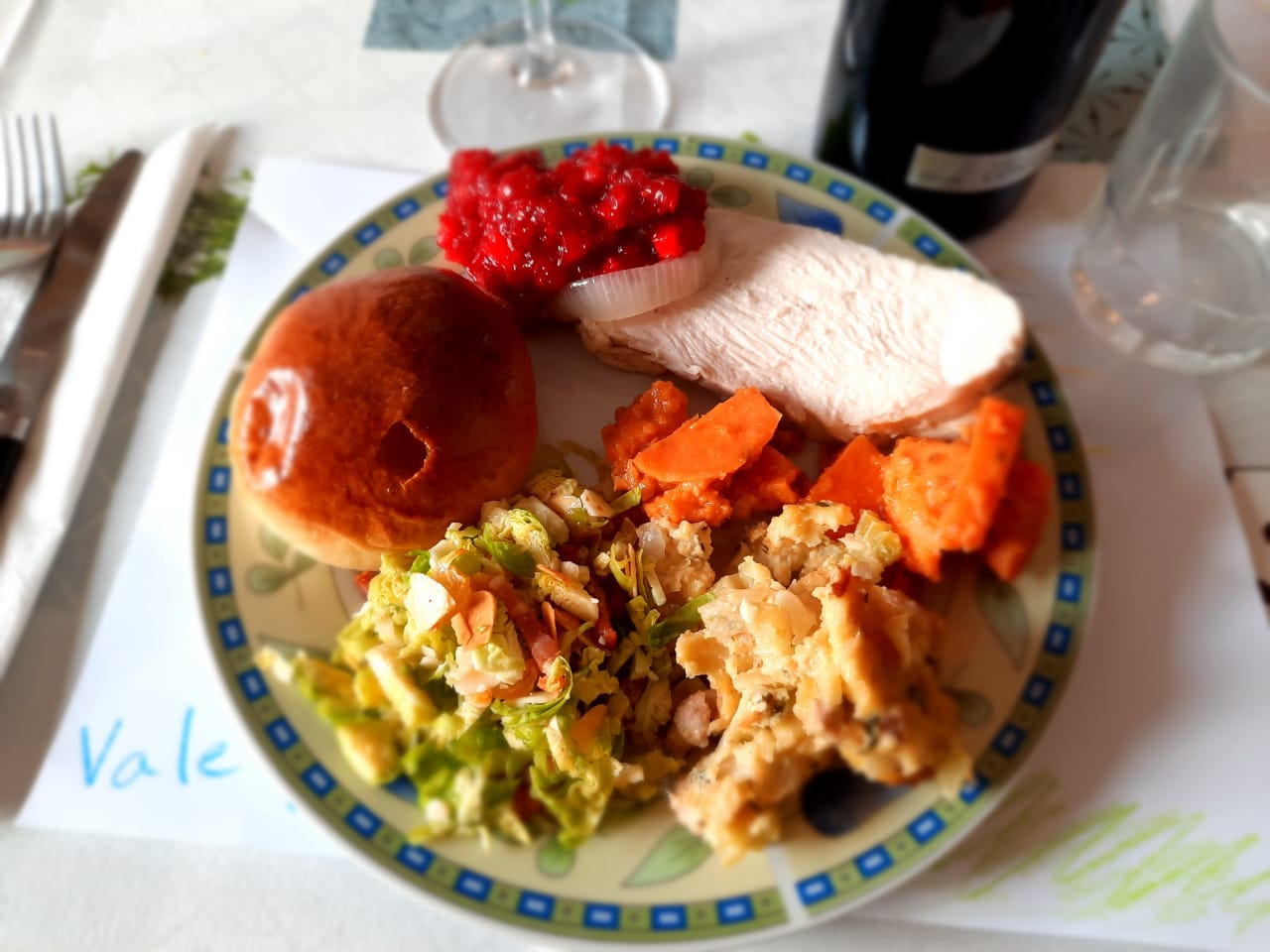
In addition to cooking the customary meal, we taught them how to draw a Turkey, the way all American school children learn to do – using your hand. So, everyone made their own turkey placemat. Jeff thought this was silly, but they loved it!


We put on some video of an NFL game, explaining that this is often the background noise for many Thanksgiving gatherings. We learned that Isra knows a good amount about American football and the NFL, and while the boys talked football, somehow the girls ended up chatting in the kitchen – some cultural norms are universal. We also explained how the US President pardons a turkey every year. They found this tradition to be strange, which it is.

After explanations and appetizers, we sat down to eat – turkey breast, stuffing, sweet potatoes, brussel sprout salad, cranberry relish, and dinner rolls (which were the only item that was store bought).

Everyone enjoyed seconds, and some even had a third plate, which to us signals it was a success. And, we even sent them home with leftovers – another excellent tradition followed.

While it was a lot of work, putting the feast together was a pleasant way to pass the time considering the COVID restrictions still in place. Home gatherings were and still are limited to 6 people, so we complied with that limitation and everyone left before the 10 p.m. curfew.

Sadly, there won’t be much to post about as we hunker down for the winter. The festivities for Santo Tomas (December 21) and La Tamborrada (January 20), the annual drum festival, were cancelled, and the options for celebrating Christmas, New Year’s and Tres Reyes have been severely restricted. Still, we hope to find small ways to celebrate and enjoy.

Sending our warmest wishes for a healthy and joyful holiday season,

Shana & Jeff

Saturday, December 5, 2020

Longing for that Pyrenean Experience


It has been 6 weeks since we escaped to the Pyrenees and how we miss the laid back, get-a-way from it all feeling we had there. Since we returned, we are back to the day-to-day routine and the regime of COVID limitations that makes life resemble the movie “Groundhog Day.” For the last several weeks all bars and restaurants have been closed and we are not supposed to leave the city limits. Life seems dull and ordinary, but we are healthy and safe and therefore try not to complain. The good news is that we hosted a lovely Thanksgiving for friends and our residency visa has been renewed for 2 more years. We are just waiting to receive our renewed ID cards. (Posts about both to come soon.)

To keep the mountain escape vibe going a bit longer, here are some additional photos of our experience. As you’ll see, we enjoyed getting to know the flora and fauna of the area:

Local wild (and not-so-wild) life:

Cool old bridges, churches and bordas (sheep barns):


Great views and trails:


Be careful and safe,

Shana & Jeff

Thursday, November 19, 2020

The Comet Line

Over the past several hundred years, the Basque people have been divided between north central Spain and southwestern France. As a result of the international border that divides them, they have become adept smugglers of both goods and people. During the time that Franco ruled Spain (1939-1975), for example, the Spanish Basques often smuggled animals across the border into France where they could obtain better prices, and brought back goods that simply could not be purchased in Spain. 

But, it was at the very beginning of the Franco period, during WWII, that the Basques were able to use their smuggling skills to great effect by helping allied pilots who had been shot down over Nazi-occupied Europe escape to Spain and ultimately return to England for further action. As you can imagine, a trained pilot was extremely valuable, and worth taking the risks involved in moving them through France and across the border. In addition, but to a lesser degree, a number of Jews were smuggled out of France into Spain with the ultimate stop being England.

The path that these people took was known as The Comet Line. For our tour of The Comet Line, we drove to a small village very near the French/Spanish border where we saw a number of safe houses that were used in the process of transferring people to relative safety in Spain. These safe houses were the end of the line of a number of safe spaces throughout France that were used to move pilots from where they were shot down to this point. From there, the final step was a 26 km (about 15.5 miles) trek over the mountains, across the Bidasoa River into Spain, and then to a safe house in Spain. This journey, which the pilots/smugglers had to complete overnight in darkness, we did part of on a beautiful October day.

As we hiked up into the hills on the French side, we encountered a number of beautiful horses, but could never figure out who they belonged to or where they came from. They mostly ignored us, although they would not let us approach too closely.
As we reached an early peak. we got to relive the first view of Spain that the pilots would see on their journey (of course, they would mostly see lights because it was dark). You can see the Bidasoa leading away from the ocean - everything on the other side of that is Spain. Unfortunately, this view came just a few miles into the trek and it was a long and dangerous way before the pilots and their Basque guides approached the river.
Slightly further along and higher up, our guide Georgina (kneeling), friend Carol and I take in a view back toward France:
Georgina is a real expert in the Comet Line and had a lot of great stories about the people involved on both sides of the border. One of my favorites was about two children who were involved, one in a safe house on the French side and another whose house was a safe destination in Spain. These two had never met until Georgina organized an introduction for them just a few years ago.

It was a beautiful (but windy) day as we walked, and when we reached the summit of the hike, we could see where the pilots and their guides would head down the mountain toward the river. Of course, what was not there was the Vichy French/Nazi patrols that had to be avoided as everyone moved as quietly as possible along the trail. In order to enhance the quiet, everyone wore traditional Basque espadrilles, which were quiet but also terribly uncomfortable and even painful over such a long distance. This type of cloth and rope shoes weren't made for this type of hiking.

Georgina drove us along the river and showed us some of the crossing points that were used depending on weather and patrols. Even there, pilots and guides still ran the risk of being caught. Once on the Spanish side of the river, the risk was reduced but not eliminated as Franco's national police, the Guardia Civil, patrolled the area.

Even though we walked far short of the total distance of The Comet Line, when we were done we treated ourselves to a celebratory drink in a small village, Biriatou, on the French side of the river, sitting outside and looking across to Spain:

Biriatou played a role in the story as well. The Nazis laid out the corpses of two men who drowned attempting to cross the Bidasoa as part of a smuggling operation as part of a threat to anyone who was collaborating with the resistance. The people of Biriatou, rather than be intimidated, decorated the two men's bodies with flowers as a sign of support for the resistance. 

We had a fascinating day learning about The Comet Line and the role the Basque people and their smuggling abilities played in this important part of WWII history.

Hasta luego,

Jeff and Shana


Tuesday, November 10, 2020

Lunch at Donamaria'ko Benta

When we planned our trip to Pyrenean Experience, in addition to relaxing and enjoying our time hiking through the villages and hills around Georgina's house, we also planned two outings. The second, which we will talk about in a later post, was to tour the Comet Line, the smuggling route through which allied WWII pilots (mostly British) were brought from Nazi-controlled France into Spain so that they could return to England (through Lisbon and, more frequently, Gibralter). But first, as our loyal readers will appreciate, we had lunch at a local restaurant, Donamaria'ko Benta.

Donamaria'ko Benta is no normal restaurant. Despite being on the edge of the tiny town of Donamaria (population 433 (yes, seriously)), the restaurant has declined a Michelin star due to not wanting all the responsibilities and hassles that come with the designation. Donamaria'ko Benta is, like so many businesses in our area, a family-run business that is now being managed by the daughters of the founders.

But, before we even got to the restaurant, we knew this would not be a normal lunch because we hiked to the restaurant from the largest town in the area, Santesteban (population 1,726), through the countryside filled with both beautiful scenery and animals of many sorts, including these curious cows who came to say hello:

And, a black-headed sheep:

In addition, although we somehow failed to take a picture, a local dog adopted us about a half mile from the restaurant and led/followed us there before disappearing to head home (we hope).

Lunch itself was, not surprisingly, fantastic. Five seasonally-based courses, including a bottle of wine matched with each course except dessert. Unfortunately, given the amount of wine we were consuming (Georgina and Carol did not pull their weight in this regard), we only have decent pictures of two of the courses: a lovely smoked-cod dish, and a pasta that included some foie gras because, well, it's Spain.


The following two dishes were both seasonal: wild boar and pigeon (squab). We knew it was pigeon-season because we heard the sound of hunters' gunshots echoing around the valley all week, and we even saw a hunter out with one of his dogs during a hike (no pigeons though). The food was fantastic, and we tried some very good, and unique Navarren wines (one of the great things about Spain, much like France and Italy, there are good wines made in many parts of the country). Finally, of course, there was dessert, although by then I am not sure that we were fully tasting the food and, fortunately, there was no additional bottle of wine with dessert.

After lunch, a slightly tipsy Shana made a new friend in the field next to the restaurant:


Finally, we finished our culinary experience by walking from the restaurant, which was in the valley south of Georgina's house, back up to the house itself, where we relaxed and went to bed early, there being no need for any further food that day. The hiking to and from lunch totaled nearly 8 miles -- so we earned every bit of that amazing lunch!

Hasta pronto,

Jeff and Shana