Hard for us to believe, but it is already time for the San Sebastian International Film Festival, the third we will attend since moving here. The Festival starts tomorrow and runs through September 29.
The first year we were here, we only attended nine movies in the nine days of the Festival (https://vinoconvino.blogspot.com/2017/10/9-movies-in-9-days.html) because we were limited by the hours we were in school and our need to do homework and sleep. Last year, we missed the first and last days of the Festival for two different trips, but managed to attend 16 movies in seven days (https://vinoconvino.blogspot.com/2018/10/san-sebastian-film-festival-2018.html).
This year, we are planning a similar pace to 2018 but during the full nine days (20 movies for Shana, 21 for me). After spending much time planning our purchases, we were ready to buy when tickets became available last Sunday at 9:00 am. However, because of technical glitches on the Festival site, what should have taken about one hour, took five! We were not very happy, but neither were all the Spaniards posting on the Festival's Twitter feed. It was fun to be able to understand all the complaining.
We will, of course, have a post about this year's Festival when it is over, but until then dear readers, we will be incommunicado.
Hasta la vista,
Jeff and Shana
Thursday, September 19, 2019

Sunday, September 15, 2019
Tivat and Dubrovnik
Although the point of our recent trip to the Balkans was to swim, we wanted to post briefly about the cities we visited - Tivat, Montenegro and Dubrovnik, Croatia.
Montenegro is a very small country (population is only about 625,000 people -- less than Seattle, not to mention LA), and Tivat is a small resort area. Although Tivat has a tiny, nearby airport, there are few flights. So, like most people, we arrived in Dubrovnik and took a car to Tivat. This required a border crossing into Montenegro, which looked a bit like crossing into an Eastern Block country in a movie from the 70's or 80's, a pretty long ride along a two-lane road and a ferry crossing. The ferry is totally utilitarian, but extremely important for getting people to and from Tivat:
 On our trip back to Dubrovnik, a large cruise ship was passing through the narrow channel that the ferry crosses causing a terrible bottleneck. Fortunately, our aggressive Montenegrin driver got us very close to the front of the line so our wait was limited.
Tivat itself is very small and, like many resort areas is all about the "beach" -- although the "beaches" were more of a pebbly water entry point or concrete ledge. We stayed in a slightly older part of town, but a relatively new harbor is filled with large yachts (including one we found on the internet, which is owned by a Saudi sheikh and cost $300 million to build), and surrounded by high-end shopping and newly constructed resorts.
The location is beautiful; here is a view from our hotel:


Jeff and Shana

Tivat itself is very small and, like many resort areas is all about the "beach" -- although the "beaches" were more of a pebbly water entry point or concrete ledge. We stayed in a slightly older part of town, but a relatively new harbor is filled with large yachts (including one we found on the internet, which is owned by a Saudi sheikh and cost $300 million to build), and surrounded by high-end shopping and newly constructed resorts.
The location is beautiful; here is a view from our hotel:

Unlike Tivat, Dubrovnik is an ancient city and a long-time tourist destination. Given the level of tourism, we were amazed to hear that the population of the city is under 50,000 people. We chose not to stay in the old town, instead renting a VRBO above the new port. The views from our balcony were spectacular:

The first morning after we arrived, we woke up early and walked a bit over a mile to the Dubrovnik old town to walk along the ancient walls that still enclose it. We were happy to have done this early because once the tour groups show up (mostly off of cruise ships), the volume of people on the walls becomes unbearable. Not to mention that it was really hot. When we were on the walls, however, the crowds were limited and the views were amazing:


Although it was expensive (over $30 each), walking the walls of Dubrovnik is definitely the highlight of any visit there. While we visited a few museums, along with the old Synagogue (second-oldest in Europe after the Old-New Synagogue in Prague), none was really very impressive. The central square of the old city is nice, but the hoards of tourists and the heat, which is reflected and intensified by the stone walls, make it difficult to savor:

We very much enjoyed our visit to this part of the world we had never visited before, and can definitely see returning to Croatia to see Split and Zagreb (in the northern part of the country), perhaps along with a tour of the islands. Plus, we know they have good wine and oysters there.
Hasta pronto,
Wednesday, September 11, 2019
Our Swimming Adventure in Montenegro
We had a terrific time on our Strel Swimming adventure in Montenegro. It was unlike anything we’d ever done before, and perhaps ever will do again; well, anytime soon at least. Perhaps a few highlights and observations will be a better format for this post, rather than a narrative.
First, our training was important. You should always train for what you are going to do and getting comfortable in the open water was super helpful. It gave us the confidence to jump right in each day, even though we weren’t the fastest or best swimmers in our group – not even close.
Second, although all levels of swimmers are welcome on these types of trips, we think that’s a bit of an overstatement. Before the trip we thought of ourselves as strong swimmers, and we still believe that’s true. But being able to swim well and being a swimmer are two different things. My background, with loads of swim lessons, swim team in high school, and swimming for exercise at various times, meant I had developed and maintained a decent level of technique. Jeff had the ability and fitness to power through the swims, but, as we learned, his lack of technique meant that he was probably working twice as hard as everyone else to keep up. Nearly everyone else on the trip regularly swims for exercise. To truly enjoy a trip like this, being a “swimmer” helps a lot.
Third, we had a great group of 16 other swimmers (and 2 guides) who were fun, supportive, and diverse in age and background. We really lucked out and hope to see members of the group again in London, Melbourne, Zurich, LA and Chicago.
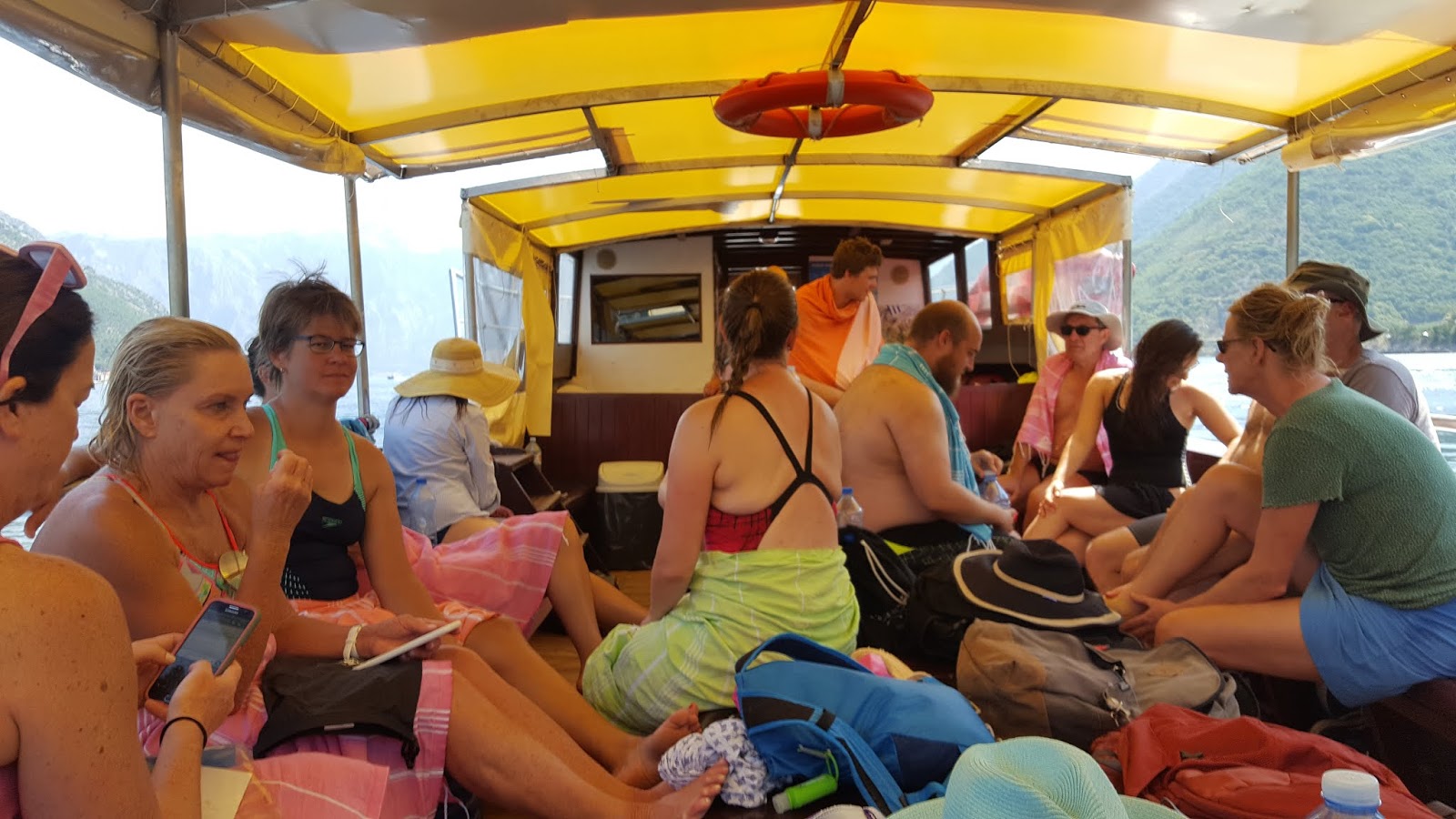
Here are photos of our main boat and a mid-swim drink break – bonus points if you can pick us out:


Our swims ranged from 2 to 2.5 km and we swam twice a day – once in the morning and once in the afternoon. In between we visited small towns in the area, had lunch, and one day did a hike. We spent two days in the Bay of Kotor and the other two in the Adriatic Sea. The scenery was amazing and being out on a boat all day was a great way to enjoy and appreciate these coastal areas.


During day 3 of swimming we were hitting our wall. Jeff was sore and developing an overuse shoulder injury and I was running out of steam. I borrowed a pair of fins to do swim #6 and was glad I did. You don’t notice your physical exhaustion in the water as quickly as you might on land. We both took the fourth day of swimming off – I was sick and Jeff was ready for a break.
We have no regrets about taking the swim trip. It was a new challenge and we met amazing people. While we confirmed that swimming is not Jeff’s thing, that made Jeff the hero of our group – everyone was so impressed that he was willing to go outside his comfort zone to make his wife happy. He gets the “super hubby” award. Jeff may not do another swim trip, but I would be up for it! Any volunteers to join me?

More details of our adventures in Montenegro and Croatia to come soon.
Hasta pronto,
Shana & Jeff
Saturday, September 7, 2019
Best Oysters Ever!
We have returned from our swimming trip to Tivat, Montenegro, and we will have much more to say about swimming, Tivat and our visit to Dubrovnik, Croatia as well. But first, I want to post about an amazing half-day tour we took from Dubrovnik to Ston (pronounced "stone"), about 45 minutes north on the Peljesac peninsula.
The ride north was beautiful along the amazing Croatian coastline, where small towns are built in picturesque inlets of the Adriatic. When we arrived, our first stop was a bay where oysters are farmed. Oysters have been cultivated in this area since Roman times, and our host for this part of the tour was a fourth-generation oyster farmer who took us out on his little boat so we could try the freshest oysters possible.
The location was drop-dead gorgeous:

 The things you can see on the water are small buoys that each mark the location of a rope covered in oysters, which is connected to a concrete block on the bottom of the bay. We watched our host haul up a rope covered in oysters and shuck them right on the boat:


The end result was simple, enjoyed with lemon, some local white wine, and absolutely delicious!


The final stop on our tour was the small town of Ston, which is home to the longest defensive wall in the world other than the Great Wall of China:


The ride north was beautiful along the amazing Croatian coastline, where small towns are built in picturesque inlets of the Adriatic. When we arrived, our first stop was a bay where oysters are farmed. Oysters have been cultivated in this area since Roman times, and our host for this part of the tour was a fourth-generation oyster farmer who took us out on his little boat so we could try the freshest oysters possible.
The location was drop-dead gorgeous:


The end result was simple, enjoyed with lemon, some local white wine, and absolutely delicious!

Definitely the freshest oysters I have ever tried, and Shana even managed to eat one although she still does not appreciate the delicacy. Oh well, more for me (I managed to eat a half-dozen with my wine for the best breakfast ever).
After leaving the boat, we continued on to a local winery, Vina Vukas, where we tasted a number of wines including what is believed to be the first champagne-style sparkling wine made in Croatia (technically, it is too hot in Croatia to make that style of wine, but the winemaker we met did it by growing the grapes in shaded areas). We were very impressed, and even bought a bottle to bring home with us.

(Our tour guide on the left, wine maker on the right). We enjoyed all four wines we tasted (a white and two reds in addition to the sparkling), and learned a lot about Plavac Mali, the most important red wine grape in Croatia, which is closely related to Zinfindel and Primativo from Italy.
The final stop on our tour was the small town of Ston, which is home to the longest defensive wall in the world other than the Great Wall of China:


So, why did Ston need this amazing defensive wall? Believe it or not, because of salt. Ston is home to the oldest salt pans in Europe, which are still in use today. In the year 1333, Ston became part of the independent Dubrovnik Republic, and its salt began to provide 1/3 of the income of the Republic (at the time, 1 kg of salt was worth 1 kg of silver, about $650 US today). So, in the 14th and 15th centuries, the Dubrovnik Republic built (and garrisoned) these walls to protect the salt of Ston.
After a short time in Ston (it really is just a tiny town), during which we devoured some really good pastries, we returned to Dubrovnik.
Overall, it was a really good tour, with spectacular oysters, great views and good wine. I couldn't ask for more.
Hasta pronto,
Jeff and Shana
Sunday, August 25, 2019
Heading To Montenegro, but first - Paris!
Regular readers may remember our post about training for our swimming trip to Montenegro. We are on our way to Montenegro now, followed by a couple of days in Dubrovnik, Croatia. We, obviously, will have something to say about this adventure after it is over. But, first, on our way, we stopped over in Paris because, of course we did . . . in part because of the cheaper flight options and well, because Paris is Paris.
The first part of this story is what it took to get to Paris. We usually can jump on the first local train from San Sebastian for the 35 minute ride to Hendaye (in France) and get on a 7:20 am TGV train to Paris. But, as we learned about a week ago, that would not be possible this time because (1) the Hendaye station is closed due to the G7 conference in Biarritz (18 miles away) and, perhaps related, (2) the earliest train wasn't leaving San Sebastian until 7:00 am!
So, the first thing we did was try to find a hotel in Hendaye, which turned out to be impossible probably because everyone else had the same idea. However, we did find a room in Irun, Spain -- just across the border -- for the night before we left. Of course, because of all that is going on, our crappy hotel room cost almost 100 Euros. Next, we took a recon mission to Irun to see what walking across the border would be like. While it is only about a 10 minute walk from Irun to Hendaye, we probably saw 20-25 heavily-armed police officers. The good news was, it did not appear that it would be a problem to walk into France.
On Friday night we took the train to Irun and checked into our hotel. After coffee and dessert in the hotel bar we walked over and saw that the bridge appeared to be relatively quiet, with police diverting car traffic, but not bothering walkers/bikers. After a less-than-great night's sleep, we walked to the train station in Hendaye at around 6:30 a.m., and we did not see a single policeman on the bridge (although traffic was still being diverted). So, we had no problem making our train.
We wish the leaders of the G7 countries just had a teleconference.
Now, we are once again in Paris. Last night we went to another show at the Atelier des Lumeries, which displays art in a unique and immersive way. We loved the show we saw in May featuring Van Gogh, and this time we saw one focused on Gustav Klimt. Although we did not think it was as dynamic as the previous one, the visuals were still impressive:


 Sunday morning (today), we headed out to the Cluny Museum, which is dedicated to art and history of the Middle Ages including the famous Lady and The Unicorn tapestries, which were commissioned around 1500 by a wealthy French family. But, the museum is also at the site of ancient Roman baths that date from the 2nd Century. When we arrived, we learned that the museum is currently undergoing a significant renovation, so while we were able to see the tapestries and a small amount of the permanent collection, we did missed out on a lot (to be fair, our entry was free). But, for me, the most interesting part was the frigidarium (cold room) of the Roman thermal baths. This amazingly-preserved room is giant, probably more than 2000 square feet with 40-foot-high ceilings. This picture only gives a small sense of the scale:

The first part of this story is what it took to get to Paris. We usually can jump on the first local train from San Sebastian for the 35 minute ride to Hendaye (in France) and get on a 7:20 am TGV train to Paris. But, as we learned about a week ago, that would not be possible this time because (1) the Hendaye station is closed due to the G7 conference in Biarritz (18 miles away) and, perhaps related, (2) the earliest train wasn't leaving San Sebastian until 7:00 am!
So, the first thing we did was try to find a hotel in Hendaye, which turned out to be impossible probably because everyone else had the same idea. However, we did find a room in Irun, Spain -- just across the border -- for the night before we left. Of course, because of all that is going on, our crappy hotel room cost almost 100 Euros. Next, we took a recon mission to Irun to see what walking across the border would be like. While it is only about a 10 minute walk from Irun to Hendaye, we probably saw 20-25 heavily-armed police officers. The good news was, it did not appear that it would be a problem to walk into France.
On Friday night we took the train to Irun and checked into our hotel. After coffee and dessert in the hotel bar we walked over and saw that the bridge appeared to be relatively quiet, with police diverting car traffic, but not bothering walkers/bikers. After a less-than-great night's sleep, we walked to the train station in Hendaye at around 6:30 a.m., and we did not see a single policeman on the bridge (although traffic was still being diverted). So, we had no problem making our train.
We wish the leaders of the G7 countries just had a teleconference.
Now, we are once again in Paris. Last night we went to another show at the Atelier des Lumeries, which displays art in a unique and immersive way. We loved the show we saw in May featuring Van Gogh, and this time we saw one focused on Gustav Klimt. Although we did not think it was as dynamic as the previous one, the visuals were still impressive:


And, of course, there were visuals of the famous Woman In Gold painting:


While we had seen the ruins of Roman baths in other places, including Pompeii, the scale of these baths was truly spectacular.
All-in-all it has been a good, if brief, stay in Paris. Tomorrow, we take an early flight to Dubrovnik (4:30 am cab (!)), and then a car transfer to Tivat. Much more about our swimming adventures to come.
Hasta pronto,
Jeff and Shana
Thursday, August 22, 2019
Back to the Flysch – the Black Flysch
We enjoyed learning more about flysch on the Essential Flysch boat tour back in May when my brother visited, so we decided to try another Geopark tour during the summer. On Saturday (Aug. 17) we went with our friends David and Maite to Deba for the Black Flysch Tour. Deba is a 45-minute train ride west of San Sebastian.
When we arrived, we had time to grab a coffee, and we were fortunate to catch some traditional Basque music and dancing happening in the streets of Deba:


Maite, who is Basque, explained that only coastal Basques wear the traditional blue dresses. She fondly remembered doing this dance when she was a teenager. The men’s performance included drumming and fencing-like play using actual hoes (we assume this is a reference to the importance of farming in the Basque region). We always enjoy these traditional cultural displays and we encounter them more often than you might think.
The Black Flysch tour took us down to Deba’s beach to observe and interpret the layers of Flysch. Deba’s flysch includes the oldest layers, contrasted with the newer pink-colored flysch in Zumaia, where we have been previously. There are three layers in Deba – the black layer, a red layer (that has iron deposits), and a sandy brown layer. (I'm leaving out the scientific names, which sound even more technical in Spanish.) These layers were formed as the Iberian Peninsula merged with Europe millions of years ago. The contrasts between flysch and the additional details our guide provider were fascinating. It was a perfect sunny day – here are a few photos:


We just might go back for one more flysch tour, this time to see the ancient nautilus fossils that have been collected from the flysch. Before you know it, we’ll be flysch experts and able to give our own tours to friends and family. Hint, hint . . .
Hasta luego,
Shana & Jeff
Sunday, August 18, 2019
Semana Grande 2019
We just finished experiencing our third Semana Grande here in San Sebastian. Like the past two years, the city did an amazing job of planning concerts and all kinds of other events. Of course, there was the annual fireworks competition.
Our enthusiasm started out strong – for the first time we went to see the kickoff event – the canonazo (a canon shot) of blue and white confetti. It was cute to see the little kids on their parents’ shoulders with their hands over their ears waiting for the shot to happen. Afterwards we enjoyed the street bands.


We saw the “giants” parade as well. As you can see, giant figures of cultural icons are carried through the streets each day. We’ve seen this type of parade in various parts of Spain and we’re not sure why it’s so “exciting,” which just goes to show that even after living here for more than 2 years, we will never be “locals.”


We only saw the fireworks show two nights this year. We figured out that if you have an 8:30 p.m. dinner reservation you can finish in time to walk out and enjoy the fireworks. So that worked out really well. But on those nights we ate at home we were just too lazy to go back out for the 10:45 p.m. fireworks.
We also caught some live music (when it didn't rain) and checked out the food truck scene. More than 10 with all kinds of offerings – burgers, hot dogs, Mexican, Argentinian, gelato, crepes, etc. We were very amused by the Basque Truck – serving bagel sandwiches. No joke!

Local ingredients stuffed into bagels. One of the owners is Basque and the other from England and this is their “fusion” concept. We didn’t eat a bagel, after all we rarely ate bagels in the US, but the truck was busy when we were there.
Never a dull moment,
Shana & Jeff
Subscribe to:
Posts (Atom)