Sunday, October 16, 2022

Second Stop -- Singapore

We stopped in Singapore to break up the trip to Australia. Who wants to take two flights totalling nearly 20 hours all at once? A stopover after a 12 hour flight was a great solution as Singapore is a fabulous destination. 

Singapore is a city-state that sits at the end of the Malaysian Peninsula, just 80 or so miles north of the equator. It has a large, important port, and sits in a key economically strategic point at the end of the Strait of Malacca (through which tons of goods, most importantly oil, pass). In recent years, Singapore has made itself into one of the most important finance hubs in Asia. The city itself is beautiful:
Yes, that is the view from the pool at our hotel -- on the 35th floor.

There are so many interesting things about Singapore. Unfortunately, I am sure that I will miss some key ones, but I will try to do it justice. First, Singapore is a country of rules and rule followers. There is virtually no crime in Singapore. There is not even any nuisance type issues: no littering, no graffiti, definitely no public urination (there are free, accessible bathrooms everywhere, and they are universally clean). And, even though we don't think it was mandatory, only suggested, every single person wore a mask on public transportation. Seriously, we did not see one person without a mask during our numerous rides (of course the system is extremely efficient and easy to use).

Second, Singapore is a multi-cultural society. Essentially, Singapore was settled by people from China, the Malay Peninsula and India, and it was a British colony from 1867, thus there are people from all over. This multiculturalism can be seen in the fact that Singapore has four official languages: Malay, Mandarin, Tamil and English.

Multi-culturalism also extends to religion, with large numbers of Christians, Buddhists, Muslims and Hindus. As far as we could see, freedom of religion is respected and all of the major religions are treated equally. For example, Singapore has ten official holidays: two secular (Singapore Day and Labor Day), three Christian/Western, two Muslim, one Hindu, one Buddhist, and the Chinese New Year. Amazing. The religious diversity is also reflected in the beautiful places of worship, as can be seen below.

We visited our first ever Chinese Temple, which was impressive, but you were not allowed to take pictures of the area with the representation of the Gods, which were amazing,  so this picture hardly does it justice:
There are several Hindu temples, this one was particularly ornate:
When we visited Little India (and saw this temple), preperations were on for the Hindu festival of Lights,  Deepavali (or Diwali), and the entire area had a festive feel as everyone prepared for the holiday.
Although we had visited a number of Buddhist temples in Thailand, this one was impressively large and had spectacular statues of Buddha:
Finally, there are many Mosques in Singapore, but this one was the most photo-worthy:
Of course, there are also plenty of churches, but none as impressive as the ones in Europe, so why take pictures?

One other aspect of Singapore's multi-culturalism is the food. The food is fantastic, and you can eat really good food incredibly cheaply. We ate amazing Chinese, Thai, Japanese and Indian food while never paying above $70 for a meal. Of course, there are also many European options along with super high-end/Michelin-starred restaurants, but we can get those at home/we had no need to spend the money when there were so many good, cheap options. 

A hawker center is an outdoor food court with many options for good, cheap food. Most of the places serve only a limited number of things, but there are options for everyone. There was a center near our hotel, that has a number of fantastic satay booths outside it. On our first night we ventured out there. Basically, right at 7 pm, the street is transformed from a traffic artery to a place where hundreds of people come to eat. After figuring out the system with the help of a couple of guys from New Zealand and South Africa (but lived in Hong Kong and now Bangkok), we lined up to order/collect our food, bought beers and grabbed a table. The satay (sold by the stick) was delicious:
Another very cool food experience we had was trying Chinese Hot Pot. Hot Pot is a soup that you make yourself. You get one or more soup bases that are kept bubbling at your table, along with different kind of meats/fish/veggies that you cook in the soup. Then, there is a buffet of various condiments that each person can add to their own soup making it a bit different from everyone else at the table. It took a bit of instruction from the very-helpful waitstaff at the restaurant, but we got the hang of it by the end.

So what did we actually do in Singapore besides eat? There are many attractions that are artificial and manufactured -- not our thing. Just walking around town with its giant skyscrapers, and fantastic architecture is an adventure in itself, but as for activities, we were selective.

We went to Gardens by the Bay, which are a series of domes/locations with various outdoor-type experiences (remember, we said things were a bit artificial). The first had flowers and plants from around the world, with a special focus on, ironically, southern Spain, including reproductions of Andalusian patios, which we have seen in real life.
The second was kind of an interior forest with an opportunity to experience what it is like at the top of a rainforest.
In the Cloud Dome we even encoutered a Chihuly piece:
After that we did two days of outdoor stuff. We did the Southern Ridges walk through a series of parks, which showed how much greenery Singapore has for a large city with many skyscrapers.
We visited the city's Botanical Garden, which were huge and contained many types of plant life along with sculptures and a very strange (for us) device: an mini automatic lawnmower, a number of which were silently working away in some of the lawns.
Although we did not see either a monkey or one of the local river otters (much to Shana's chagrin), we did see a number of these large, handsome lizards:
We visited the Singapore National Museum. We enjoyed learning about how although there is limited information about a trading post existing in the 14th and 15th centuries, Singapore's history really begins in 1819, when the British East India Company arrived and set up a trading port with the agreement of the Johor Sultane. By 1867, Singapore was a British Crown Colony, which it remained until it was conquered by the Japanese in 1942. After the war, Singapore was returned to Britain, but there was agitation for independence, which led to partial self rule in 1955 and then full self rule in 1959. In 1963, the city attached itself to Malaysia, but only two years later, for reasons that the museum glossed over, but appear to include economics and race, Singapore separated from Malaysia and because a truly independent country on August 9, 1965. We thought the museum, which was in a beautiful old colonial building, was well done if a bit whitewashed (e.g., it mentions various riots by Chinese citizens without really going into the issues or what happened).

On our last night in Singapore, we returned to The Gardens by the Bay area to watch a free concert of (coincidently) Spanish music, followed by the nightly light/music show, which was impressive:
We enjoyed Singapore a lot -- it is a very interesting society that has many things going for it even if it seems a bit Disneyfied at times.

Now, on to rainy Sydney.

Until next week,

Jeff and Shana


Tuesday, October 11, 2022

Stolen Italian Art, Pasta & Gelato


We made a stop in Rome for 2 nights before heading to Singapore. While we would have preferred a longer stay, the most cost and time efficient flight meant a quick departure. We made the most of it and enjoyed more pasta and gelato, and a new museum. I had read about the very recent opening of a new part of the Museo Nazionale Romano – the Museo dell’Arte Salvata (“Museum for Rescued Art”). This seemed like the perfect thing to do with our limited time in Rome.

Placed in the Aula Ottagona, part of the Baths of Diocletian complex built in the 4th century, it is an exhibition of antiquities recovered by a special Carabinieri (national police) unit for the Protection of Cultural Heritage. All the items displayed were reclaimed in cooperation with US authorities, including the NY District Attorney’s Office. The exhibit will rotate through about 100 pieces at a time. After they’ve been shown in Rome, the intent is to return them for display in local museums in their areas of origin. What we saw were high-quality pieces – the best gets stolen and sold to the highest bidder. These pieces were better than almost anything we saw in Agrigento, Sicily, which houses a large museum for Valley of the Temples artifacts.

Among the best pieces recovered are statues of two sirens with a seated Orpheus. The detail on these statues is amazing (notice the bird feet as mythologically, the sirens were part avian and the mermaid-like tails):
This exhibit was a fascinating introduction into the world of stolen art, a topic that has garnered a lot of interest recently in the press. Perhaps you’ve heard about the British Museum’s near total refusal to consider returning the Elgin Marbles or Benin Bronzes. John Oliver did a great piece about the issue just recently: https://www.youtube.com/watch?v=eJPLiT1kCSM  While the British are standing by their colonial legacy, it is nice to see the US authorities cooperating extensively. The Getty Museum has returned numerous pieces and US law enforcement has helped identify and investigate illegal transactions by illicit dealers.

After laid back Puglia, Rome was a bit of shock to the system, but in a good way. We both agreed that Rome has a great energy. In case you were wondering, the tourists are back in force at the Trevi Fountain. We also witnessed a different type of crowd as well – a large protest by the biggest labor union that featured quite a few anti-fascist signs. Finally, we saw a nearly full moon over the city’s many churches.

Of course, we continued to eat really well in Rome, but unlike in Puglia we took advantage of the city's amazing gelato. We managed to eat it three times in under 48 hours, trying two different fantastic places. We definitely plan to return to Rome for a longer stay when we are back in Europe.

And now, so long to Europe; hello to Asia.

Hasta pronto,

Shana & Jeff


Friday, October 7, 2022

First Stop: Puglia, Italy


The Big Trip is underway, although in some ways we feel like it does not officially begin until we head to Singapore on October 9. So far, a week in Italy feels like any other trip. Nonetheless, we have now been “homeless” for 8 nights out of 153. After a week eating our way through the heel of the Italian boot with Jeff’s parents, we are almost ready for Asian food, but we still have the opportunity for more pasta and gelato in Rome.

Puglia has a rustic landscape lined with olive trees and rocky coastal zones. It is filled with small towns and areas of archaeological interest. Each town is unique and at the same time very similar – there’s an old walled city and a lot of churches, of course. It’s the perfect place to just go from town to town enjoying the scenery and food. No need for museums or anything that works your brain too hard.

We spent 3 nights at a lovely “agriturismo” with an old olive mill near Monopoli on the east coast. Monopoli’s old town has picturesque narrow lanes:

We spent a morning at the Grotte di Castellana touring a network of caves that extend over 3 kilometers and sit on average 300 feet underground. The first cave is open and, unfortunately, the only place where photos are permitted, but the entire tour was pretty spectacular.

The absolute star of Puglia is Alberobello, a town with the largest conglomeration of trulli, small stone structures that look like gnome homes. They are darling, but mostly filled with shops selling cheesy trinkets.

The skippable town was Taranto, on the west side, which has a well-maintained fort, typical of coastal towns, but not much more. 

Since you can cross from one side of the heel to the other in about an hour’s drive, on the same day we were able to visit the fantastic Polignano a Mare, on the east side, with a tiny beach and lovely viewpoints. We also had gelato for dinner there after a lovely (and large) lunch in Martina Franco, which merits a visit.

Ostuni is a white hill town with views across the central plains of Puglia.


Gallipoli’s old town sits on a small peninsula that can get quite windy. It’s where we tried our first pasticciotto, a Pugliese specialty (a custard filled shortbread type pastry that is delicious).

Santa Maria di Leuca at the southern tip of the boot offered beautiful views and a fabulous fish lunch. It wasn’t quite warm enough to swim “simultaneously” in the Adriatic and Ionian seas.

We stayed in a very nice VRBO in Lecce that served as the perfect base to explore the southern towns. Lecce is chock full of amazing baroque architecture and has a Roman amphitheater in its historic center:

Our last fun stop was a winery (of course): Consorzio Produttori Vini di Manduria. The winery is a cooperative for Primitivo grape growers (400 of them!) that produces wines at all levels. The museum had a lot of artifacts featuring 80 years of regional history. We tasted some of their better wines, but most interesting was the way they sold table wine in bulk to the locals – directly from steel tanks using “gas station” equipment. We’ve never seen anything like it:

We use the term charming a lot in this blog, and it is quite apropos for Puglia, which reminded us of Sicily. We may have liked Sicily more, but there is also a lot to recommend in Puglia.

Arrivederci,

Shana & Jeff

PS – Having written this on the train from Brindisi to Rome, I feel compelled to tell you that French trains are better than Italian and Spanish trains. 

Saturday, October 1, 2022

Exploring Euskal Herria with Wonderful Friends

Before getting in to the details and start of "The Big Trip," for the first time, we are featuring a guest blogger, our dear friend, and my college roommate Jill, who spent a week with us. Here’s her take on our little corner of the world.


Hello, this is Jill Spadia. I recently had scheduled vacation time but hadn’t made any specific plans, and my husband was unable to leave work, so I had to decide what to do. Rather than sit home and do chores or errands, I decided to do something I’ve wanted to do for years—visit Jeff and Shana. They have given me the honor of sharing my thoughts with you.


While I tell people I visited Spain, in truth, I visited the Pais Vasco / Pays Basque. I knew San Sebastián was in the “Basque region” but knew little about the Basque people or culture. My entire trip was a crash course in all things Basque. At every turn, I was able to see and learn about the Basque people, an ethnic group whose homeland includes areas in southern France and northern Spain. Everything from their food and language, to traditional dress. Even their sports, like rowing races of fishing boats with 13 rowers and 1 skipper, strength contests that feature wood chopping and carrying heavy stones, and their favorite sport, pelota, which is like jai alai. The Basques have a very vibrant culture and are a very proud people.


My first stop was Bilbao where I met Shana. From that first evening, Basque culture was on display everywhere we went. Immediately, I was exposed to the Basque language. While Spanish is the official national language; the Basque language is alive and well. You hear it spoken frequently, see it on signs, and it is the language most students are educated in at school. The Basque language was forbidden during Franco’s rule. Since his death, the language has made a resurgence.


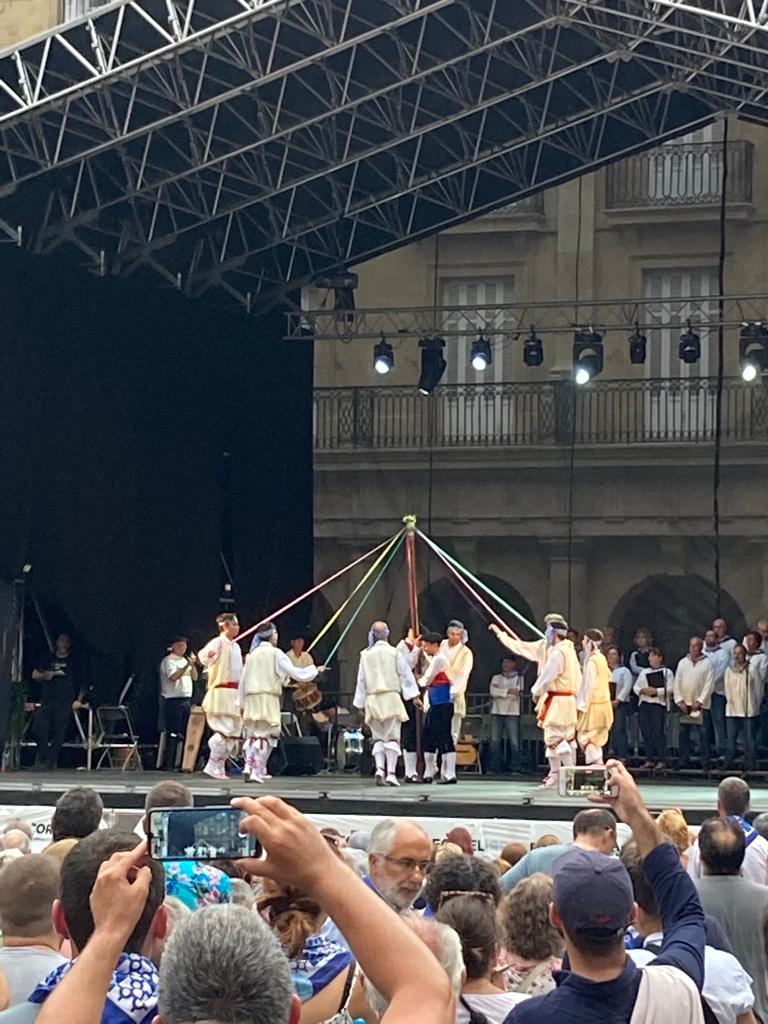
The Sunday I arrived was the last day of Bilbao’s Semana Grande--a weeklong festival of parades, bull fighting, music, food, drinking, and general civic celebration. Shana and I made our way to a central square in the Casco Viejo (old town) which was packed with friends and families celebrating. Some wore traditional dress, there were men in berets, and many others wore the town’s bandana (this year blue in color) around their necks to add to the civic pride. Everyone, us included, enjoyed pintxos (tapas) and the local txakoli wine. Musicians played traditional folk tunes and people were spontaneously singing along and dancing. The music consisted of 3 types of instruments—a drum, a flute type instrument, and an instrument that was something between a clarinet and a recorder. The combination sounded somewhat like fife and drum music of the American Revolution crossed with an elementary school band composed of 75% flutes. On the central stage, groups danced, including this group of men performing around a Maypole.


After Jeff joined us, we rented a car and explored the villages heading east from Bilbao. Each fishing village is cuter than the next. Some are so small you miss the whole town if you blink. Others are a bit larger with functioning harbors and all have beautiful beaches. Basque flags and the local town’s rowing team’s flag decorated apartment buildings in each. Our first stop was San Juan de Gaztelugatxe (say that 3 times fast!). Does this staircase look at all familiar to you? For GOT fans, imagine Daenerys Targaryen walking up to Dragonstone castle. Pathway real... Dragonstone castle, not so much.


We continued to Guernica—today a beautiful, peaceful town with a tragic history. The Basques have had democratic assemblies as governing bodies for centuries. The Guernica assembly dates to the 1500’s. Under an oak tree, the assembly would make governing decisions and agreements between the Basques and Spanish Kings, allowing for relative Basque independence. The current Assembly Hall, which lies adjacent to the oak tree, contains a fantastic stained glass ceiling that depicts the Assembly and the tree as well as local fishermen, farmers, and other Basque cultural symbols. The more you look, the more you see of the local history.

As for the tragic history....in1937, the Nazis wanted to try out a new bombing tactic which would inflict maximum civilian death and infrastructure destruction. Franco was looking for a way to destroy the Basques during the Spanish Civil war and suggested to Hitler that he use Guernica as the town on which to try the new type of warfare. On April 26, 1937, Guernica was bombed destroying most of the town and killing approximately one-third of the civilian population. Amazingly the Assembly and oak tree survived. The city has been completely rebuilt and is now a beautiful, peaceful, thriving town. There is still a heaviness in the town though, an echo of what happened there that you can feel.


Next on the list was exploring the French Basque area—Biarritz and Saint-Jean-de-Luz. Both are less than an hour’s drive from San Sebastián. While clearly still Basque with Basque architecture and the Basque beret everywhere, the towns do feel much more “French” somehow. Biarritz is the larger of the towns—a sophisticated surf town. I could spend quite a few lazy days in Biarritz, lounging on the beach and eating. The shoreline is stunning.

Saint-Jean-de-Luz is a simpler fishing village. Its claim to fame is that it was the wedding site of French King Louis XIV and Marie-Therese of Spain in 1660. The site was chosen as it was half way for both parties. The church in which they were married, St-Jean-Baptiste Church, is much less grand than I expected. It is quite simple and very dark. Not exactly the grand cathedrals of France you think would befit the marriage of a king. I loved that the current church pays homage to the fishermen and fishing industry with ship models hanging from the ceiling.


My next big Basque cultural event was the San Sebastián August 31 celebration—a yearly commemoration of the day the city nearly burned down! Back in 1813, during the Napoleonic war, San Sebastián was occupied by French troops. The Spanish asked the English and Portuguese to come help take back the city. After a long battle, the Spanish, English and Portuguese allies were able to breach the city walls and drive the French out. Apparently the Spanish then failed to pay their allies. So, the English and Portuguese pillaged the city, resulting in the death of many citizens and starting a fire that nearly destroyed the city. Only one street remained unscathed--today known as 31 August Street. Every year there is a re-enactment of the battle. And when I say re-enactment, they go all out!! In a central plaza, a “wall” is built with hay bales. The “French soldiers” are on one side of the wall. A parade marches to the plaza including people dressed as Basque civilians and battalions of Spanish, English, and Portuguese soldiers. When the two groups meet at the plaza, a gun/cannon battle takes place where I think they actually shoot a historically correct number of blank gun rounds and cannons! After the wall is breached, everyone cheers! The battle continues into the old town. Then to commemorate the fire, after the sun has set, all the lights in the old town are turned off. People light candles in their windows. A group of citizens holding torches, playing music, singing traditional songs, makes a slow march down August 31 Street. The entire town seemed to come out for the event.


While not exactly Basque, we did venture south/inland to Pamplona. While the area around San Sebastián is mountainous, green, and lush, Pamplona lies in a much drier and hotter plateau, with “golden” grasses, like the California “golden hills”. We entered the walled city near the bull pen, where the bulls are held prior to the famous run with the bulls. Bull fights in Pamplona occur only during the San Fermin festival, for 8 days a year in July. We walked  from the bull pen along the path the bulls take, past the statue of San Fermin (to whom those running with the bulls pray), down the city streets to the bull ring. I had expected large streets, wide open spaces to allow for the bulls and the insane humans to run. But no. Pamplona is a “typical” ancient walled city with narrow, cobblestone streets. You must be absolutely out of your mind to think running with the bulls in those narrow streets is a good idea!


After exploring the bull ring, cathedral, and city, we had the most amazing lunch at Hamabi, a restaurant on the upper floors of the Pamplona central market. Lunch in Spain is an affair that starts mid-afternoon. I think we sat down to our 5-course lunch at 2:30 and left close to 5 pm! I can’t do justice to either the amount of food served or the fabulous flavors. But I do leave you with a picture of the desserts. Notice the Basque cheesecake on the right. Apparently, it was not cheesy enough as they added extra grated cheese on top! It was beyond fabulous.


There are many beautiful towns along the coast that are an easy train ride from San Sebastián. One day we went to Zarautz, a beautiful beach town that many locals come to for vacation, and then walked to the next town over, Getaria, which is the birthplace of Juan Sebastian Elkano. Who is Elkano you ask? A Basque explorer who sailed with Magellan. The Basques point out that he was the first explorer to circumnavigate the Earth in one continuous journey. He completed his journey September 6, 1522, so 2022 is the 500th anniversary and the Gipuzkoa province celebrated that day as a holiday. We had a fabulous fish lunch overlooking the Getaria harbor, toasting Elkano and his accomplishments--and laughing at our inability to take selfies!


Our last excursion was taking the train to Zumaia to see the Flysch. Flysch is a type of sedimentary rock. Eons ago, the Spanish peninsula was an island. Sedimentary rock was laid down on the seabed between the Spanish land mass and Europe. When what is now Spain moved and “crashed” into the European continent, the seabed was pushed together and the sedimentary rock folded upwards. Those layers of sedimentary rock were pushed out of the ocean to create mountains along the shore and those sediment layers bent like ribbon candy. The layers are now in an almost vertical configuration, best seen along the coast. These are stunning in Zumaia. From some angles, the rock looks like pages of a book or mille-feuille in French pastry. At other angles it looks like scales on a dragon (hence the use of the beach and

rock formations in GOT). The layers of rock are a timeline of history oriented along the coast from east to west. Scientists have dated the different layers and even found a distinct black band that corresponds to the time after the asteroid hit the earth, resulting in the extinction of the dinosaurs. The coastline is stunning. We enjoyed it both from land and on a boat tour. Spectacular is the only word I can use.


And of course, I got to explore San Sebastián with my hosts! I now see why Jeff and Shana chose San Sebastián as their new home. It is a fantastic city. The coast includes three beautiful beaches, complete with a seaside promenade. It really looks made for movies.


The downtown is full of Belle Époque buildings, beautiful parks, multiple squares/plazas with flowers and fountains. And sculptures everywhere. I really liked The Comb of the Wind by Basque sculptor Eduardo Chilida. It features 3 parts set on the rocks at the western end of La Concha Bay.


People really use the outdoor spaces in their city, sitting outside at cafes, reading on benches, sitting on the beach. It is a very livable and walkable city. Feels large enough to be called a city, but small enough to be easy to get around and friendly. In the old town, we tried numerous pintxos bars—one specializing in anchovies. We tried three: one with blueberry preserves, one with mixed vegetables, and one with anchovy and foie gras. The anchovy and blueberry was surprisingly delicious! One evening we had Basque cheesecake and Pedro Ximenez sherry for dinner! Can’t beat that. I also tried a Spanish vermouth—a sweet red vermouth served with an orange slice or peel.


In preparation for the rowing competition that was happening in San Sebastián the upcoming weekend, there were food stalls one day—one making a Basque specialty, talo. It is a coarse, handmade corn tortilla cooked to order, that is filled with your choice of cheese, Spanish chorizo sausage, and bacon. OMG... so simple and so good!

I thoroughly enjoyed my time in San Sebastián and the Basque Country. It is a beautiful part of

the world. And sharing it with such wonderful friends was such a treat!

Thanks for the memories, 

Jill

Thursday, September 29, 2022

The Big Trip -- Introduction

What is The Big Trip (always capitalized)? Well, Shana and I have been discussing for years taking a multi-month trip through Asia and Oceania. We had originally thought we would take this trip prior to moving to Spain, but the result of the 2016 election and accelerated our time-frame for leaving the US. Then, we planned to begin the trip in October 2020, but Covid intervened and made any such trip impossible. Now, the time has finally come! 

We have, once again, rented a storage unit and put most of what we own there, while packing just one suitcase and one backpack each for the road.


This afternoon (September 29), we left the apartment we  lived in for five years for the last time and grabbed a bus to the San Sebastian airport for a quick flight to Barcelona (we got a traditional San Sebastian send off, i.e. it was raining). After an overnight stay near the airport, we will catch a flight for Bari, Italy, which is in the Puglia region (the "boot"). In Puglia, we will meet up with my parents for a week before heading to Rome and, after a couple of nights there, we will fly to Singapore.

Since we don't want to give too much away in advance, we will just say that the trip will be about five months (September 29, 2022 - March 1, 2023), and will include visits to seven countries: Italy, Singapore, Austrailia, New Zealand, Vietnam, (the soon to be reopened) Japan, and the US.

You can follow our adventures here. We plan to blog once a week during the trip, probably late in the week. So, hopefully you will check in each week to see where we ( are and what we are doing.

Arrivederci,

Jeff and Shana


Monday, September 26, 2022

Film Festival 2022 Wrap Up

Every year we look forward to the film festival with a high level of anticipation. The film festival is, to borrow a movie phrase, "like a box of chocolates. You never know what you're going to get." This year had its fill of good, bad, and really bad movies. We both left at least one movie early -- a first for me. Here's the wrap up of what we saw and our thoughts on each movie:

Mi Pais Imaginario / My Imaginary Country: A fantastic documentary about the recent revolution (I don't think that is too big a word) in Chile. Amazing footage of the street battles between protestors and police, including interviews with people who took part. The movie includes discussion about the framing of the country's new Constitution, but ends before the recent vote to reject that Constitution. At the 2019 Festival, we saw a movie from Argentina called The Green Wave/ Let it Be Law about the fight for abortion rights there. That movie ended with the rejection of the proposed abortion law, but the fight continued and it has subsequently passed. It will be interesting to watch how things progress now in Chile.

En Los Margenes / On the Fringe: A very depressing movie about the financial strain on the lower classes in Spain, particularly surrounding the topic of evictions. The plot moves at an almost frentic pace over the course of a single day (with the final scene taking place the next morning) presenting the intersecting lives of people in dire financial straits and those trying to help them.

Runner: A movie that has gotten a lot of buzz at various film festivals, but I found it increadibly slow. It is clear what the movie is designed to do, but with little dialogue, I did not enjoy it at all. Shana was smart to give this one a pass.

Avec Amour et Acharnement / Both Sides of the Blade: A French movie starring Juliette Bincoche as a woman involved in a love triangle. She lies to her partner and as expected that doesn't go well. Not worth recommending and Jeff made a good choice not to see it.

El Caso Padillo (The Padilla Affair): A very interesting documentary about Cuban poet Herberto Padilla who after being held by the secret police of Cuba and (maybe?) tortured engaged in a night of "self-criticism" before his colleagues in the writers' guild in which he praised the Cuban Revolution and accused several other writers of holding anti-revolutionary thoughts. The recently found footage of his speech represents the bulk of the movie and makes for a very intense evening that will seem familiar to anyone who has read Orwell's 1984. A documentary well worth seeing.

Don't Worry Darling: One of the few mainstream American movies we saw at this festival. It is the kind of movie you want to see without knowing anything about the plot, so we will just say "go see it". We both enjoyed it.

Gran Marin: Shana saw this film about a woman wanting to work on a fishing boat. It was in the New Directors section, and the director also starred in it. The film showed how she just wanted to work hard and be treated like everyone else. Ultimately she earned her co-workers respect. Overall it was not compelling.

L'Innocent: directed by and starring French director/actor Louis Garrell. Last year, we saw his movie The Crusade about children selling their parents' possessions to raise funds to fight the climate crisis. This film did not include social commentary, but it was a very entertaining love story/heist movie that I really liked (Shana liked it less, but did enjoy it). There are several brilliant set pieces, and the movie is worth seeking out even though you will have to read subtitles.

Tax Me If You Can: A documentary with very good information about how wealthy individuals and large corporations avoid taxes while politicians pretend to do something about it. But, as a movie, not very interesting or engaging. We felt it could have been done better.

La Huella: Our culinary movie this year, about a restaurant opened twenty years ago on a (then) pretty deserted beach in Uruguay. The movie told the story of how three friends opened this restaurant and showed a number of fantastic dishes that they serve, but it really seemed like an extended episode of Chef's Table, which is not a compliment for a cinematic documentary.

The "dinner" that we attended afterward was a big dissapointment because it turned out not to be a dinner, but rather a drinks and hor d'oeuvres event, which seemed like a bit of a bait and switch to us. We have to admit that the food was delicious, but not having a place to sit and enjoy it after paying for what we thought was a dinner did put a damper on the evening.

La Consagracion de la Primavera / Rite of Spring: Shana went to this story of a young woman who has come to Madrid to attend university and is having a tough time finding her way. She meets and befriends a young man with cerebal palsy and even attends to his sexual needs. Oddly the director claimed the movie was about the disabled community's need for sexual fulfillment, but she thought the movie was her story, not his. And it wasn't that interesting in the end. 

Kings of the World / Los Reyes del Mundo: A movie about five kids who live on the streets of Medellin, Columbia travelling to reclaim land stolen from the grandparents of one of them. The grandson's legal claim has been accepted after years of trying, but of course it is not that easy. Basically, it is a story of five boys who want a shot at a good life, but, while some people help them in their travels, the world is definitely not going to give them a fair shot. Very depressing but well-done film, it ultimately won the award for best film in the Official Selection section of the festival.

Something You Said Last Night: A story of a Canadian-Italian family on vacation. The debut long film from its Canadian director, the movie is being hailed as a big step for transgender people (the main character, one of the daughters, is trans). While I thought the performances were good overall, the family is so annoying, that it is somewhat difficult to watch this movie.

Mutzenbacher: Well-known Austrian filmaker Ruth Beckermann takes the 1906 erotic novel Josefine Mutzenbacher or The Story of a Viennese Whore as a jumping-off point by publishing a casting call for men to audition for a movie version of the novel. The documentary consists of them reading and discussing portions of the book to examine male erotic fantasy. It was strangly cringe-worthy (the source material contains very controversial scenes of child sexual behavior) and boring at the same time. I didn't stay for long.

El Amor en su Lugar / Love Gets a Room: Set in 1942 in the Warsaw ghetto, the movie is a based around an actual play called Love Gets a Room that was witten by a Polish Jew, and performed for four weeks in the ghetto prior to the beginning of deportations. The movie itself is fiction and, for me, surprisingly unaffecting, despite the subject matter. Shana liked it more than I did, for it's clever use of a play within a movie setting.

Walk Up: A Korean movie set in a single building where the passage of (an undefined amount of) time occurs whenever the characters exit the building. The dialogue was strangely stilted -- maybe a Korean thing, but we have seen other Korean movies, including Parasite, that did not have thiss issue -- and the characters were not very engaging. Shana left early, and I stayed to the end, but am not sure why.

El Sostre Groc/The Yellow Ceiling: A fantastic documentary from Isabel Coixet, one of Spain's best directors, examines the sexual abuse of young women that took place at the Lleida Theater School. The documentary does an amazing job explaining how the primary perpetrator, a teacher and later director of the school, was able to both abuse his young, female students while carrying on affairs with a number of teachers. As is often true in cases like this, everyone knew, but no one did anything until years later when a number of the girls (now women) got together to denounce the perpetrator (still the director of the school). It is possible this documentary will not come to the US, but if you have a chance, see it. We were fortunate to see Coixet introduce the film with several of the brave women whose story she told so well.

La Amiga de mi Amiga/Girlfriends and Girlfriends: Really no way to describe this movie other than as a small group of lesbians jumping into and out of the each others' beds. The dialogue was boring and we have nothing really good to say about this movie. Not terrible, but not good either.

Tori et Lokita: Very (!) depressing movie about two young African migrants attempting to make it in Belgium. As with Los Reyes del Mundo (above), the end result was pretty clear from the beginning. The young actors (one in her teens, the other a boy of about 10-years-old making his acting debut) provided very good performances, but it is a difficult-to-watch movie despite being very well done.

Marlowe: Good cast led by Liam Neeson in a somewhat pointless film noir. We agreed that there is nothing wrong with the movie, but there is also nothing to really recommend it other than beautiful 1930's cars, clothing, etc. Overall, it was just fine.

You Have to Come and See It/  Tienes que Venga a Verlo: A very short (64 minutes) movie that is made shorter by an opening sequence of watching the characters listen to live music for over five minutes. The movie was trying to say something about the world and the environment, but it was not at all clear, and basically ended up as a boring and pointless movie. Trust us, you DON'T have to come and see it.

Suprise Movie -- Blonde: Each year the festival sells tickets to a "surprise" movie and this year we bought tickets. A few days into the festival they announced the movie would be Blonde, the new Marilyn Monroe biopic starring Anna de Armas. Initially we figured it would be a nice way to end the festival, but an hour or so before the movie we looked and saw that the movie is 2 hours and 46 minutes long. After seeing 18 and 16 movies previously, we had not bandwitdth left for such a lengthy movie and just skipped it. 

So, that is it for another edition of the San Sebastian Film Festival. Hopefully, you will be able to see some of the (better) movies that we were able to see.

Hasta pronto,

Jeff and Shana


Thursday, September 15, 2022

It’s Film Festival Time Again


September means that the San Sebastian International Film Festival is around the corner. This will be our 6th festival, and, as always, we are excited to enjoy our favorite San Sebastian event.

This year the festival is celebrating 70 years. Earlier this week we went to see a special exhibit in the Tabakalera (the former tobacco factory turned cultural center) that provided a pictorial and video history of the festival. While it was entertaining to see the number of celebrities who have attended the festival during its lengthy history, having lived in Los Angeles for so many years, that kind of celebrity worship isn’t that appealing to us.

Preparing for the festival is time-consuming. The list of movies that will be shown trickles out during the weeks before tickets go on sale. I had a running list of movies that seemed interesting and when it came time to cull the list down, there were some movies I couldn’t remember why I included and others I couldn’t believe I had omitted.

About a week before tickets go on sale, the program is released, which includes an important detail – each movie's run time. This year there were several movies that had caught our eye but that turned out to be well over 2 hours long. When you are planning to see more than a dozen movies in 9 days, a super long movie is not an attractive option. Those movies were the first to drop off the list.

Each movie generally has between 3 and 5 showings over a couple of days at different locations and times. Putting together your schedule is like a puzzle. We prefer certain theaters and do not like late start times. We spent hours figuring it all out, including having alternative times for certain movies if tickets sell out for those that will be in high demand.

Finally, tickets go on sale over three days and every year we cross our fingers that there won’t be a system glitch or screw up.

We’re pleased to report that while there was frustration with the process, as usual, overall things went well. We’re going all out this year – I’m seeing 16 movies over 8 days; Jeff is seeing 19 movies over 9 days. And one of the movies is part of the culinary films section with a corresponding dinner at the Basque Culinary Center. When all is said and done, we will post our usual wrap-up post when it is over.

Viva la cinema!

Shana & Jeff