Sunday, May 1, 2022

Milan -- Return to Italy

We are always happy to return to Italy. Unfortunately being a bit sick did make it difficult to enjoy the wonderful Italian food. Nonetheless, we made do, and were also very appreciative of the history of Milan.

Milan is another city that was very important during the Roman Empire, and after the Empire legalized Christianity, Milan became its religious center. The site of the current Duomo (cathedral) of Milan was the site of a church as early as the 4th Century. The current spectacular building is the third largest in the world (after St. Peter's in the Vatican and the cathedral in Sevilla). When it was  begun in 1386, it was designed to hold the enire population of Milan -- 40,000 people:

Although we generally do not like to pay to see churches, we were happy to pay 15 Euros each for the full ticket in Milan. In addition to seeing the inside of the Duomo (impressive stained-glass windows and 100 giant columns), we visited the Duomo museum (which houses the many statues that have been taken down from the Duomo over the years, along with a scale-model of the building), and got to climb up to the building's roof. This was definitely the best part.

First, on the way up, there is an intermediate stop where you get a good look at the building's flying buttresses:

Then, on the roof itself, you have great views of the city (duh), but also of many of the 135 statues of saints that sit on pillars around the building (this guy seems to be taking in the view of modern Milan with us or perhaps he is judging Milan's modern materialism):
Being on the roof of the Duomo really makes it obvious what an incredible architectual achievement the building is, especially considering that its construction took place mostly between 800 and 400 years ago!

After the Duomo, we visited  one of Milan's main art museums, the Pinocoteca de Brera, which contains paintings almost entirely from Italian artists. Although we were not really impressed with the art -- so, so, much of it religious -- there were two interesting things about the museum. First, it is in a beautiful old building that also houses an art school (sorry, no pictures); and second, they have built a large clear "box" in which the museum's art restorers do their work. Very interesting to be able to watch this process.

Of course, the Duomo is not even close to the only church in Milan. We also were able to visit two others. First, the beautiful Church of San Maurizio al Monastero Maggiore. This heavily-frescoed church was built for a group of closistered nuns, which means it is basically two churches back to back -- one for the public, and the other for the nuns so they can participate in the services without being seen (even including a small space in the wall between the sections so they could receive communion). Here you can see the ceiling and just some of the frescos on the nun's side of the church:
And, the frescos are not limited to scences from the New Testament. Here is part of a fresco representing the story of Noah and the flood -- we were surprised to see a couple of unicorns (?!?) climbing up the gangplank into the ark.
The second church was the Basilica di Sant Ambrogio. Yet another site where a church has stood since the 4th Century. The original church (called the Basilica of the Martyrs) was built by St. Ambrose in 379-386, and the relics of the original martyrs remain in the current church. Although not the original building, the current 11th-12th century building is impressively old. There are also two very interesting older items in the church, both of which can be seen in the photo below. On the left, is the 4th century sarcophagus of Stilicho, which contains many carvings of Jesus and his disciples. To the right is the golden alter and the wooden structure above it (called a ciborium) are from the 9th century. The basilica of Sant Ambrogio is definitely worth a visit if you are in Milan.
Finally, we walked a lot in Milan (of course), and wandered through the grounds of the impressive Sforzesco Castle. This impressive structure (including at least one drawbridge over a now water-less moat) was begun in the 15th century, but significantly expanded in the 16th and 17th centuries when it was one of the largest in Europe. Now, it houses about nine different museums (it really is huge), and its courtyard is open to the public where plenty of people are just strolling through or hanging out.
While Milan may not be our favorite city in Italy, it was good to learn about the extensive history of yet another city that has been a center of various civilizations for over 1500 years.

Now, on to Venice.

Ciao,

Jeff and Shana


Wednesday, April 27, 2022

Geneva


We stopped off in Geneva, just two hours from Lyon by train, for two nights with one goal in mind: to visit CERN, the location of the Large Hadron Collider. It would be an opportunity to “geek out” on science at one of the smartest places in the world. CERN is a science cooperative that sits just outside Geneva; the collider covers a 27-kilometer ring that runs under both Switzerland and France. CERN offers 1-hour guided tours, but you can’t sign up in advance, you can only register in person up to two hours before a tour begins. Jeff wasn’t feeling well and decided to rest in the hotel, so I ventured out on my own.

When I arrived via tram around 9:40 a.m., I learned that the 11 a.m. tour was full. I had realized this was a possibility and knew I could stick around to register up for the next (1 p.m.) tour. I met a Canadian, who also had to wait, and we went to the Microcosm exhibition about the collider to kill time. When we went back to the tour desk a bit before 11 a.m. we were met with chaos. Now that more people were arriving, there was absolutely no organization or ability to discern what was going on. The individuals responsible for arranging the tours had no system whatsoever for understanding who had arrived previously and in what order. After observing this disorder and learning that I wouldn’t make the 1 p.m. tour I decided to throw in the towel. Although they were adding a 2 p.m. tour, I was not standing around for close to another hour only to be bamboozled again by sheer incompetence. (It was that bad, I’m not exaggerating.) It is hard to believe that tours for the smartest place are operated by the dumbest.

It was a disappointment, but sometimes you must move on. I learned something as well – consider avoiding places that can’t organize online signups in advance. It is the 21st century after all. You’d think the scientists would use science – the internet was supposedly created at CERN – to manage such simple tasks.

Geneva sits on a beautiful lake and has an old town area to explore. It also reeks of money and is super expensive. At least it gave us the chance to eat more Asian food.

Near the lake sits a lovely flower clock, which was accurate and ran with Swiss precision.

And we checked out the Jet d’eau, Geneva’s signature sight, from all angles even getting a bit wet.

We also enjoyed the display of Philippe Geluck’s “Le Chat” (the cat) sculptures along the Quai Wilson a lot. Geluck is a Belgian cartoonist/comedian/artist/etc. who features a cat in his comics. You’ll easily appreciate his sense of humor from this sampling of the 20 pieces on display:

Hopefully you can the see that it is raining under the umbrella! Also, we loved the fact that the "car hit by a cat" was a Mini Cooper.

Geneva was not a favorite city for us, perhaps due to the inability to do what we came for, but it was a nice pause and it allowed me to add Switzerland to my list of countries visited.

Onward to Italy,

Shana & Jeff

Monday, April 25, 2022

Delightful Lyon


We spent six nights total in Lyon, which was a function of the Easter holiday schedule. Both Easter Sunday and Monday are holidays in most European countries. Thus, knowing we’d have two “slower” days with limited opportunities to do things, we chose to stay in Lyon longer, which worked out well. We found Lyon to be charming, accessible, easy-going, and delicious. The city has a relaxed vibe, a first-rate transportation system with a metro, trams and buses, an array of cuisine options, and charm to spare. Plus, as noted in the previous post, opportunities to taste local wines. It’s easy to understand why the tourist office’s catch phrase is “Only Lyon”.

Lyon sits at the confluence of the Rhone and Saone rivers. Walking along the rivers and across the many bridges is beautiful:

You can see the famous Basilica Notre Dame de Fourviere from most points in the city. Mother Mary is always watching over and protecting Lyon:

The views of the city down from the church are just as precious.

We took a one-hour walking tour of Vieux Lyon, or “old Lyon” to learn a bit of history. The oldest parts of the city are built onto the hill above the Saone river. Clever builders connected the various buildings with “traboules,” interior corridors that hop directly from one street to another via inner courtyards and stairwells. If you know how to find them, traboules make for efficient transfers as you avoid going around the city blocks and they are great hiding places – they were even used by the resistance during WWII because the Nazis did not know they were there. Traboules are very "only Lyon."

Lyon was a very important city during Roman times (two Roman Emporers were born there), and has well-preserved ruins that are free to visit.

Finally, one of the most charming areas of the city is where the two rivers meet -- the confluence. The two rivers are actually different colors, and you can see the contrast as they join, albeit not easily in this photo.

The area has been developed recently and features interesting modern buildings. The Museum of Confluences (archaeology and science exhibits) looks like a Gehry-designed building, but it’s not:

We ate at bouchons, which are considered basic restaurants offering typical Lyonnaise fare. Most French restaurants in the city offer a three-course meal with farm fresh products. While the options may be limited, every dish is made with care, and the prices can be very reasonable. We also took advantage of the opportunity to eat good Vietnamese and Chinese food, which we don’t get back in San Sebastian.

In the end, six nights was not too many to spend in Lyon. There are still several places we could visit and many more restaurants to try. We would definitely return.

One last bit of praise: Lyon also has numerous easy to find, clean, free public bathrooms. Now that’s civilized! Sadly the graffiti is the norm around many European cities, San Sebastian included.

Au revoir,

Shana & Jeff 

Saturday, April 23, 2022

Wine Tasting From Lyon

In addition to being the gastronomic capital of France, Lyon also sits directly between two French wine regions -- Beaujolais to the north, and the Rhone (specifically the Northern Rhone) to the south. Not wanting the have to choose between them, of course we booked two half-day tours!

Our first tour was to the Beaujolais area, and we were lucky enough not only to have the tour company's owner, Julie (pronounce TZUH-lie) as our guilde, but there was only one other person -- a soccer-obsessed Brit -- on our tour. 

As our regular readers know, France has insane rules for its various wine regions. In order to call a wine a Beaujolais, it must either be 100% chardonnay (white) or 100% gamay (red). Other grapes are grown in the region, and we tried wine made from them, but those wines cannot be labeled Beaujolais, and are considered "table wine" even though the quality can be very high.

For our first stop on the tour, we simply took a break on a hillside among the vines where Julie broke out both a red and white Beaujolais. As we sipped, she gave us details about the region and its wines. Note the short stumpy looking vines shown, these are Gamay vines which stay close to the ground.

Next, we visited an organic winery, Domaine des Prevelieres, run by two brothers from the Morel family. We started with a discussion about their farming process. For example, notice the foliage at my feet in the following picture. They use this to nourish the soil so they can avoid using any type of chemicals or fertilizers. During this time, the brothers' two dogs, one of whom we were amused to learn is named Obama, were running free through the vineyard (no idea how we failed to get a picture of the dogs, but we definitely enjoyed petting them).
Then, after a quick tour of their winemaking process, it was time to taste. The winemaker brother who led our tour seemed to like us (he pretended not to speak a lot of English, but we think he knew more than he let on), and since we were such a small group he ended up opening a couple of wines that were not originally part of the tasting.
We started with a very good Viogner, then moved on to the Beaujolais (2 white and 2 red) before finishing with a wine made from gamaret grapes. We had never heard of this grape before, which is not surprising since there are only about 500 acres planted in the entire world (ironically, in Geneva we ended up drinking a gamaret/syrah blend). We enjoyed our tasting so much, we bought three bottles, which we continue to drag around Europe on our journeys.

The next day, we took a tour with Julie to the Northern Rhone, which included cheese as well as wine. Unfortunately, this time there were 15 of us (two vans worth) so it was definitely less personal.

First, we stopped for an introduction to the region among some vines in the Cote Rotie area, which are almost entirely on steep hills overlooking the Rhone river. Cote Rotie means roasted hill -- the steepness and sun/wind exposure definitely give meaning to the idea of how "terroir" shapes a wine. 
Then, we had a quick tour of a cheese farm including "meeting" the goats that provide the milk for the cheese before we tasted a couple of wines with three of the cheeses from the farm. Really it was one cheese at three different levels of aging, and it was so interesting to see how the cheese changes in texture and taste over time.
Finally, it was off to a winery where we tried a number of Northern Rhone wines, both red (syrah) and white (viogner, marsanne and roussanne) along with a variety of cheeses. It was a nice tasting, and we certainly enjoyed the inclusion of cheese tasting, but it was not as fun as the small group of the day before. The tour did confirm that Americans are back to traveling as we met people from DC, Florida, Oregon, and Seattle.

As usual, we very much enjoyed wine tasting in France as we continue to learn about its wide, wide variety of regions.

Hasta pronto,

Jeff and Shana

Thursday, April 14, 2022

Early Notes from Lyon

We arrived in Lyon, the first stop on our current trip, on Tuesday evening. After two days here, we are really enjoying this beautiful city and, of course, its food and wine.

Just a couple of quick initial notes on Lyon. First, the city sports a number of really cool, extremely lifelike murals painted on whole buildings, a couple of which we found on our first day in the city. 

The second picture is of one of the more famous murals in the city. As you can see, it is very lifelike (even more so in person). Notice Shana interacting with the worker at the bottom of the stairs.

Today, we had fantastic weather. The flowers are blooming as spring has arrived in Lyon:
We also had a really cool experience when we went to the Lyon Resistance Museum. Just as we arrived, a youth wind orchestra from Germany was preparing to play a concert in the plaza outside the museum. We stayed and listened to several pieces before going inside.
From the museum, we could still hear them as they played for about and hour and a half, including a number of modern songs like Bohemian Rhapsody, Englishman in New York, and Imagine. You can see from the below photo (taken from the window of the museum) that they had drawn a good crowd.
More to come soon.

Jeff and Shana


Sunday, April 10, 2022

Human Rights Film Festival

Although we have talked about the Human Rights Film Festival before, we have never written a post about it. Of course, we also had only gone to see two movies (Shana only one) in all of the previous years. Often, this is due to the fact that we forget it is coming, and because it generally has subpar marketing. This year, however, we read about it in the newspaper, and were able to review the movies that were offered. There were three that we particularly wanted to see, but one was by invitation only and we were not invited. So, we saw two.

The first was a French movie called Debout Les Femmes, which could really have been produced in any country as it focused on the low pay and precarious lives of in-home carers who take care of the elderly and disabled (almost all of whom are women), among other low paying jobs. The movie did an excellent job of showing how important this work is by going along with a number of carers into their clients' homes. Related interviews talk about how little they are paid, how unprotected they are, and how many of them need to have other jobs to make ends meet.

The driving force behind the movie was an attempt by the director to introduce changes to the French budget to improve the lives of these women. A late scene shows each of these changes being rejected by parliament by huge margins. After watching the intervies of these women for over an hour, it is a devestating scene. The movie is well worth seeing if you have a chance.

The second movie we saw was called Fadia's Tree. Directed by a British visual artist in her first documentary, this movie describes the director's friendship with a Palestinian women who lives in a refugee camp in Lebanon. Over the course of fifteen years, the director does what her friend cannot -- goes to the site of her family's village in Israel to find a mulberry tree that sat accross from her grandfather's house prior to 1948. 

The film moved quite slowly, although I felt that was perhaps intentional to reflect life in a refugee camp where, as Fadia says, everyday is the same unless someone "dies unexpectedly." However, it is very effective in telling what might seem like a simple story using the birds that migrate through the middle east every spring and fall -- the concept of the birds' freedom to cross boundaries is contrasted with the inability of Fadia to do the same. The fairly somber tone of the movie is broken up by scenes of the children in the kindergarten where Fadia works.

Although we did not like this film as much as Debout Les Femmes, it was an interesting take on a contentious subject.

We know that our output of blog posts has been limited recently, but our self-imposed break from traveling is nearing its end, so expect a more normal output of posts coming soon.

Hasta pronto,

Jeff and Shana


Tuesday, March 29, 2022

Spring Is Here


There hasn’t been much to write about since our spa adventure in Orio. We’ve been hunkered down and living our normal routine, waiting for our next opportunity to travel. The winter hasn’t been too bad. While it started out cold and wet in November, overall, it’s been mild and less rainy than normal. Most COVID restrictions have been dropped, but we are still wearing masks inside. It is unclear when that will stop, although we know it’s coming eventually.

Spring has arrived. There are leaves on the trees again and we’re seeing some warm days. Whenever the weather is nice enough, between October and May we really enjoy a walk on the beach because dogs are allowed to join their owners. It is a joy to see the dogs running free, chasing balls, jumping in the water, and getting to know each other. This past week the weather was perfect.


La Concha, the main beach, is just a 15-minute walk from our place, so it is easy to head out without any planning. It is especially nice at low tide when the beach is really spacious.

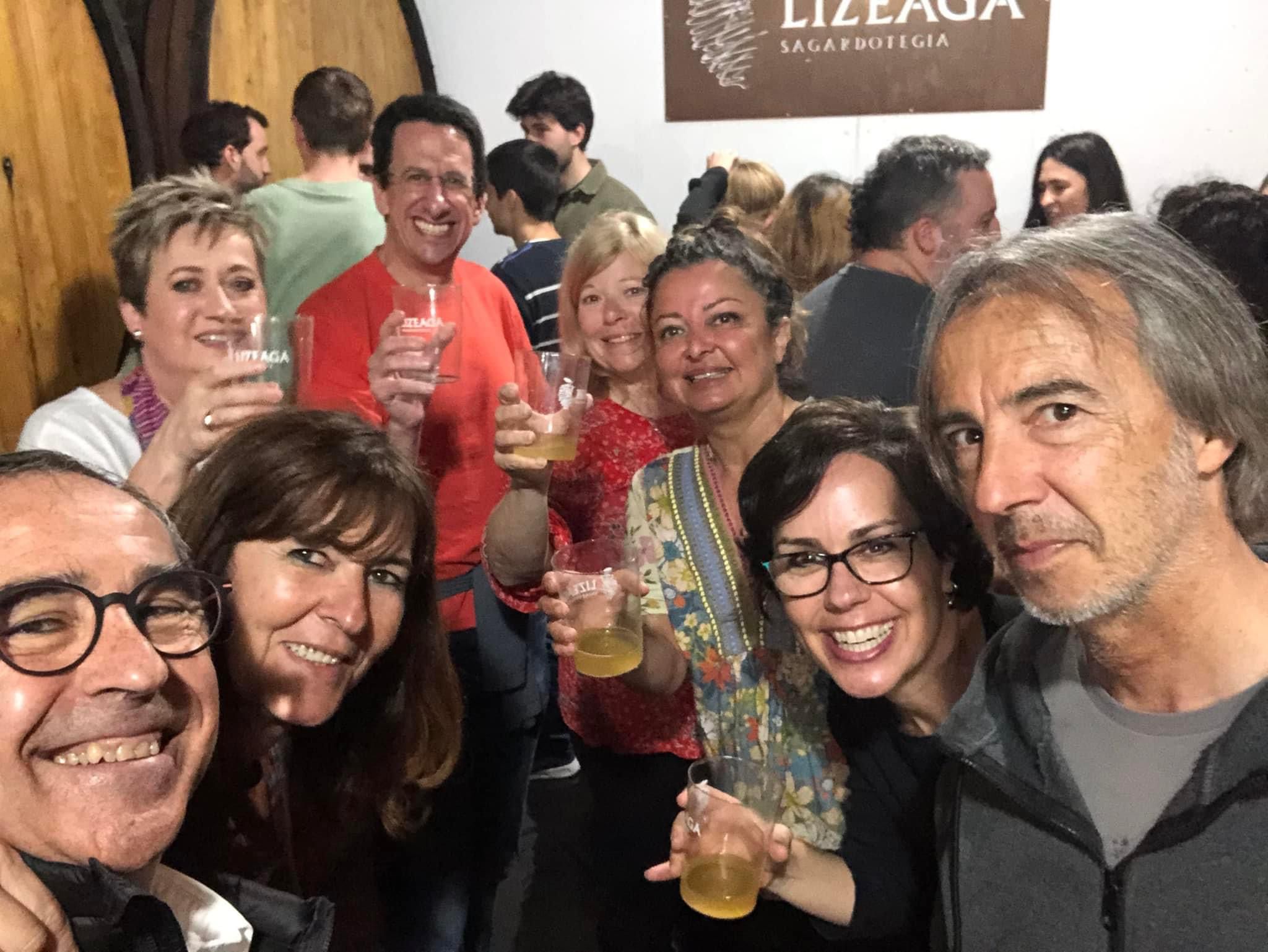
This past week we enjoyed another quintessential Basque experience – the sidreria. We’ve written about the Basque cider houses before. The cider house we went to is so traditional that you eat standing up! While we’d prefer to eat steak sitting down, it was a lot of fun. Our group of 8 had a terrific time trying the different ciders and enjoying the customary menu of chorizo, Spanish tortilla with bacalao (cod), cod with peppers, txuleta (steak), and cheese, walnuts and quince, along with some cookies.

The cider house was full, and the mood was jovial. It felt so normal.

We are looking forward to a few movies this week. Now that CODA won best picture, we’ll have an opportunity to see it. Previously it was had only played for one day; now, there are multiple showings this week. And the Human Rights Film Festival runs from April 1-8. We have tickets for two movies.

Starting next month we’ll be traveling again. We have a busy travel schedule over the next 3 months. We look forward to sharing our adventures with you.

Hasta pronto,

Shana & Jeff