Friday, September 17, 2021

Bru Na Boinne

Sorry for the delay in getting this post up, but from September 3rd until the 13th, we were very busy as our nephew David visited us. We enjoyed showing him San Sebastian including the beaches, old city and local hiking, along with visits to Zumaia to take a flysch tour, and Biarritz just to enjoy the beautiful scenery (and eat French food). In addition, he spent a week studying Spanish at Lacunza (our old Spanish school). Overall a very busy trip and another satisfied visitor. Now, however, we want to return to Ireland, and one of the coolest places we visited there: Bru Na Boinne. 

Bru Na Boinne is a site north of Dublin where there are approximately 40 burial mounds built over 5000 years ago. To give some perspective, these mounds are older than the pyramids at Giza. Like the pyramids, these sites are archaeological marvels. With bases of stones that weigh five tons, no one is quite sure how the ancient people who built these sites did so, but they are fantastic.

Since these sites are obviously quite fragile, you can't just drive to them yourself. You start at the visitors center where you can learn a bit about the mounds, including their discovery and excavation, as well as some speculation about the people who built them. Interestingly, it appears that these people lived in wooden buildings, which means they built much stronger and longer-lasting places for their dead than for the living. I am sure that means something.

From the visitors center, you take a bus to the first site, Knowth (rhymes with south), which contains several burial mounds, the largest of which is 220 feet wide and 40 feet high.

Although the mound is now supported by a concrete shelf, you can see the large stones on which it rested when built. Amazingly, many of these large stones contain carvings, mostly of geometric designs such as spirals.


After a bit of time to wander around the Knowth site, where Shana interrogated one of the docents who passed the test with flying colors, the bus brings you on to Newgrange, where there is only a single, albeit quite impressive burial mound:
Unfortunately, due to Covid, one of the coolest parts of the tour is not available right now. That part allows people to enter the main chamber of the burial mound at Newgrange down this narrow corridor of large stones, and stand in the main burial chamber. Another knowledgeable docent noted that keeping people out for the past 18 months has allowed some small nesting birds to return to the site. 

Perhaps the most interesting and amazing part of the entire site is the fact that the above opening to the main burial chamber is aligned to the rising sun on the winter solstice such that at dawn (assuming no clouds) the sun shines directly down the narrow passageway and lights up the chamber. It is the only time of year that the chamber is touched by the sun, and archaeologists who have studied the site do not believe it is a coincidence that this occurs on the solstice as ancient people viewed that day as a kind of rebirth as days would start getting longer thereafter. This affect was discovered in 1967 by an archaeologist who had been working on the Newgrange site and who was likely the first person in over 5000 years to experience it.

On our return to the visitors center, Shana and I learned that there is a drawing every year for the opportunity to be in the main burial chamber at Newgrange on one of the days around the solstice when this affect can be seen! So, when we returned to Spain, we signed up for this year's drawing. We would love to experience this amazing effect created by an unknown people over 5000 years ago. But, even if we don't win the lottery, it was a great place to visit and we highly recommend a trip to Bru Na Boinne if you are ever in Dublin.

Hasta pronto,

Jeff and Shana

Saturday, September 4, 2021

Driving the Kerry & Dingle Peninsulas


Ireland has a beautiful coastline and one of the best and most popular places to experience the coast is County Kerry in the southwest region. The area includes rugged and striking terrain, a national park, historical landmarks, and charming small villages.

We started our Kerry journey in Killarney National Park where we enjoyed a sunny day (one of the only ones we had). We did a fun bike ride through the park visiting Torc waterfall, the grounds of the Muckross estate, and the remains of Muckross abbey (a former Franciscan friary). The courtyard yew tree, the burial place of ancient chieftains, is said to be as old as the abbey (circa 1450). 


The Ring of Kerry along the Iveragh Peninsula is a 135-mile drive that takes nearly an entire day as you stop and admire the fantastic scenery. It’s a journey through an unspoiled landscape where each turn seems to bring a better view.

There were three particularly memorable stops: (1) the Skellig Chocolate Factory, (2) the Skellig Experience Center on Valentia Island, and (3) the ring forts. The first needs no explanation; suffice it to say there were lots of free samples.

The Skellig Experience Center explains the history of Skellig Michael, a fascinating island monastic settlement dating back to the sixth century. It is best known as the place where Luke Skywalker is found at the end of Star Wars: The Force Awakens. It’s a rugged little island that isn’t hard to get to if the weather cooperates, but it didn’t for us, so we missed out on our boat tour around the island and seeing the seabirds. Still, we learned a lot about the monks’ lives and history by stopping here.

The ring forts are circular stone forts built sometime between 500 BC and 300 AD without the aid of mortar or cement. These impressively large structures have withstood the test of time and the rainy Irish climate. Jeff’s position in each photo gives some perspective on their size.

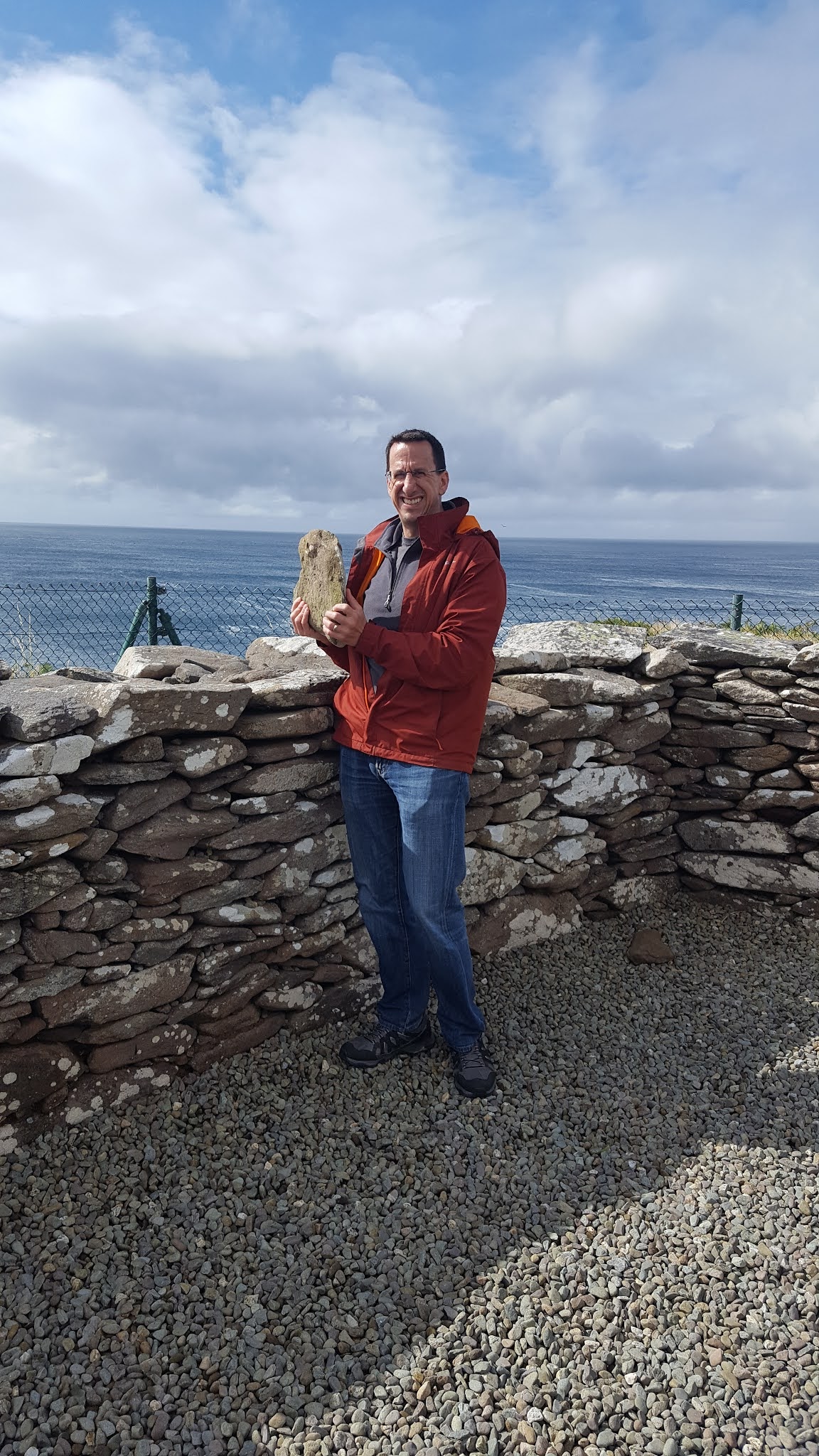
The Dingle Slea Head Loop is much shorter at 30 miles but is even more charming. We stopped at various sites, one even included the opportunity to feed some farm animals. You can become a bit jaded since in Ireland it’s one stone structure after another, but these structures were built somewhere between 1700 and 2500 years ago without any mortar (note in the third photo below Jeff has removed a stone from the wall - with enough space and time, you could simply dismantle the whole thing, yet it has withstood the elements for centuries). The Dunberg Fort, built right on the edge of a cliff offered great views as you can see; and we visited a group of beehive huts, which are unique specimens even for Ireland. Finally, the 1,300-year-old Gallarus Oratory is a well-preserved early Christian church, which is tiny and could only hold about a dozen monks for prayers. Amazingly, in all of the centuries, and with all of the rain Ireland receives, it has never leaked.


While we didn’t have great weather on either day, we enjoyed the scenery and stepping back into history along the way. Both drives are highly recommended.

More posts and photos to come,

Shana & Jeff

Thursday, September 2, 2021

Up Close with a Hawk, a Falcon, an Owl, and a Puppy; and some History


While staying near Kilkenny, our first stop after leaving Dublin, we had several fun adventures. We spent a very special morning with Hawkeye Falconry meeting Mabel the hawk, Elvis the falcon, Turbo the owl, and Lily the cocker spaniel puppy. You don’t know me at all if you can’t guess which wonderful creature was my favorite. We learned a lot about birds of prey and witnessed Mabel hunting, albeit not catching anything.  We even got to play a part as we learned how to call Mabel to our gloved arms (with the help of a bit of raw chicken placed strategically). We also learned that when Lily grows up, she’ll help flush rabbits for the hawks to hunt. Elvis provided a fantastic show as he attempted to catch a lure swung by our host. The most amazing part of that was the incredible speed with which he did so. We could literally hear him flying past us.

Mabel and Elvis were amazing – highly intelligent, fast, and efficient in their movements; while Turbo was almost as cute as Lily – almost.


We did a bike tour of Kilkenny, a town with an interesting medieval history. It turns out that small Kilkenny is home to Cartoon Saloon, an animation company that has received several Academy Award nominations. Its co-founder painted the mural in the photo. The town’s castle includes a wonderful park area for the public to enjoy.


Also in the area, we visited Jerpoint Abbey, founded in 1180, and the Rock of Cashel, seat of the ancient kings of Munster (AD 300-1100).

The abbey was built by Cistercian monks who became the dominant religious authority by creating a network of monasteries.


The Rock of Cashel is a fortified hill that became a prominent castle and church. St. Patrick baptized King Aengus on the Rock in about AD 450, which was a key moment that started the expansion of Catholicism in Ireland. This site is fascinating for several reasons. First, it was a site being fought over by competing kings (important for its strategic hillside position) before one of them donated it to the Catholic Church to keep it from the hands of his rival (pretty clever). In addition, the buildings on the site were built over many centuries: in the first two pictures below, the round tower was the first building built on the site when the Catholic Church took over in 1101, while the surrounding church was built between 1230 and 1290. Finally, and this is something we saw throughout Ireland, the graveyard on this site has been in continuous use for centuries and is still in use by the local town. Thus, you’ll see ancient graves adjacent to modern ones.


More rocks and more history to come.

Shana & Jeff

Wednesday, August 25, 2021

Ireland - Introduction

One of the main things we love about living in Europe is the traveling we are able to do. Of course, the pandemic put a significant damper on our travel schedule. In the 17 months between February 2020 (when we were in Portugal, and Covid was just some illness most people knew little about), and July 2021, we had only taken a brief, 5-day trip to Paris (July 2020), and a week hiking in the Pyrenees (October 2020). Now that we are vaccinated, we felt it was time to get back on the road.

We chose Ireland mainly because it would not be too hot in August, especially compared to possible destinations in southern Europe, and because we did not expect it to be too crowded since the country only opened for visitors on July 19th, giving foreign travelers little time to plan trips there. We were right on both counts. The weather was cool and rainy (as you will see from our pictures), and although the Irish were traveling in fairly large numbers, there were not many foreign travelers. Generally we felt that most sites we visited were not overrun. 

Traveling during Covid was a bit of a different experience. We had extra forms to complete before entering Ireland and returning to Spain; nearly every site required you to book a time to visit, although many of the government-run sites in Ireland waived their fees as an incentive to get people to travel; and, in order to eat inside a restaurant, you had to provide proof of vaccination. Almost every restaurant we went to over the 17-day trip adhered to this requirement, and at least checked our vaccination certificates, with the majority scanning them to confirm they were valid. Inside masking requirements were almost universally followed, and we generally felt pretty "safe," although on occasion it seemed like there were just too many people in an enclosed space.

So, what did we do in Ireland? Well, of course, we ate a lot of good food, drank a lot of good wine (no wine is made in Ireland, but they have a decent wine culture with most restaurants offering wines from Europe, South America, New Zealand and even South Africa) and, of course, drank a good amount of local beer, especially Guinness.

(No, I did not go bald in the last year, that is Shana's brother Adam, who met us for a few days in Dublin as a detour from his own visit to Iceland. Adam has traveled more during Covid than anyone else we know. I don't even want to think about how many Covid tests he has taken.)

After spending five nights in Dublin, seeing the sites, including St. Patrick's Cathedral and the famous Temple Bar, and especially enjoying ethnic food that we cannot find in San Sebastian, we set out driving around the south and west of the country for 12 days. This meant that I got to drive on the "wrong" (left) side of the road for the first time. And, while I did not actually find this too difficult, driving in Ireland is complicated by the fact that many Irish roads are very narrow, and the speed limit on these narrow roads is often a surprising 80 kph (48 mph). So, although I was driving below the speed limit, many of the Irish were not, which led to many moments where cars would come around a blind corner in the middle of the road before moving over (to the left, remember) forcing us to scrape our car along the foliage that lines practically every road in the country. Overall, a fairly stressful part of the trip.

All that said, we had a wonderful time visiting Ireland, as we will show more completely over a number of upcoming posts. And, we will say that the Irish reputation for friendliness is 100% deserved. They are all genuinely nice, helpful and friendly, and add to the enjoyment of a visit to their country.

Hasta pronto,

Jeff and Shana

Monday, August 2, 2021

Jazzaldia 2021


If it’s July in San Sebastian, then it’s time for Jazzaldia, the annual jazz festival. Despite the rampant spread of the delta variant, the show did go on with similar COVID safety protocols to last year's event. We saw two great shows, both in outdoor settings.

The first concert was a solo piano recital by Marcin Masecki, a Polish pianist, who performed ragtime music. Jeff chose this concert, and it was a real winner. Unlike last year’s soloist, Masecki spoke to the audience (in Spanish) before each piece, providing a bit of information and history about the artist. Most fascinating was how he got into performing ragtime in the first place:  he was inspired by the ragtime music he heard at Disneyland as a child. Ragtime became his passion and he started focusing on it more and more, including composing original pieces. It was easy to know that the music brings him great joy because we could watch his feet energetically dance under the piano while he played – we had a great view from our first-row seats in the cloister of the San Telmo Museum (a former monastery).


The second concert was Noa & Gil Dor, an Israeli duo, who performed with Inaki Salvador, a local pianist. There was an opening performance by Naissam Jalal & Rhythms of Resistance. Jalal is a Syrian flutist who lives in Paris. Her performance was enjoyable but not as dynamic as the main act.

Noa has a captivating voice and knows how to connect with her audience. She spoke almost exclusively in Spanish, while singing in English, Hebrew, Spanish, and even Basque. The selections played from her 2019 album “Letters to Bach” were marvelous – it is worth checking out her unique tribute to J.S. Bach. But the most special moment was when she sang as her final encore “Txoria Txori,” a Basque song that is considered a piece of resistance against the Franco regime’s prohibition of the Basque language, and a current symbolic yearning for independence. It is based on a poem about a how a caged bird loses its essence and can no longer be considered a bird. Listening to the audience sing along was incredibly moving. She truly held the crowd in the palm of her hand.

We are already looking forward to next year’s festival. Hopefully COVID security measures will be a thing of the past by then.

Hasta pronto,

Shana & Jeff