Hasta luego,

When we planned our trip to Pyrenean Experience, in addition to relaxing and enjoying our time hiking through the villages and hills around Georgina's house, we also planned two outings. The second, which we will talk about in a later post, was to tour the Comet Line, the smuggling route through which allied WWII pilots (mostly British) were brought from Nazi-controlled France into Spain so that they could return to England (through Lisbon and, more frequently, Gibralter). But first, as our loyal readers will appreciate, we had lunch at a local restaurant, Donamaria'ko Benta.
Donamaria'ko Benta is no normal restaurant. Despite being on the edge of the tiny town of Donamaria (population 433 (yes, seriously)), the restaurant has declined a Michelin star due to not wanting all the responsibilities and hassles that come with the designation. Donamaria'ko Benta is, like so many businesses in our area, a family-run business that is now being managed by the daughters of the founders.
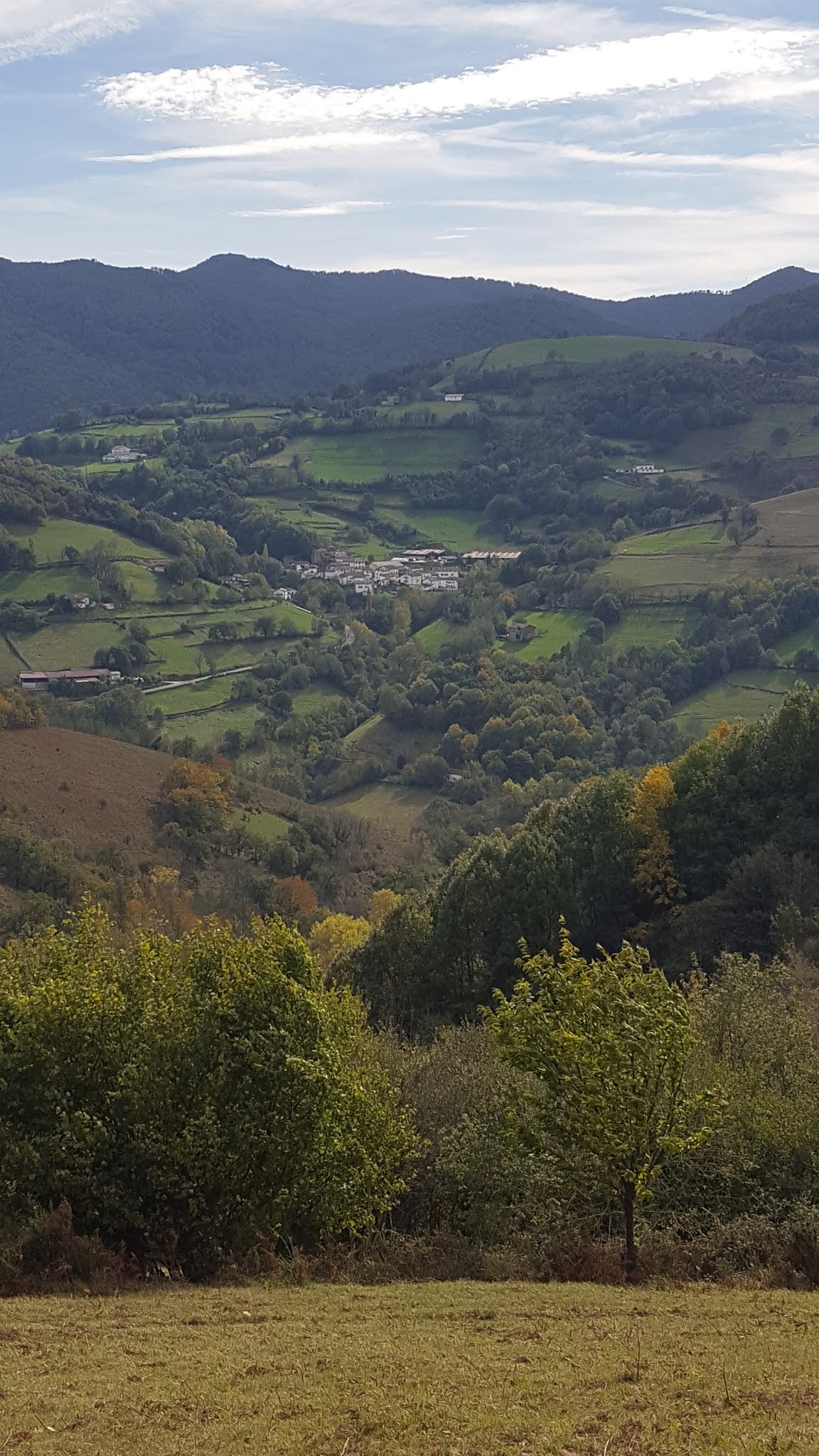
But, before we even got to the restaurant, we knew this would not be a normal lunch because we hiked to the restaurant from the largest town in the area, Santesteban (population 1,726), through the countryside filled with both beautiful scenery and animals of many sorts, including these curious cows who came to say hello:
And, a black-headed sheep:
In addition, although we somehow failed to take a picture, a local dog adopted us about a half mile from the restaurant and led/followed us there before disappearing to head home (we hope).
Lunch itself was, not surprisingly, fantastic. Five seasonally-based courses, including a bottle of wine matched with each course except dessert. Unfortunately, given the amount of wine we were consuming (Georgina and Carol did not pull their weight in this regard), we only have decent pictures of two of the courses: a lovely smoked-cod dish, and a pasta that included some foie gras because, well, it's Spain.
After lunch, a slightly tipsy Shana made a new friend in the field next to the restaurant:
Finally, we finished our culinary experience by walking from the restaurant, which was in the valley south of Georgina's house, back up to the house itself, where we relaxed and went to bed early, there being no need for any further food that day. The hiking to and from lunch totaled nearly 8 miles -- so we earned every bit of that amazing lunch!
Hasta pronto,
Jeff and Shana
We had the good fortune of spending the week of October 18 in the Pyrenees high on a mountain that has more sheep than people. It was a terrific way to get away from it all. You might ask, how did this come about amid the pandemic? Well, it is a good lesson in taking advantage of unexpected opportunities.
A week or so before, Carol, a friend of mine from yoga, mentioned she was spending the weekend at her friend’s mountain place and we might like it. She sent me the link to Pyrenean Experience, and I thought it looked terrific. So, I asked her to find out if there was any availability in early November. She replied that there was availability in mid-October – which was less than a week away! It turned out that a couple from the UK had just cancelled due to the UK quarantine requirements. After all the cancelled travel plans this year, we enthusiastically said “yes, we’ll do it!” And Carol even agreed to come along too.
So that’s how we ended up driving with Carol the hour or so ride to Ameztia, a small mountain in Navarre (in the foothills of the Spanish Pyrenees), and spending a week with Georgina (the owner) at her fabulous mountain hideaway, just as the territory was showing off its fabulous fall colors. Here is the view from the dining room – with the morning fog and without:
There is a guest house with 5 bedrooms (each with a bathroom), a dining room, kitchen, library and sitting room. And we had it all to ourselves! (The owner has a separate house on the property.) Georgina has mapped out more than a dozen, mostly circular, walking routes from the guest house that allow guests to explore the mountain, along with the various little towns in the valleys on either side. In addition, there are various cultural, culinary, historical, and language activities to enhance the experience. We elected to visit a local restaurant that has rejected a Michelin star and to visit and walk part of the Comet Line – the smuggling routes used during WWII to transport Allied pilots out of Nazi territory to safety (blog posts on each to come).
While we consider ourselves to be “city mice,” spending time learning to be “country mice” is never a bad thing. We spent the first full day hiking with Georgina to get the lay of the land, learning to use her topographical hiking maps, and seeing what the mountain had to offer:
Food and wine were included. Each morning we put together our own breakfast, lunch depended on the day’s plans, and dinner was a group affair. We disconnected from the news, went to bed early (not much to do once it gets dark on a mountain top), slept in, and slept well because it was so dark and quiet.
It was an incredibly relaxing week, the scenery was amazing, and we learned a lot about the local Basque culture as well. Of course, the week went by too quickly and we were sorry to leave. More posts and photos coming soon!
Hasta pronto,
Shana & Jeff
As our loyal readers know, the San Sebastian Film Festival is our favorite event of the year. Of course, due to Covid-19, 2020 would be a film festival unlike any other. First, of course, wearing a mask was mandatory at all times in the theaters. And, although we did not see any problems at the movies we attended, an American-born French director who was there presenting a movie was ejected from his own movie (!), and from the Festival, for refusing to wear a mask. So, they were serious.
Second, seats were assigned, and the number of seats available was limited to 60% of capacity in the normal movie theaters, and about one-third in the cultural center and opera house that are used as theaters during the festival. In those locations, even couples could not sit together as every-other-seat was blocked off.
Third, when you arrived at the theater, your hands were sprayed with sanitizer (literally, that was someone's job), and they showed the same group of health protocols on screen (recited in Basque, Spanish and English) before each movie.
Finally, they asked people to remain in their seats after the movie so everyone could leave in an orderly manner, which meant watching all of the credits for each movie, which is something we never do. We saw more credits at this festival than at any time in our lives.
Given what is going on, and the risks involved, we tried to limit ourselves to no more than two movies a day, and to see as many as possible in the three largest theaters where we felt high ceilings (and presumably good air filter systems) would make being exposed less likely. Tickets were sold three days at a time instead of all at once, and as we did last year, we had some difficulty with the ticket-buying system. Nonetheless, we were able to buy tickets for 11 movies (compared to 20 last year).
Unfortunately, compared to previous festivals, we were not very impressed with most of the movies we saw. Maybe we saw too many English-language films this time, but overall too many of the films we chose were just not that good.
Here are the movies that we saw:
Rifkin's Festival - the latest from Woody Allen; we only chose to see this movie because it is set at the San Sebastian Film Festival and was filmed in San Sebastian (a friend was an extra in the film). Unfortunately, the only good thing about the movie was the scenery of our beautiful city. Seriously, do not see this movie.
El Gran Fellove - for us, this was the surprise of the festival. A documentary of 1950's Cuban musician Francisco Fellove, we mostly chose to see it because it was presented by Matt Dillon. It turned out to be a fascinating look at many things including the Cuban music scene of the 1950's; how so many Afro-Cuban musicians fled Cuba because of racism and ended up together in Mexico City; and how when Dillon discovered Fellove was alive in 1999, they made an album (and this documentary). Unfortunately no one was interested in the album or the documentary before Fellove's death in 2013, but both are being released now. If you can find it, see it.
Nomadland - based on a non-fiction book, the movie is an interesting combination of storytelling and documentary. Frances McDormand plays a woman in her 60's who has been forced by circumstances to live in a van and travel around the western US looking for seasonal work. Along the way, she meets many other real people who live this way. The film is about how they help each other and survive in 21st century America. A bit depressing, but a very good film that shows America at its worst (the fact that people have to live like this during their "golden years") and its best (the community that is formed among the nomads is impressive, as are the beautiful vistas of the American west).
Courtroom 3H - the only movie we left early - fortunately, we were sitting in seats that allowed us to sneak out. This is a documentary that shows scenes from a courtroom in Florida that handles family law issues. We watched for about half of the two-hour run time. It was like sitting in a courtroom and watching the proceedings. Definitely not our thing.
La Isla de Las Mentiras/The Island of Lies - a strange movie based loosely on the wreck of a ship headed to Buenos Aires that took place on an island - Salvora - off the Galician coast of Spain in 1921. The very simple people who eke out a living on the island are not prepared to have their secrets investigated by the Argentine reporter who arrives to report on the shipwreck. Many odd events follow.
Supernova - the first of two movies (Falling is the other) that involved gay men and dementia. Colin Firth and Stanley Tucci play a couple facing Tucci's advancing early onset dementia. A bit slow, especially in the beginning, but overall a decent movie.
Falling - Viggo Mortensen wrote, directed and starred in this movie of a gay man dealing with his father's advancing dementia. The problem with this movie is that the father was a terrible person both in the present, and when Mortensen was growing up (presented in multiple flashbacks throughout the movie). This left us wondering why Mortensen's character would subject himself, his partner and their daughter to this man who seemed to have no redeeming qualities despite a few scenes of empathy/love.
While we do not recommend seeing Falling, if you are a Viggo fan, we do recommend Captain Fantastic, a small (US gross of under $6 million) movie in which he stars as a father raising his six kids in the woods. A very good movie for which he received an Oscar nomination.
Never, Rarely, Sometimes, Always - a movie about a teenager from Pennsylvania who secretly sets off with her cousin to New York City to get an abortion, which she cannot get without parental permission in her home state. The movie does a good job showing both how difficult it is to get an abortion in the United States, and the emotional toll this takes on the person seeking the abortion. Unfortunately, we felt the movie was very slow, and despite the protagonists being two teenage girls, there is a surprising lack of dialogue. However, this movie was quite popular among the audiences here in San Sebastian, and has won awards at other film festivals, so it may be worth seeing.
Lobster Soup - this movie was about a small fishing village in Iceland (population 2,500), and the importance of a particular cafe to the village. Fortunately none of you will ever see it because it is in Icelandic with Spanish subtitles (English subtitles were added for the festival). Enough said.
El Agente Topo/The Mole Agent - if you get a chance to see this Chilean movie (Spanish with English subtitles), we recommend it. A private investigator needs an 80-90 year-old man to go undercover in an old-age home. Many funny parts, especially relating to the elderly and technology, but the overall tone is poignant and bittersweet.
The Truffle Hunters - each year, we try to see one or more movies in the Festival's gastronomic section, and last year, we went to a dinner related to one of the movies we saw. This year, although only four such dinners were offered, we managed to get tickets to this one. (Tickets to the dinners sold out in less than 5 minutes!) The movie itself is about a group of old Italian men who go out in the forests with their dogs searching for very expensive truffles, and the interesting economy that surrounds the selling and buying of these truffles. At the dinner, we learned that the movie took three years to make because the truffle hunters are so secretive that at first no one would even tell the filmmakers who they were. An interesting film with some very entertaining characters.
The dinner, as you might have guessed, was all about truffles, but not the super-expensive ones that were the subject of the movie. There were three chefs who presented dishes using truffles from both Spain and Italy. As with all of these types of events, there was way too much food (and wine). Unfortunately, unlike last year when we sat at a table with a fun group of Spaniards, the Covid protocols meant that each group had to sit at their own table. Less fun, but still a very tasty meal.
Our chefs for the evening:
Pickled quail emulsion with preserved greens:So, that is it for the 2020 San Sebastian Film Festival. We are very hopeful that next year the event will return to normal, and be the fun, joyous time that we love so much.
Hasta luego,
Jeff and Shana
See our previous Film Festival reviews:
Our second excursion this month was a hike among the Torreones de Jaizkibel (12 September). A torreón is a tower or turret. Monte Jaizkibel sits between San Sebastian and the French border and is the last peak of the Pyrenees, although it is only 545 meters high. Carlos selected this hike for its relative ease, beautiful views, and historical towers.
During the third and last Carlist War (1872-1876), six fortified towers were built along the summit of Jaizkibel to help warn and defend the local cities from attack. Five of the six towers remain, although the years have not been kind to them. Still, it was fun to imagine what it might have been like to stand guard from the highest point in the area. The concept of a string of towers reminded us of that remarkable scene in “The Return of the King” where the beacon at Minas Tirith is lit, setting off a chain reaction of beacons being lit across the mountains of Gondor all the way to Rohan.
The trail was scenic, green and lush. Due to Covid, trail maintenance has not been a priority for the local government and nature has certainly taken advantage. Still, it was easy to follow the path and it was great to be out without our masks for once. Because we were out early, we avoided the heat of the day and most of the other outdoor enthusiasts who had the same brilliant idea to get out of the city and enjoy the local trails.
Here are a few photos from our morning hike, including one of the towers, the view towards San Sebastian, and the view towards France:


It was a particularly good day.
Hasta luego,
Shana & Jeff
Over the past few weeks, we had a chance to enjoy a pair of fun adventures outside. The first was a visit to the outdoor sculpture museum Chillida Leku (4 September). We had been there once before for a special concert event last summer, but we wanted to return and experience the museum at our own pace.
The museum is a bit out of town and, while it can be accessed via train and bus, the most convenient way is by car. This time we went with our friends Ploy and Carlos who drove there. Neither had been before, so it was fun to experience the museum from new perspectives; especially because Carlos, as a local, grew up knowing the Chillida name, and Ploy, who is Thai, knew very little about the artist.
The museum grounds are a large open space sprinkled with sculptures, providing the opportunity to enjoy the art as the artist intended:
Chillida created large scale abstract pieces that focused on the theory of space and how it is perceived and conveyed. It was a beautiful day and we had the place practically to ourselves, which made for some fun photo opportunities:


We enjoyed walking around, the fresh air and sun, and the overall peaceful environment of the museum. Afterwards, we enjoyed lunch at a local golf club. It was good to be out and about taking advantage of the good weather and a covid-safe activity.
Stay safe and healthy,
Shana & Jeff
We had originally planned to return to the Musée d'Orsay, but when the Louvre was more crowded than expected, we changed the plan and visited the Pompidou Centre for the first time instead. The modern art collection – it is the largest modern art museum in Europe – as well as the special exhibitions made it an attractive destination.
We first visited the “Christo and Jeanne-Claude: Paris!” exhibition, which is dedicated to the famous artist couple’s time in Paris between 1958 and 1964, before they moved to New York, and their project to wrap the Pont-Neuf bridge. Honestly, the early pieces were mostly forgettable. But the behind the scenes history of their effort to wrap the bridge was fascinating. The project took 10 years to come to fruition, while the bridge was only wrapped for a very brief period (from 22 September to 6 October 1985). Most interesting were the photos and detailed drawings of the endeavor, along with a model:
The amount of work, preparation, and gear that went into such a short-lived piece was astounding. We learned that since 1962 Christo had also wanted to wrap the Arc de Triomphe, and that despite his recent death, the Arc will be wrapped in 2021. I see another trip to Paris in our future.
We also enjoyed a special exhibit titled “Global(e) Resistance,” which included works about political protest and injustice primarily by artists from the global south. It was really interesting to see an artistic perspective that is often not displayed in the European museums we usually visit.
The modern art collection was robust and spanned a number of well-known artists like Kandinsky and Chagall, but my favorite was a comical piece called “A Time Coloured Space” by Philippe Parreno, which consisted of “My Room is Another Fish Bowl,” fish-shaped balloons moving through the room; and “Orange Bay,” orange filters; together with the amplified sound of the fish moving through the room. Check it out:
![]() |
| A Fish With a View |
It is always fun when you get to be part of the art. Note that you can see the famous Sacre Coeur Church from the exhibit. But the best part was that this room had a docent whose job was to ensure none of the fish balloons escaped!
Au revoir,
Shana & Jeff