Saturday, December 22, 2018

La Loteria de Navidad (The Christmas Lottery)

The Christmas Lottery in Spain is a really big deal. First organized in 1812 (!) it has happened every year since, including during the Spanish Civil War. It is also considered the largest lottery in the world, with a total payout of about $2.8 billion (the total payout represents 70% of ticket sales, meaning that total sales are about $4 billion). Technically, a ticket for the lottery costs 200 euros, but they are generally sold in "decimos" (one-tenth) for, not surprisingly, 20 euros. Many groups and organizations further divide tickets allowing people to participate for as little as 1-2 euros. It is estimated that 75% of the Spanish population takes part in the lottery.

Many groups of friends or business associates form groups to buy tickets, and often people have friends buy tickets in other parts of the country because ticket numbers are sold geographically (this is, of course, pointless from an odds perspective, but people are superstitious). One small town in Catalunya is named Sort, which in the local Catalan dialect it is the word for luck. This small town sells 19% of all lottery tickets in the country -- mostly through the internet.

The lottery drawing is held each year on December 22. While we were aware of the lottery last year, we left Spain on December 2 and did not return until after the lottery was over, so we did not learn a lot about it, nor did we buy any tickets. This year our teacher talked a lot about the drawing and was the perfect example of how excited Spaniards get about the lottery.

We figured we'd try our luck and we bought a single ticket:
As you can see, the ticket contains a five-digit number. The drawing, which is televised on multiple stations, takes place in Madrid using two giant spherical cages. One contains the numbers from 00000-99999, the other containing the prizes. There are 1794 smaller prizes (100 euros), 8 fifth-place prizes (6000 euros), 2 fourth-place prizes (20,000 euros), 1 third-place prize  (50,000 euros), 1 second-place prize (125,000 euros) and "El Gordo," which literally means "the fat one". This grand prize is 400,000 euros. 

Two children receive each ball as they are ejected into the chute and literally sing the winning number and the prize won. With over 1800 prizes to award, this process takes hours. When one of the 13 large prizes is won, the process is briefly halted and the winning number is specially noted. It is considered an honor to sing when El Gordo is drawn and those children are congratulated. The children are from a school in Madrid and wear their school uniforms during the drawing. We watched a bit this morning, and now the tune to which the numbers are sung is stuck in our heads.

The mathematically inclined among you will note that there are only 100,000 numbers in this lottery. This is correct, which is why the prize amounts seem so low. In fact, multiple tickets with the same number are sold and all collect on whatever prize that ticket wins. In addition, there are other prizes related to having some of the same numbers as the big prizes. In particular, tickets that end in the same number as the ticket that wins El Gordo win 20 euros (in other words 10% of all tickets get their money back). The result is that the money won is widely distributed throughout the country.

So, how did we do in our first Christmas lottery? We actually won one of the small 100 euro prizes!! Next year, maybe El Gordo.

Hasta pronto,

Jeff and Shana


Tuesday, December 18, 2018

Jewish Prague

As mentioned in our last post, we learned a lot about the history of Prague during our visit. We were familiar with certain “big” events from our studies and general knowledge of “current events,” including the defenestration of Prague in 1618, the Soviet suppression of the Prague Spring in 1968, and the Velvet Revolution in 1993. But it was tremendously interesting to dig into the details at the various sites we visited. One element we focused on was the Jewish history of Prague. One of the reasons we went to Prague when we did was the opportunity to see our friends Jeff and Lauren (one of my oldest friends) and join them for one day in their tour of Eastern Europe and Israel.  We spent the day with their group, giving us the benefit of both a local Czech Jewish guide and an Israeli guide.
Our day started at the Prague castle, where we saw the actual window from which the famous defenestration took place. (Bob W., my and Lauren's former AP European History teacher would have been proud.)  We also visited the St. Vitus Cathedral, which sits in the center of the castle complex. The stained glass was stunning:
After visiting the Cathedral and the castle complex, we wound our way down into town and saw the most unique statue:
Yes, that is two men urinating in a pool shaped like the Czech Republic outside of the Franz Kafka museum in the Mala Strana neighborhood. Kafka was a Bohemian Jew (born in Prague when it was part of the Austro-Hungarian Empire) and is now recognized as one of Prague's most famous residents. But, during his lifetime Kafka published little, and actually worked as a lawyer for an insurance company (of all things) before dying of tuberculosis at age 40 in 1924.
The artist of the above statue, David Černý, also created the Franz Kafka metamorphosizing head statue, which has become a huge Prague tourist attraction:
After lunch we started our tour of the old Jewish Quarter. You can visit 7 well-preserved, beautiful, old synagogue buildings within central Prague. It is wonderful to see so many beautiful synagogues, but the reason they still exist is disturbing. The Nazis found Prague to be a lovely city and wanted to maintain its charm and history, and this included its synagogues. Apparently, Hitler wanted many of these buildings and their contents to become a museum to an extinct race – the Jewish community he intended to eradicate. 
There were more than 40,000 Jews in Czechoslovakia when WWII started. Most of them fell victim to the Nazi Final Solution. Now less than 4,500 Jews remain in the Czech Republic. Sadly, that means that these synagogues no longer function as places of worship. Rather they are museums and memorials of a nearly-vanished community. While Hitler did not succeed, it almost seems like he did. Here are some photos of the ceiling of the Spanish synagogue, the Jewish ceremonial hall, and the Jerusalem synagogue (inside and out):
However, there is at least one old Synagogue in Prague that continues to operate. The Old-New Synagogue, which was completed in 1270, is Europe's oldest active synagogue. The nearby Old Jewish Cemetery contains graves dating from the mid-15th century through the late 18th century and contains the graves of many famous Jewish residents of Prague. This amazing site shows that the Jewish presence in Prague is both longstanding and important.
The Jerusalem synagogue included an exhibit regarding Jewish life in Czechoslovakia after WWII. Unfortunately, things did not improve for the Jews who survived and returned after the war. Instead, persecution and prejudice continued to pervade daily life under Communist rule, which prevented the Jewish community from flourishing and expanding. Our Jewish guide commented, “there’s no antisemitism in the Czech Republic,” based on the scarcity of Jews. But does the absence of an abundant Jewish population really mean there is no antisemitism? Based on the news in Europe, we don’t think so.
It was wonderful to spend time with Jeff and Lauren and their group. Going all the way to Prague to see dear friends and learn so much was worth it.
We’ve finally concluded telling you about our “summer” travels and visits. We returned to San Sebastian in mid-October and look forward to catching you up on our lives here in our next posts.
Hasta luego,
Shana & Jeff

Tuesday, December 11, 2018

Prague

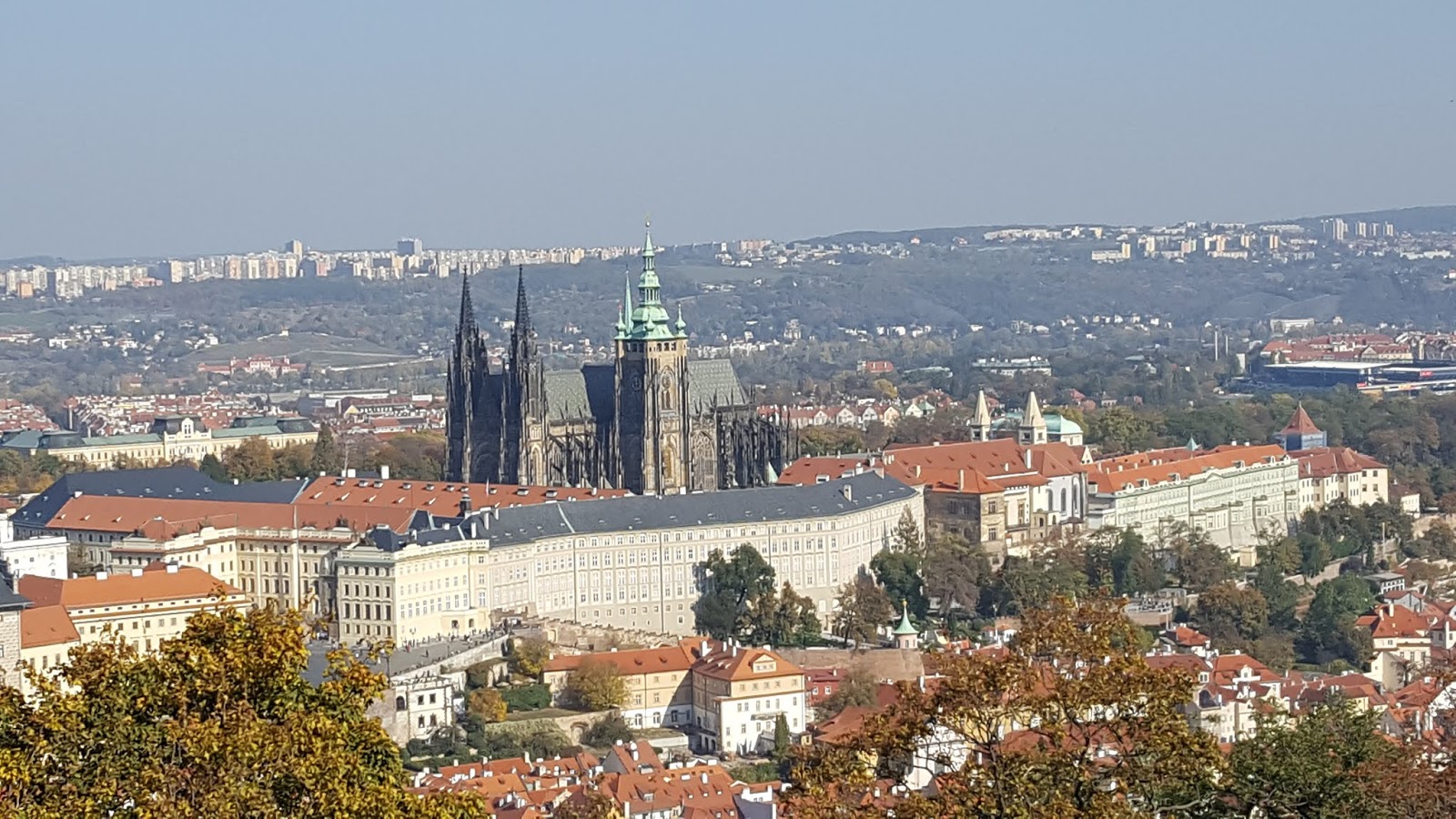
Drinking wine was not the only thing we did in Prague. We also did quite a bit of sight-seeing during our time there. Prague is a beautiful old city that almost entirely escaped bombing during WWII -- a single attack by American bombers that was supposed hit Dresden, Germany (only 70 miles away), killed over 700 and destroyed over 100 buildings. But compared to other cities in Eastern Europe, the history of Prague is easily seen in its old, well-preserved buildings, including the Prague Castle:
We climbed to the highest point in Prague and then up the Petrin Lookout Tower, which resembles the Eiffel Tower, only much smaller:
From there, the views were fantastic:
We also learned a lot about the history of Czechslovakia and the Czech Republic. After the fall of Communism, on January 1, 1993, Czechslovakia peacefully split into two countries: the Czech Republic and Slovakia. The non-violent split is also known as the Velvet Revolution. The gardens at the Wallenstein Palace, now the site of the Czech Senate, are beautiful with much greenery, fountains and a surprising number of statues that were copies because the originals were taken by Sweden at the end of the 30 Years War (1648) and apparently never returned.
We also, of course, ate really well. We definitely took advantage of being in a bigger city, eating decent Asian and Mexican food. We also found a really good deli -- all the meat imported from Argentina -- and I already regret not going back for a second pastrami sandwich with good mustard and, of course, sauerkraut. We also tried some local dishes although we drew the line at pigs' knees, which is apparently a local delicacy.

More about Prague still to come...

Hasta luego,

Jeff and Shana

Wednesday, December 5, 2018

Czech WIne

We were a bit surprised to learn that the Czech Republic makes well-regarded wines. Although, obviously better-known for its beer, wine grapes have been grown in the area since the Romans did so in the 2nd century C.E. Although the communists essentially destroyed the industry after taking control post-WWII, the industry has come back strong in the almost 30 years since the fall of the Soviet Union.

Most of the grapes are grown in Southern Moravia in the very south of the country, which is not near Prague. But, of course, where there is wine, there is wine tourism. The first thing we found when planning our trip was a small evening wine cruise along the Vltava River, which flows through the center of Prague. Taking this hour-long cruise on our first night allowed us to sample some Czech wine and see the city from the river at night. It was beautiful.

Here is the Prague Castle as seen from the river:
This shot is from a small area of canals that is known as the Venice of Prague:
We also got a bit of the history of the city including, of course, the Charles Bridge, whose construction began in 1537:
As you can see, the views were amazing and we were able to maneuver through and under some tight spots in the little boat:
Oh, and the wine was really good. We tried a number of wines that were made with Czech-specific grapes we had never heard of, but also tried a very good pinot noir. After this introduction, we made sure to try more wine at a number of the wine bars around the city, and continued to be favorably impressed. Just one of the many great things we experienced in Prague. More about our adventures there soon.

Hasta Pronto,

Jeff and Shana

Friday, November 30, 2018

Cinque Terre - Part 2

In one day (Oct 9), we visited all five of the towns of Cinque Terre. We woke up in Monterosso (the northernmost Cinque) and went south from there. Each of the Cinque has its own character and personality. Monterosso is the largest of them and is also the flattest. It has an “old town,” a “new town,” and a large beach. 

Our first stop was Vernazza, a 3.5 km hike from Monterosso. The trail to Vernazza was tough but beautiful. Along the way, we passed various vineyards and citrus orchards. Here are the views as we approached the town:
Vernazza is quite a jewel, with a small amphitheater-shaped harbor that includes a beautiful medieval church:
We had “second breakfast” in Vernazza at a lovely café, where Jeff had an interesting encounter while paying the bill. The owner asked where he was from, and when he replied the US, the owner guessed Seattle! What are the chances?!? When Jeff confirmed but stated that we now live in Spain, and specifically San Sebastian, the owner replied that his wife was from the area!! It is a very small world!
Vernazza had a Roman installation and the remains of the watchtower and castello are still visible. Here is the view (looking north towards Monterosso) as we walked out of town and headed south to Corniglia:
Corniglia sits 100 meters above the sea and is the only town that cannot be accessed by boat. It is the smallest of the Cinque. The 4 km trail from Vernazza provides stunning views of Corniglia as you approach it:
Although you can technically walk between all the villages, the main trails between Corniglia, Manarola, and Riomaggiore have been closed for some time due to storm damage. And, although we were initially disappointed that we would not be able to walk the entire trail, by the time we reached Corniglia, the terrain had taken its toll and we were happy that we would be taking the train between the next two Cinque.  We celebrated this fact with a lovely lunch:
To leave Corniglia, we headed to the train station, which is some 400 steps down to the shoreline. This is why it’s better to leave Corniglia by train as opposed to arrive that way. Our next stop, Manarola, sits among terraced vineyards and has a tiny port. While we didn’t walk there, we were able to walk the perimeter of the town among the vineyards. In my opinion, Manarola is the prettiest of the Cinque – perhaps you’ll agree:


At this point, we were starting to tire, but we had one more stop – Riomaggiore – before we would take the train back to Monterosso. We pushed through and while Riomaggiore is charming, we had pretty much reached our saturation level. I almost forgot to take a photo, but I did snap one:
We returned by train to Monterosso to shower and had a lovely dinner. The restaurants in Monterosso were quite good and we shared stories and great conversation with several lovely American couples of all ages during our stay. Nearly all the restaurants have outdoor seating and there is something about dining al fresco that sparks conversation among tables. The wine probably helps too!
Our fourth and final day in Cinque Terre we relaxed, ate amazing pizza, went to the beach, and had one final fantastic fresh fish dinner. There is nothing like a swim in the Ligurian sea to cure what ails you after so much hiking! We were sad to leave such an outstanding destination. But off we went to Bologna for 2 nights before heading to our final stop of this 3-week trip . . . Prague.
Ciao,
Shana & Jeff 

Monday, November 26, 2018

Cinque Terre - Part 1

We went from one group of coastal, cliff-side villages on the Amalfi Coast to another, Cinque Terre, on the Ligurian (northwest) coast. The name, Cinque Terre means "five lands" and it includes five villages that are linked by walking trails, by train, and by boat:  Monterosso al Mare, Vernazza, Corniglia, Manarola, and Riomaggiore. We chose Monterosso as our base and it was a great choice.
It is difficult to choose photos to display here. The beauty of the coastline and the character of each village are unparalleled. It is obvious why the Cinque Terre are a very popular destination. We were fortunate to have 5 nights there to explore.
Our first hike went north from Monterosso to Levanto. This is an 8 km hike that includes amazing views of all of the Cinque, the town of Levanto, and the ruins of the Chapel of St. Antonio. It took us about 3 hours to complete this challenging trail. All of the trails involve a lot of climbing and descending, because, well, what goes up must come down. We were fortunate to have a fairly cloudy day to keep us from overheating. Also, by visiting in October, we avoided the worst of the crowds.
Here is the view looking back to Monterrosso and the other Cinque:
Along the way we encountered some inuksuk-like rock piles created by fellow hikers:
And here is the view towards Levanto as we approached the town:
When we arrived in Levanto we had a lovely lunch – we had definitely earned the bread and pasta! We quickly learned that the fish is super fresh and the local white wines are really crisp in Cinque Terre. Perfect after a long hike.
The next day we took the sanctuary trail in Monterrosso. Each town has a sanctuary, an area where the village inhabitants could seek safety from any threats, including pirates! Just climb up the hill and you’ll encounter a protective church with amazing views. Here are the views down to Monterosso:
Here’s the trail marker at the top (you can see from the many options how extensive the trail network is:
We made our way back down the trail – down is always easier, albeit a bit rough on the knees, and spent our afternoon at the local winery, Buranco, where we enjoyed a lovely tasting with very tasty snacks. I was happy to meet the winery’s dog, whose name we can’t recall. He was super friendly, especially while we had food. I am always happy to get my puppy-fix.
The wines were lovely and the atmosphere perfect for relaxation. We met a fun group of three couples sharing an adventure through Italy. They were our parents’ age and highly entertaining. 
Here’s the view from near the winery:
After two days, we were loving Cinque Terre and we had not even been to any of the other Cinque yet!
Ciao,
Shana & Jeff

Friday, November 23, 2018

Naples - Go for the Best Pizza in the World (seriously)

There is no truly polite way to put this. Naples, the city, is...gritty. It is noisy and not particularly clean; people are constantly out on the streets, and traffic is crazy. We felt as if we were taking our lives in our hands every time we left our hotel. So, why would we recommend visiting Naples. Well, the city is the birthplace of pizza and it is amazing (and cheap).

When we arrived in Italy, we spent one night in Naples before heading to meet our friends Matt and Amy in Sorrento the next day. We checked into our small, out-of-the-way hotel and asked the owner where to go for dinner. He recommended a pizza place literally 100 feet from the hotel. We were a bit skeptical because it seemed unlikely that a good pizza place was so close, but we were hungry and tired from a long day of travel, so we went there. The place was packed, with literally dozens of people (locals) waiting for take-out. That was a good sign. We actually got a table quickly, and noticed how cheap the pizzas were on the menu - 5 Euros for a Margherita, and almost every pizza was below 10 Euros. We ordered two pizzas and wine (the wine was cheap and bad...enough said), and proceeded to wait about half-an-hour for our pizzas because the pizza oven was so backed up with all the people waiting for to-go orders. But, when the pizzas came, they were worth the wait! Without a doubt the best pizza we have ever had. And, our whole meal was less than 20 Euros.

After spending time on the Amalfi Coast, we returned to Naples for a couple of days to see the city. And, although we warmed up to it a bit, it certainly does not make our list of favorite cities to visit. There is not a huge amount for a tourist to do there. Although there is an old fort (we did not go in):
The National Archaeological Museum is worthy of a visit, after having visited Pompeii because many items found in Pompeii are in the museum and not at the site. And, of course, you can always visit a church or two. This one had a wedding going on the day we were there:
The one site we did visit was the Teatro di San Carlo, the Naples Opera House, which is the oldest still-operating opera venue in the world - founded in 1737. While not as grand as the Opera House in Paris, it was still beautiful, with an impressive painted ceiling:
But, the best part of our visit was that there was a rehearsal going on for an upcoming show and we got to watch and listen for several minutes, and hear the fantastic acoustics of the theater. The acoustics were so amazing that we could even hear the people on stage talking when the director would stop the rehearsal and give directions. And, we were not exactly close:
We really enjoyed our visit to the Teatro di San Carlo.

As usual, the rest of our best experiences in Naples involved food. In addition to returning to the pizza place near our hotel (this time we drank beer), we had a wonderful dinner at a restaurant that was off the beaten track, but was relatively close to our hotel, and again filled with locals. We started talking to the trio next to us (who were speaking English) and they turned out to be on a business dinner: a father who owned the business, the early-20's son who will one day take over, and an American woman who was in Italy as a representative of a customer. In addition to learning that we had chosen a very good, local restaurant, we also talked about Italian wine and they shared their second bottle with us. Even the waiter got in on the fun, coming over to refill our glasses with their wine! A really great experience.

I don't know that we would highly recommend an extended visit to Naples, but go for the pizza and as a jumping-off point to Pompeii and the Amalfi Coast.

Ciao,

Jeff and Shana