Sunday, January 15, 2023

Hoi An -- City of Lanterns

Hoi An is a beautiful old city on the banks of the Thu Bon River. It was the most important trading port in central Vietnam in the 15th-18th centuries with large influence from Japanese and Chinese traders. Around the end of the 18th century, Hoi An lost its status as a trading port due to the silting up of the river. As a result, the city became a backwater, untouched by the next several hundred years of Vietnam history, including the American War. Therefore, the old town remains an exceptional example of an old Southeast Asian trading port.

The city is particularly well known for its covered Japanese Bridge, which dates from the 16th-17th century.

No, we do not know the couple in traditional Vietnamese dress in the boat posing for (wedding?) photos, but we thought they created a great shot of the bridge. We saw a lot of people wearing traditional clothes (including matching outfits) in Hoi An, which is known for its tailors, and where many tourists have clothes made at very reasonable prices. We indulged in this tradition as well, getting a few items made. It was a fun experience and we are very pleased with the end product.

Hoi An is also famous for its colorful silk and paper lanterns, which are everywhere in the old part of the city, including on boats that cruise the river at night. Many people told us that Hoi An was their favorite place in Vietnam, and the romantic vision created by these lanterns is likely why.
We took a tour to My (pronounced me-ee) Son Sanctuary, which was constructed as a (Hindu) temple complex by the Cham people over 1000 years (4th-14th century). Unfortunately, after significant renovation work in the 1930's and 1940's, the US bombed this area in 1969 leaving many buildings destroyed. Also, many of the best statues have been removed to museums, including the one we visited in Da Nang. Nonetheless, it is still an impressive site.
One of the coolest things we learned on this tour is that to this day, archeologists and scientists cannot figure out what the Cham people used between their bricks to prevent  moisture from getting between them (very important in the wet Vietnam climate). Despite the passage of so many centuries, no one can explain how they built some of their temples.

A second stop on our tour gave us the opportunity to see rice paper being made, which was great since we have eaten so much of it while we have been here. We even got a chance to try it ourselves.
Note how tall Shana is compared to our diminutive hostess -- the Vietnamese are definitely not a tall people. What they lack in stature they make up for in kindness.

Another great outing was to the Hoi An Silk Village, where they make silk the old way.  On our walk there Google Maps sent us where no roads exist yet, and we ran into this fellow, despite still being in the city.
Once we found our way to our destination, we took a tour to learn about the silk making process starting from the silk worms.
The white things in the picture above are silk worms, which we watched being added by hand to this board, while the yellow things are the cocoons of silk worms that were previously placed. Next, we saw the process by which they extract the silk fibers, which requires boiling the cocoon.
This looks like an incredibly tedious process, but it was amazing to see the silk fibers being pulled directly from the cocoons.

Finally, we saw a woman weaving on a very old-fashion type loom (yes, that silk ribbon in the photo on the right is what she is making).This loom requires that she reset the threads repeatedly using the weighted strings and a foot pedal on her right so that the pattern is correctly repeated through the cloth. 
Perhaps the best thing we did in Hoi An was have two 90-minute massages in the five days we were there. While this would be an extremely expensive luxury in the US or Europe, in Hoi An it cost about $20 for each massage. They even give you tea when you arrive and before you leave. It was fantastic!
We really liked Hoi An. The only thing that took away from it was the constant attempt of people to sell you things -- food, boat rides, pop-up greeting cards, small toys, etc., etc. Shana calls this "chicle, chicle" after the children trying to sell tourists Chiclets gum in Tiajuana. It was a constant barrage that took away from Hoi An's charm. Vietnam may have a communist government, but the people have embraced capitalism in a big way, espeically in Hoi An.

Next, the Imperial Capital of Vietnam's last Emporers, Hue.

Hasta pronto,

Jeff and Shana


Tuesday, January 10, 2023

Da Nang

The city of Da Nang is in Central Vietnam on the Han River, separated from the ocean by a narrow penninsula. We stayed on the beach side of the penninsula, with a good view of the East Vietnamese Sea (or South China Sea depending on who you are talking to). Da Nang was the first place in Vietnam that US troops landed, with marines coming ashore there in 1965 on what became known as China Beach (later the title of a brief, 1988-1991, war drama TV series starring Dana Delany -- not that we ever saw it).

We spent five days in Da Nang, and because most of the things worth seeing were nearby, were able to avoid doing any tours. Instead we visited the Museum of Cham Sculpture, Marble Mountain and the Linh Ung Pagoda on our own by taxi, which is unusual for us, but unfortunately public transport is virtually non-existent in Da Nang. We never even saw a public bus, although the internet says they exist.

The Museum of Cham Sculpture is dedicated to the best of the sculptures discovered at several locations, including My Son, the capital of the Cham (or Champa) people, who ruled central Vietnam between the 5th and 15th centuries. The museum was extremely well organized, and did a good job of explaining the meaning of the sculptures, including the Cham deities, fertility symbols and decorative symbols taken from both Hinduism and Buddhism, which had great influence on the Cham culture.
Another common theme was the Astara dancers, who are shown in bent postures in order to suggest movement. There are many impressive examples in the museum. Most of the sculptures are sandstone.
We walked around Da Nang, which was a lot like walking around other Vietnamese cities: difficult to maneuver among broken sidewalks and parked scooters while trying to avoid cars and moving scooters. Not for the faint of heart. In the city we visited the Chua Phap Lam Buddhist Temple, along with the city's cathedral. Note the banner honoring Pope Benedict, who had died only days before.
Da Nang has a number of very cool bridges, but none is cooler than the Dragon Bridge. We did not get to see the dragon breathe fire as it does on weekend nights, but it is still impressive. As you can see, we had grey and rainy weather the whole time we were in Da Nang.
One day, we went to the Marble Mountains. Many years ago, these five mountains were mined for their marble and limestone. Now, they provide a series of caves and Buddhist and Hindu religious sites that you can explore with hundreds of your closest friends.
The main cave (pictured above), was the first time that we felt overwhelmed by tourists in Vietnam (really this whole trip so far), because many tours stop there. After that, we were able to explore other caves and religious sites with fewer people around.
We also climbed to the top of the main mountain where the views were spectacular.
After exploring the Marble Mountains, we had lunch at a truly local place that had exactly two items on its menu: noodles and pho. We shared one of each, and both were delicious. Total cost: $7. This area of Vietnam is known for producing sculpture, which we observed in the number of nearby shops selling statues, mostly of Buddha. Seriously, you could buy statues ranging from small to giant (15-20 foot tall Buddhas were common). Shana liked these Buddhas that were only slighty larger than life-size.
Another day, we caught a cab out to the Linh Ung Pagoda, which is in a beautiful location right on the water, and against the mountains of the Son Tra Penninsula. It is known for two things: monkeys and the 200-foot tall "Lady Buddha" statue. We were fortunate to see a lot of monkeys who are not always about, including one eating from a banana peel he had found. Shana was thrilled since monkeys had eluded us in Singapore, despite all the signs warning us not to feed the no-show monkeys.
The Buddha statue was beautiful (and imposing), and there were many other picturesque locations at the site.
Overall, we enjoyed our time in Da Nang, despite the consistently overcast weather that several times turned into serious downpours.

Next, on to Hoi An, with more rain in the forecast. The wet season is supposed to end by December, but so far, not this year.

Hasta pronto,

Jeff and Shana


Saturday, January 7, 2023

Da Lat – City of Eternal Spring

From Saigon we flew to Da Lat, a city in the Central Highlands. What a refreshing change of scenery. Da Lat is situated at about 5,000 feet above sea level and its average daytime temperature is about 70 F all year around – leading to its nickname, City of Eternal Spring. After 90 degrees with high humidity, this felt like heaven. The French developed the city as a resort town and even built an artificial lake that is in the center.

We had two days in Da Lat and it was not hard to fill them, especially with a flower festival underway. There were flowers nearly everywhere.
We made the obligatory stop at Crazy House Da Lat – a wacky house built by someone with Gaudi envy. The "house" is a behemoth that towers over the neighborhood and is a labyrinth of bridges and tunnels with views of the city below.
We particularly liked the inside of the main building, which was painted to look as if you were under water.
It was an interesting experience that made you feel like you were in a drug-induced dream.

We also took the time to walk the entire perimeter of the city's small lake (about seven kilometers around) enjoying the scenery and flower displays.
We then had a mellow New Year's Eve – a pho dinner that cost all of $6.
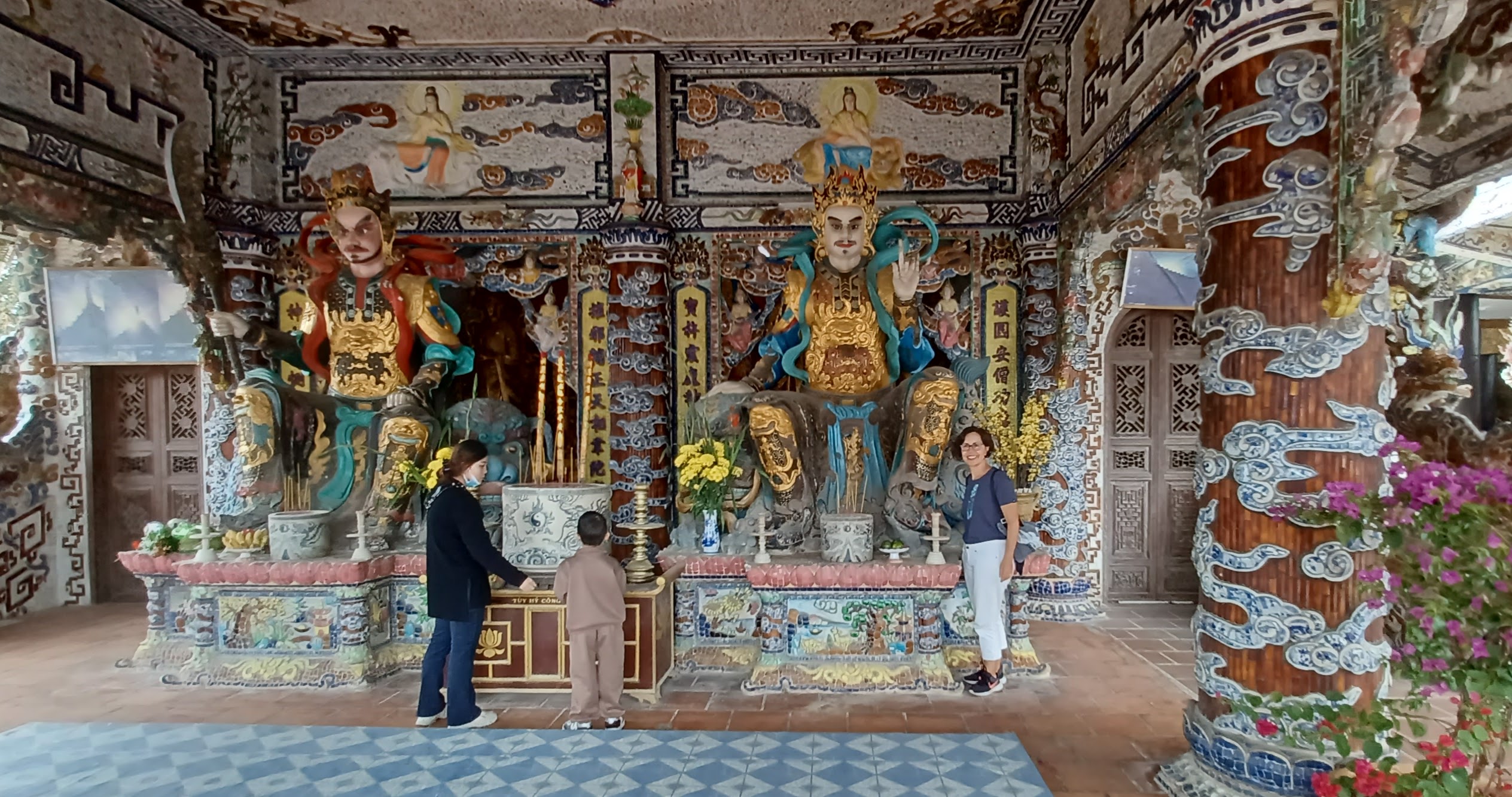
On New Year's Day, we took a restored vintage train from Da Lat to Trai Mat, about seven kilometers away, to visit the Linh Phuoc Pagoda. While the train ride wasn't the most scenic, the pagoda was a highly colorful place.
Da Lat is the center of an agricultural region, and you could see the fertile countryside from the pagoda.
All in all, Da Lat was a great contrast with Saigon. Perhaps each of our stops in Vietnam will be more diverse than the previous one.

On to Danang.

Shana and Jeff