Saturday, December 28, 2019

Foie y Vino

After returning to San Sebastian on December 11, we had tickets for December 13 to go to another event at the Basque Culinary Center. While the last event we attended there was a tasting of ham and wine this one was advertised as Mas Que Foie y Vino, more than foie gras and wine, and it was that exactly.

There were about 18 of us in a room at the BCC, with presenters from a maker of duck products, and a Spanish winery. First, we learned a bit about the process of raising and preparing the ducks for making foie, along with a video that showed the process of dividing a duck for sale of its various parts. While that may sound daunting, it was very interesting and not bloody at all because the ducks are actually killed by stunning them and then draining their blood, making the division process quite clean. Then, it was time to taste.

We started with a plate of three types of cold foie with a taste of white tempranillo, which was new to us as tempranillo is usually a red grape and we did not know that a white version exists.
Not very pretty to look at, but extremely tasty with textures ranging from pate-like on the left, to more what we think of as foie on the right.

Next was a plate of cooked foie, which is often served in the Basque region as foie a la plancha, with a very nice red wine.
Third, and this was a surprise, was a duck breast with another red. We were surprised because we thought the event was only foie, and with the duck breast it was turning into a full meal:
Yes, the meat may look raw, but that is how they serve meat in Spain, whether it is beef or duck.

The coup-de-grace was another thing that we did not know existed -- foie bon-bons. Essentially they were foie covered with sweet things including chocolate. Paired with a Gran Reserva red, they were one of the best things I have ever eaten:
We definitely need to find more of those.

Finally, as if we had not had enough to eat already (spoiler alert: we had) there was a bit of duck ham to try:
 Without a doubt, we had fun at the event:
And, we even took home a few parting gifts of foie (not the fake duck) after talking to the representative of the duck company.
Not surprisingly, we will continue to look for more fun events to try at the Basque Culinary Center.

Que tengais un buen nochevieja (have a happy new year)!

Jeff and Shana

Wednesday, December 18, 2019

California Dreaming

We recently enjoyed a visit to Northern California for Thanksgiving and to Southern California the week after. It is always good to see family and friends – in person. Skype and WhatsApp video calls are great, but they are still no substitute for actual hugs from the people you love. We enjoyed catching up with everyone and learning, well confirming, that everyone’s family is crazy in some way or another.
This was our first trip to the US since December 2017! And to be honest, our friends and family remain the main draw. Ok, them and Trader Joe’s. We don’t miss driving at all. Jeff probably drove more during our two-week visit than he has in two years. We didn’t encounter too much traffic by planning our travels well, but there are just so many cars in CA!! We brought some much-needed rain with us from San Sebastian, so we didn’t enjoy as much sunshine or time outdoors as we would have liked. But CA always needs rain, so – you’re welcome. We did enjoy eating Mexican food a lot. And we tried not to be too overwhelmed by how expensive life in CA is in comparison with San Sebastian. The prices on good running shoes and peanut butter, among other things, are better in the US though.
We were supposed to stop in Paris on our way home to see the special Leonardo DaVinci exhibit at the Louvre, but due to the transport strikes in France, we didn’t want to take any chances on getting stuck if our train back was cancelled. So, we changed our flight and flew back from London to Bilbao instead. We were sorry to miss the exhibit, but happy to be home.
Another hearty thanks to all those who hosted us during our visit. Your hospitality was sensational.
We’re back to the routine and ready for the holiday season here, which starts December 21 and lasts officially through January 6, with the added bonus of Tamborrada on January 20.
Hasta pronto,
Shana & Jeff 

Wednesday, December 4, 2019

Local Happenings

As we enjoy our trip to California for Thanksgiving, we wanted to share a couple of recent events of interest (at least to us) in San Sebastian.

First, there are a number of bridges in San Sebastian that cross the Urumea River, which runs through the city. Some are simply utilitarian, but the Maria Christina Bridge is considered the most elegant structure crossing the river. Modeled on the Alexander III Bridge in Paris, it was built in only nine months in 1904, and opened in 1905. Each corner of the bridge contains an obelisk with decorative sculptures.

We have always noted the elegance of the bridge and its sculptures, but we had no idea how beautiful it actually is until the city undertook the process of cleaning the obelisks and sculptures over the past several months. The results are impressive as the before-and-after pictures below show:
We expect the cleaning of all four of these edifices to be completed in the next few weeks, which will provide an even better photo opportunity for the many tourists this summer.

Second, while you may know that San Sebastian is a destination for serious surfers, especially in the winter, you may not have realized that storms often bring significant swells into the Urumea. While we often see surfers at the confluence of the river and the sea, this guy is more than  half-a-mile from the ocean at the fourth bridge (the one closest to our apartment):
Finally, this being San Sebastian, there has to be something about food. Each year for many years, the local beer company called Keller has sponsored a pintxos event in which bars participate by offering a special pintxo and a Keller beer for a discounted price during a limited period. Apparently, last year (although we do not remember this), they decided to do a second such event specifically for bocatas (basically sub sandwiches). This year, we came across one of the signs for the bocata event, and were very excited because the sandwiches offered by the various bars looked great, and at 7 Euros for a sandwich and a beer, the price was very good.

Although we wanted to try about 20 of the 30 or so options, we only had time to try two. While they were both good, the winner for us was definitely the bocata from Rita (whose restaurant we have eaten at several times), which included lamb meatballs and a green curry sauce. Yum!
Happy Thanksgiving,

Jeff and Shana

Saturday, November 30, 2019

Art in Madrid

As our long-time readers know, we spend a lot of time visiting art museums when we travel, and this was true on our recent trip to Austria and Madrid. 
We have had the good fortune of going to the Prado National Museum several times now and it has become a favorite place. And each visit we experience something different. Our most recent visit was exceptional for a few reasons. First, we enjoyed visiting with Karen and Cathy Ostiller. We didn’t know Karen was an art history major at UCLA, which turned out to be a bonus for us. Her outlook and knowledge of the various artworks really added to our experience. Jeff particularly enjoyed playing “name that Saint.” Second, there was a special exhibit, A Tale of Two Women Painters: Sofonisba Anguissola and Lavinia Fontana, which was remarkable. As you walk through the Prado, or any other major art museum, you may not think about the fact that the vast majority of the artwork is by male artists. This exhibit brought together key works by these two women painters from the second half of the 16th century. They achieved fame and renown among their contemporaries, but their recognition became obscured over time. None of us had ever heard of either of them, but their works were just as outstanding as the works by the Prado’s masters. Finally, we encountered a “copista” at work, which was a phenomenon I had been hoping to see.
Last month I encountered a feature in the Diario Vasco about the “copistas” – copyists – in the Prado. These are artists who are permitted to copy the artwork in the Prado while in the museum. They set up an easel and paint while surrounded by the masters, and by the museum’s patrons. It’s not new, in the past many artists did this as part of their training, including Picasso. The DV article highlighted the oldest and newest copistas – an 80-year old artist who has been making his living painting copies for 50 years, and a recently retired professor who just started more for fun. There is a process to becoming a “copista,” which includes completing an application, submitting a portfolio of work, and letters of recommendation. And there are rules, including limitations on the size of a copy, prohibitions on copying certain works, and advising the nearest security guard when leaving. The article was so interesting that I planned to do (and did) my Spanish class presentation about it. Now I just needed to find one and, thanks to Karen we did.
She wanted to see Caravaggio’s David with the Head of Goliath, which I wrongly assumed was in Vienna in the special Caravaggio and Bernini exhibit we had seen at the Kunst Historisches Museum the week before. It turns out that Caravaggio painted David with Goliath more than once. The one in the Prado is from 1600, the one we saw in Vienna is from 1607, and there is a third in Rome from 1610. If we hadn’t gone to see the painting that I assumed wasn’t there, we wouldn’t have found the copista:
Isn’t it amazing? The original and copy are nearly identical – yet based on the Prado’s rules, we know the copy is not the same size. But the best part was getting the chance to talk to the copista and ask him our questions, in Spanish, of course. At first, I didn’t want to interrupt his work, but the security guard started talking to him, so I jumped right into the conversation. We learned he had been working on the copy for more than a month, for more than four hours a day, and the painting was a paid commission. He showed us photos of x-rays done of the original, which demonstrated that Goliath’s head was originally portrayed more violently than in the final – perhaps because the original patron didn’t like how it was first done. He was fascinated to hear about the article I had read. It really was the “cherry on top” of a marvelous day at the Prado.
The next day, we headed to the Thyssen-Bornemisza Museum, which is only the third most famous art museum in the city (after the Prado and Reina Sofia). The collection of over 1600 works of art was originally the private collection of a German Baron. After marrying a former Miss Spain in 1985 and introducing her to art collecting, she convinced him to move the bulk of their collection to Spain. Eventually, the government of Spain bought the entirety of the Baron's collection, while 429 of his wife's works have been on loan to the museum since 1999. The travel writer Rick Steves describes the museum as housing "major works by minor artists and minor works by major artists". Overall, it is an enjoyable museum, but does not have the cache of the Prado or Reina Sofia.

We visited the Thyssen on this trip to see a special exhibition called The Impressionists and Photography. Since we both like the impressionists, we though we would enjoy the exhibit, and we were right. In addition to simply enjoying the art, it was really interesting to the interaction between the photography of the same time period and the art. In many cases, the museum had photographs hanging next to a painting representing the same place. We really got a great perspective on how the impressionists represented these locations, and even people. And, again, we enjoyed having Karen to provide greater insight into the art than we usually have at such exhibits.

Our next big art adventure will be at the special da Vinci exhibition at the Louvre, which we will be visiting in December on our return from visiting family and friends in California. We are looking forward to this exhibition, which celebrates the 500th anniversary of his death and apparently took 10 years to bring to fruition.

Hasta luego,
Shana & Jeff

Friday, November 22, 2019

Making Apple Strudel in Salzburg

We generally aren’t organized tour people but occasionally we find one that piques our interest. In Salzburg it was the opportunity to learn to make apple strudel. I’m not much of a baker, so this seemed like a good way to experience the local pastry scene. Upon our arrival in Salzburg, we headed to the Edelweiss Cooking School. What a great afternoon! As you’ll see from the photos, even Jeff loved it.
First, we learned to make apple strudel, which turns out not to be that hard. We would even be willing to try it on our own. Here we are stretching the dough, seasoning the apple/raisin mix with sugar and cinnamon, filling the pastry, rolling it up, and with the finished product – before and after baking.
Second, we learned to make Salzburger Nockerl soufflé, a local specialty that is meant to represent the three hills that surround the city. Essentially it is a sweet merengue dessert. Here is our before and after.
While our creations baked, we enjoyed a hot bowl of goulash and then savored both desserts. Everything was delicious. We were super full after all of it! Yet we had a 6 p.m. dinner reservation to enjoy a small Columbian restaurant that we didn’t want to cancel. So, we spent the next three hours walking through the city trying to work up an appetite, which ended up working. Good thing too, we were glad we didn’t pass up a chance to eat at Bistro Marquez.
The added bonus was that our leftover strudel was almost as good the next morning with coffee. As always, it’s all about the food with us.
Bon Appetit!
Shana & Jeff

Tuesday, November 19, 2019

Charming Salzburg

We took the two-and-a-half hour train from Vienna to Salzburg, and were pleased to discover that Austrian trains have “family-friendly” cars and “quiet” cars. You can guess which one we selected. Although we enjoyed Vienna, we found it a bit sterile. Maybe it was all the grand, elegant palaces and former palaces, or the cold that set in during our visit. Whatever it was, Salzburg was quite the opposite. Perhaps because of its much smaller size and the way it is embraced by the nature around it. We were immediately impressed by the change of scenery. The temperatures didn’t improve much though.
We hiked up to the Hohensalzurg Fortress (above on the hill), which overlooks the city from the top of Mount Festungsberg. It was built in 1077 and expanded over the centuries. It is the largest fully preserved castle-fortress in Europe and the museum within provides a bit of information about Salzburg’s history as an independent region. We were amused by the museum’s explanations, which we speculated were written by a 4th grader. Regardless, we learned a good amount, including that Salzburg, like Dubrovnik, was wealthy in part due to the salt trade. Here are a couple of photos of the fortress from the very top, as well as the view of Salzburg from there:
Salzburg is known as the home of the Von Trapp family and the location of the Sound of Music. We did not take any tours centered on the movie – Jeff might have jumped in the river after only 10 minutes of random people singing, but we did enjoy a few of the sites, including the Schloss Mirabell gardens.
We missed out on a few museums because our visit coincided with All Saints’ Day – Nov. 1. But we were happy to be outside in the brisk, autumnal weather. Our last day we stumbled upon an amazing local market where we purchased all the fixings for a picnic for the train ride back to Vienna. And we learned that schmuck does not only mean “idiot,” which is Yiddish, but it means jewelry in German.
We’d recommend a visit to Salzburg if you get the chance. Unfortunately, with 8 million visitors a year, you will likely be sharing this small town of only 150,000 people with lots of other tourists.
Auf wiedersehen,
Shana & Jeff

Saturday, November 16, 2019

Our Vienna Visit

It’s been raining every day since we returned from our trip to Vienna, Salzburg and Madrid. And when it rains here, it tends to pour. None of that Seattle drizzly stuff. Although you would think that being cooped up inside would be conducive to writing a few blog posts, we’ve been lazy. So here goes – Vienna.
Vienna is known as one of the most cosmopolitan and livable cities in Europe. It had been on our list for a while, and it jumped up the list after Jeff’s sister’s family spent a month there this summer. When we realized that we could head somewhere from Madrid, where we would be to meet up with dear LA friends, Cathy and Karen Ostiller, Vienna seemed like the obvious choice. We’re glad we finally made it there.
We had one beautiful, sunny day, which we spent at Schonbrunn Palace – the Hofburg dynasty’s summer home. The audio-guided tour through the palace (which we listened to in Spanish, of course) was interesting enough, but the hordes of tourists became a bit overwhelming, so we headed out to enjoy the gardens, which were lovely.
In the end, ornate palaces only make us think of Mel Brooks saying, “It’s good to be the King,” and of income inequality. So, we skipped the Hofburg palace in the city. We did however enjoy the morning exercise at the Spanish Riding School, which in on the palace grounds. The school has a 450-year history and is the home of the world-famous Lipizzaner stallions. The morning exercise is an opportunity to watch the horses rehearse, and we got lucky and saw two perform the pas-de-deux from the actual show. The performance hall is quite ornate.
As usual, we ate our way through the city, trying kasekrainer (a cheesy sausage), sacher torte, schnitzel, and the coffee culture. A cup of coffee is expensive in Vienna! We also saw a classical music concert in St. Peter’s church. To this day, there is more live music performed in Vienna, especially classical music, than any other city in Europe.
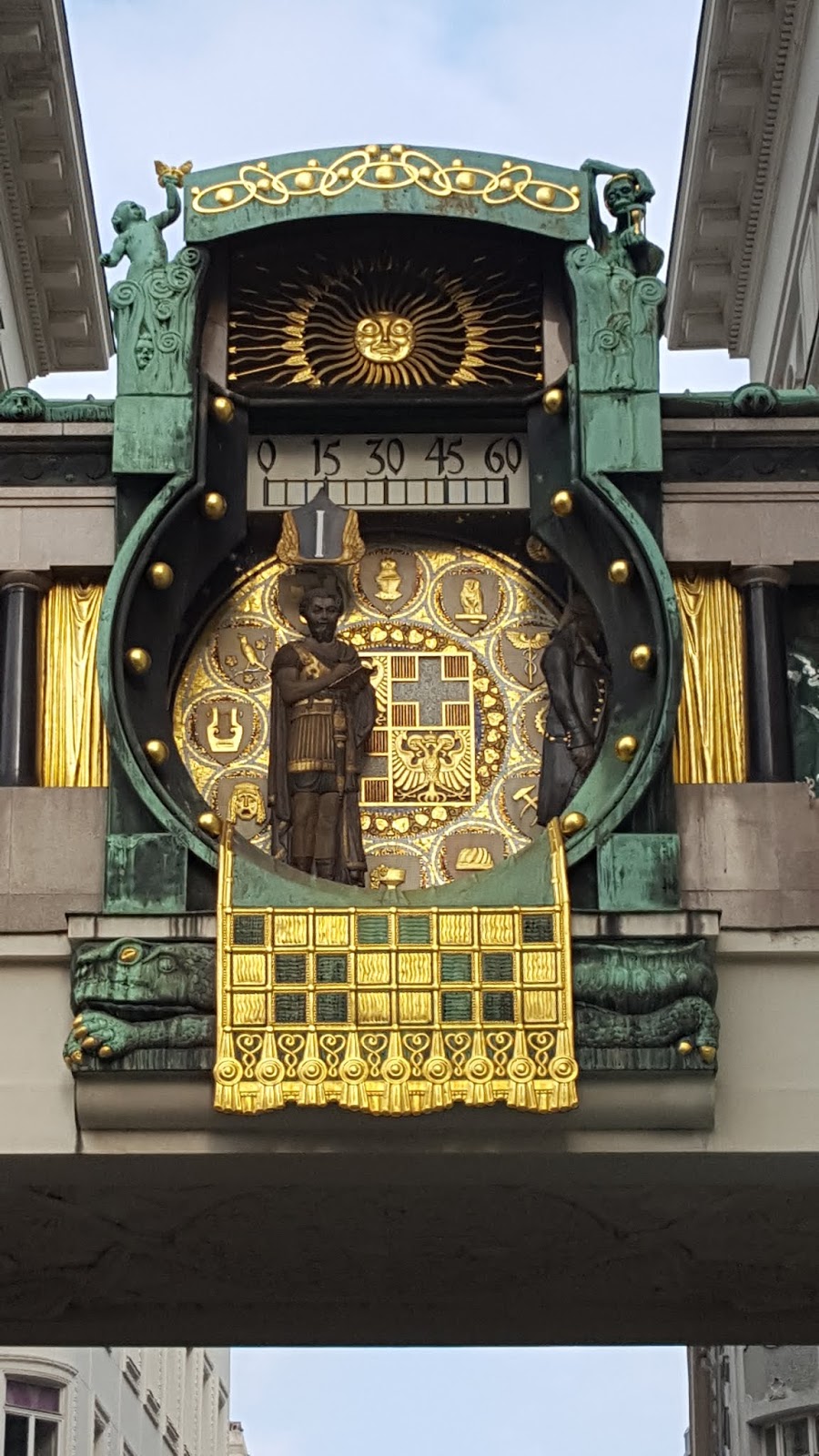
We found the Anker clock, built in 1911-1914, which forms a bridge between the two parts of the Anker Insurance building. In the course of 12 hours, twelve historical figures or pairs of figures move across the bridge (notice the numbers above their heads, which marks the hour). We saw two of them on our way to and from the Archives of the Austrian Resistance.
Vienna has no shortage of royal sites, churches and museums. Certainly more than you can take in over a five-day visit. We enjoyed the Batliner collection of Impressionist and Modernist art at the Albertina museum, and I even went back at the end of the day to take in a special Durer exhibit after the daytime crowds had cleared out.

We appreciated the walkability of the city, as well as the well-designed metro system. We only wish the weather had held up. It turned cold and we didn’t get to enjoy the city’s parks as much as we would have liked.
Auf wiedersehen,
Shana & Jeff