Thursday, January 24, 2019

La Tamborrada 2019

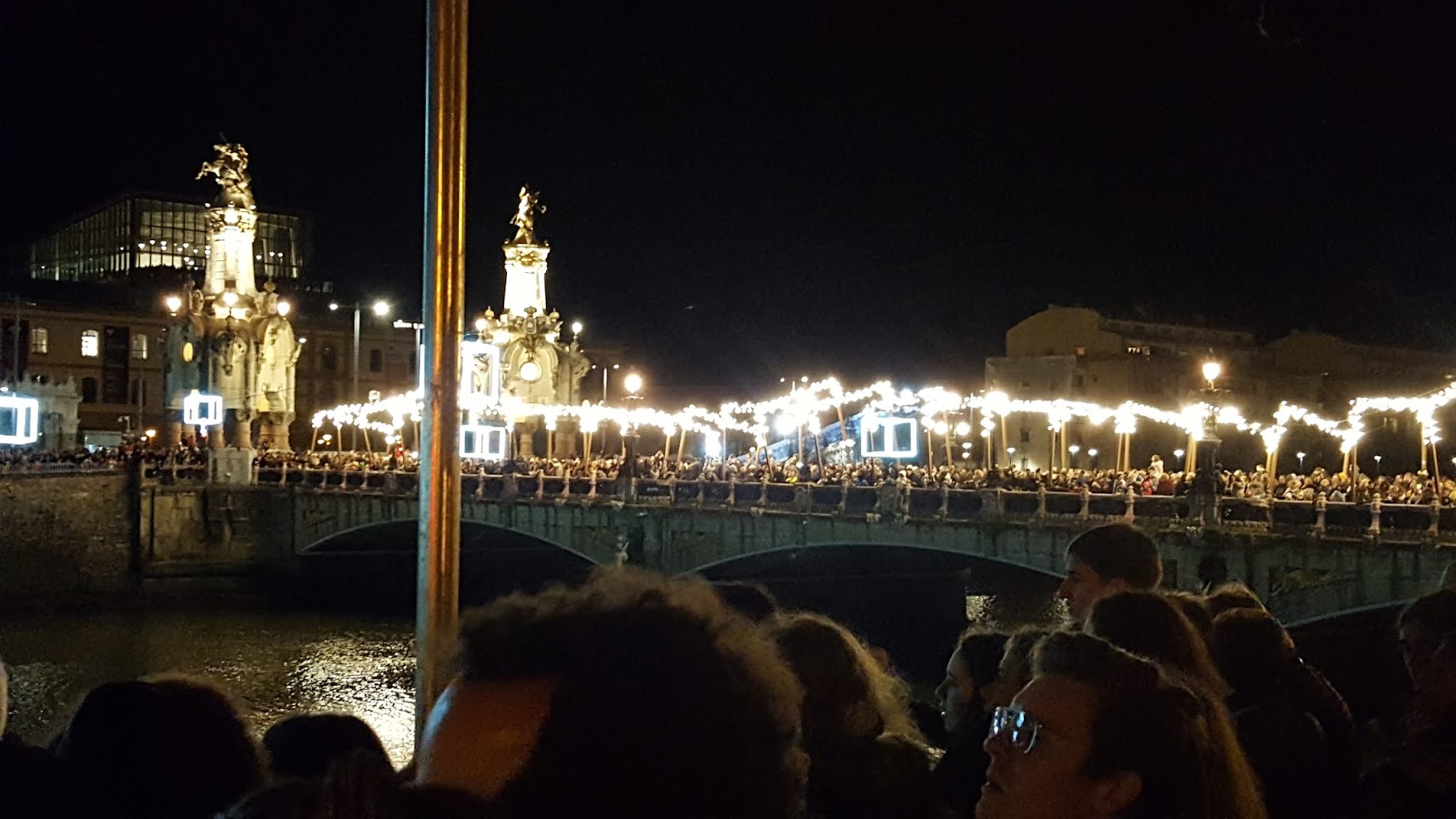
Well, it is that time of year again. Time for the 24-hour drumming festival known as La Tamborrada, which celebrates San Sebastian Day. (If you missed our experiences during our first Tamborrada, you can check them out in our January 27, 2018, post)

This year, we decided not to join the mosh pit at midnight in Constitution Plaza to see the raising of the city flag, which marks the beginning of everything. Instead, we got a good night's sleep (we are fortunate to live in a part of the city without bands playing at all hours), and set out at a reasonable hour on Sunday to observe the festivities. We saw a bit of the main kids'parade, but bypassed most of that to see what was happening in and near the old part of the city (la Parte Vieja). Over 8,000 kids participated this year in these parades.

We headed out on our favorite walk around the sea wall behind the old city. Although it was raining when we left our place, it had cleared up a lot and we had a beautiful walk. The sea was very rough, which is normal in the winter, and Shana got a great shot of the city and the sea:
On re-entering the old city, we encountered this band in front of the one of the city's oldest churches:
You can't actually see how many drummers there are in this one band -- that's not all of them. Most adorably, though, they were being aided by this future Tamborrada drum major:
We went to grab some pintxos and drinks and were joined by one of the band members -- apparently, drumming is thirsty work:
After refueling, we made our way to Constitution Plaza where there is a stage and a schedule of bands throughout the event. We were just in time to see a really enthusiastic band who even had a couple of people on horses (not on stage):
As you can see, everyone is in high spirits even if they do play the same songs over and over again (a schoolmate in a band told us that they learn 10 songs for Tamborrada, but we think they play about three songs 90% of the time). Oh, by the way, the numerous adult bands include over 18,000, participants, which, combined with the kids' bands, means that over 26,000 people  participate in the Tamborrada. One of Shana's yoga instructors, Sarah, is in this band and is even in the third picture. We discovered this because it turns out that Shana is in one of her pictures taken from the stage with the first row of spectators in the background. 

After making our way home, we got to enjoy some other bands as they made their way through our neighborhood. Fortunately for everyone involved, Monday was holiday in San Sebastian so most people did not have to work and we did not have school. Although we've come to the conclusion that the participants enjoy Tamborrada the most, we doubt we'll be taking up the sticks in time for next year. We do however have several talented nephews who could easily fit right in based on their drumming and trombone skills.  

Another fun San Sebastian celebration.

Hasta luego,

Jeff and Shana

Saturday, January 19, 2019

Adjustments

We’ve been living in San Sebastian for a year and a half now, which led us to consider what kind of adjustments we’ve made since arriving. Frankly, there really aren’t as many as you might think and most are obvious and easily managed. Here are the few that we still have trouble with or are surprised by despite being here so long:
Not having a clothes dryer. While we have a dishwasher, I would trade it in a NY minute for a dryer. Here in our humid, damp, wet climate it takes nearly 24 hours for clothes to dry inside. And we just don’t get many opportunities to put our clothes outside to dry even in the summer. One benefit: our workout clothes will last longer.
Supermarkets, and many other stores, are closed on Sundays. We are used to being able to go to Trader Joe’s (oh, how we miss TJ’s) or other markets any time, but here nearly all the major supermarkets are closed on Sundays. This means planning ahead for dinner on Sunday night. And neither the gym nor the yoga studio have Sunday classes. Sundays are quiet here.
Siesta hours. Most smaller stores close between 1:30 p.m. and 4:30 p.m. We can’t tell you how many times we want to pick something up and realize that we are out of luck and need to return later. Our school schedule causes this conflict more than anything because we finish at 1 p.m. When we are done with school this Spring, we won’t face this issue as much.
The modest cost of healthcare. Recently we’ve been taking care of our general health needs. We went back to the dentist, where the cleaning and check-up is completely covered by our insurance. I need two cavities filled, which is partially covered, and will cost about $100 for both. We also went and got our eyes checked, which only cost about $32 each. Glasses were more comparable to US prices, but still somewhat cheaper. And Jeff went to the podiatrist where his nearly hour-long examination cost about $60 and custom orthotics less than $200. While we are not part of Spain’s socialized medicine system, we reap the benefits of costs being low.
Spicy and international food. The Spaniards are not fans of hot and spicy food. You’d think it would go with bullfighting, but nope. Sometimes a menu will identify something as spicy, but we are always disappointed – it never goes beyond a 3 on our heat scale (1-10). One time at a Japanese restaurant Jeff was having sushi and they asked if he wanted it spicy, and when he said “yes,” they brought him soy sauce only, but no wasabi. Sadly, the international or ethnic food options here leave a lot to be desired. So, we get our spicy and international food fix when we travel to big cities.
Stoplight location. For some unknown reason, stoplights are placed on the near side of the intersection as opposed to the far side. This impacts us as pedestrians because it is difficult, if not near impossible, to see when the light changes from red to green.
My name. I spent most of my life correcting the pronunciation of my name. Here I am far more willing to be Shauna because Shana is pronounced that way in Spanish and the Spaniards have trouble with Shana. I’ve mellowed with age. ðŸ˜‰
As you can see, the adjustment to life here as not been overly difficult. 
Hasta luego,
Shana & Jeff

Saturday, January 12, 2019

A Whole “New”, But Not Surprising, Way To Define "Mintz"

The Mintz family has an inside joke regarding the meaning of “mintz.” When we all gather to share a meal, we often discuss the next meal. Most families simply enjoy the meal in front of them, but the Mintzes tend to think ahead. So, our brother-in-law Jim defined the verb "to mintz" to mean simultaneously eating one meal and discussing the next.
Now, imagine our surprise when we picked up our local newspaper, the Diario Vasco, one Saturday in November to see Mintz in the headline! (The headline actually used the term “Mintzodromoa.”) We were intrigued. What on earth could a mintzodromoa be? And what is a mintzalaguna (a word in the sub-headline)? Well, it turns out that “mintz” means “to talk” in Basque! Who knew? But if you know the Mintzes, you probably aren’t surprised. We’ve been in school more than a year now, yet none of our teachers, most of whom speak at least some Basque, ever made the connection between our last name and the Basque word.
The Basque language, known as Euskara, is believed to be one of the few surviving pre-Indo-European languages in Europe – which means it is older than the Romance languages. The origin of the language is not conclusively known, but it is not linguistically related to any known living language. During Franco’s era, the use of Euskara was essentially prohibited, but in the last 30 years the language has made a comeback. More than 90% of children in the Basque regions go to schools where the language of instruction is Euskara. Still, fewer than a million people speak Euskara. Our generation of Basques, the parents of current schoolchildren, went to school in Spanish, so many are not fluent in Euskara and struggle to help with schoolwork sometimes.
To encourage the more frequent use of Euskara, the local governments promote Basque cultural events and other programs. In November, Gipuzkoa (the Basque region where we live) celebrated “Euskaraldia,” a nearly month-long series of events encouraging citizens to speak Euskara on a daily basis. As part of the program, San Sebastian (and other cities) hosted Mintzodromoas and Mintzalagunas, which are discussion or conversation groups where people can practice speaking Euskara together. We think there are two different formats to the groups, thus the two different names. There also are Mintzakuadrillas (groups that meet more regularly) and Mintzapraktika (more general practice opportunities).
If you are wondering if we plan to learn Euskara so we can participate in this Mintzapalooza (our word), the answer is “no.” We have enough challenges learning Spanish! But we have learned many Basque words, mostly related to food, of course.
What does Mintz really mean? A quick google search leads to the following definition: German and Jewish (Ashkenazic) surname; a habitational name from the city of Mainz in Germany. For what it’s worth, Mainz was founded by the Romans at the confluence of the Rhine and Main rivers (southwestern Germany) in the 1st century BC. Mainz’s most famous citizen was Johannes Gutenberg, the inventor of the printing press, and there is a museum in Mainz dedicated to him that has two of the remaining editions of the Gutenberg bible. Mainz is also considered the wine capital of Germany, known for its Riesling and Silvaner. News to me after 22.5 years of marriage! Clearly we are adding Mainz to our list of future destinations and perhaps one day soon you’ll read a blog post about our visit.
Keep on “mintzing,” no matter how you define it!  
Shana & Jeff

Sunday, January 6, 2019

Barcelona...Closing Out 2018's Travel Extravaganza

Because we had two weeks off from school for the holidays, and we hadn't been anywhere since October (!?!) we decided to take a short trip to ring in the new year. We looked at a number of possible locations, but flights were really expensive, so we finally settled on taking a train to a city we know well, Barcelona.

This was our second trip to Barcelona this year, and our fourth trip there overall, so we did not have a huge number of touristy things to do that we hadn't done before. Nonetheless, we found quite a few things that piqued our interest. First, we returned to the Miro Foundation, a museum we had been to on our second trip to Barcelona in 2011. Prior to going we had read an article about Miro and how he treated making art like a job -- working every day from the 1920's almost until his death in 1983 at age 90. It was interesting to look at the dates of the various works in the museum. This work is from a later period when he was experimenting with different mediums:
You can't tell from the picture, but the work is like a giant crochet rug, which apparently is not meant to look like a dog. But, to me, that is all I can see.

We also went to Palau Guell, a mansion designed by famous architect Antoni Gaudi for the Guell family, which was his benefactor (Forbes estimates the family's wealth as the equivalent of $70 billion today, which would make them one of the richest of all time). The mansion was interesting with many Gaudi touches including designs for the many chimneys on the roof:

We spent a few hours at the Catalan history museum, which we had not been to before, and which gave us a new perspective on what is going on in Catalunya today. It really is a situation that has been going on for hundreds of years.

We also went to two art exhibits at the Caixa Forum, an arts center sponsored in several Spanish cities by our bank (which meant we got into the exhibits free). The texts related to these exhibits were only in Spanish and Catalan, which gave us a chance to practice, and we were impressed with how much we understood. One of the exhibits we saw was about the French artist Henri de Toulouse-Lautrec and his cohorts in the Montmartre neighborhood of Paris around the turn of the 20th Century. This exhibit was fascinating, and we really learned a lot about both the art and the period. 

The second exhibit was about Diego Velazquez, probably Spain's most famous pre-19th century artist, and others who painted during the Siglo de Oro (Century of Gold - the 16th). Although the exhibit used seven Velazquez paintings to look at a number of themes that were found throughout the period, we also learned that almost 80% of the works by Velazquez and related Spanish artists during this period have religious themes. This confirmed our intuition that most of the older Spanish art we see has a religious theme, but we were surprised the percentage was that high.

Finally, we made a trip out to the Montserrat Monastery, which is about an hour outside of Barcelona by train. We had visited the Monastery on our first trip to Barcelona in 2007, but this time we took advantage of the nice weather and hiked a bit in the hills surrounding the monastery. The views were fantastic:
The weather was really great for our entire trip: sunny and not too cold, and despite all the things we did, we still found time to walk along the beach, and to just sit at an old favorite cafe near the beach and drink coffee. We ate well (of course), including things we can't really get in San Sebastian: good pizza, good ramen, good falafel, as well as a fantastic seven-course meal on New Year's Eve. All-in-all it was a great trip and a great way to finish 2018 and start 2019.

Now that 2018 is over, we looked back at our travels and discovered that we spent 81 nights away from San Sebastian this year (Shana actually spent 84 nights away since she spent an extra three nights in Barcelona with her sister in June). We stayed in Spain (Bilbao, Barcelona), Portugal (Lisbon, Porto), France (Paris, Bourdeax), Italy (Bologna, Naples, the Amalfi Coast, Cinque Terra), Canada (Montreal, Quebec City, Toronto) and the Czech Republic (Prague). Truly a fantastic year of travel. We are already looking forward to more travels in 2019, so stay tuned.

Hasta Luego,

Jeff and Shana 

Monday, December 31, 2018

Celebrating the Holidays in San Sebastian

Last year we spent nearly all of December in California and Mexico, so we missed out on most of the holiday festivities here in San Sebastian, and there are many. This year we have done our best to take it all in. Here’s a quick recap of the excitement.
On December 1, the city turned on all the holiday lights and inaugurated the Christmas market. We joined what seemed like the whole town to see the lights come on:
The Christmas market is set up along the river and includes a diverse group of merchants selling artisanal wares. This year the city installed a giant Bavarian style Ferris wheel along the La Concha beach walk, which has been very popular, especially thanks to the good weather we’ve had so far this winter. We rode it on the 24th and the views were spectacular:
Starting on December 21 with the fair of Santo Tomas, San Sebastian celebrates a month of festivities that continues with Christmas (Nochebuena), New Year’s (Nochevieja), Tres Reyes (Jan. 6), and ends with La Tamborrada (San Sebastian Day, the drumming festival, which you can read all about here: http://vinoconvino.blogspot.com/2018/01/la-tamborrada-san-sebastians-biggest_27.html).
Santo Tomas was a kick. San Sebastian transforms into a huge country market to commemorate the day farmers came to pay their rents to the city-dwelling property owners, sell their wares, and buy products they could only get in the city. Most everyone dresses up in traditional Basque costumes and there are lots of stands selling txistorra (pork sausage) sandwiches and wraps, cider, honey, cheese, and other local products. It is yet another excuse to eat and drink in excess – like anyone needs such an excuse here in the gastronomic capital of the world. There is even a 340-kilo pig brought in and displayed in the main square. The pig used to be auctioned off to a lucky winner:
Here are a few choice photos of the events, including some of our friends in their traditional dress, txistorra in hand:
The city has been busy with lots of shopping activity, music, and decorations. On Christmas we went for a nice long walk on the beaches – it was a beautiful day.
We are spending NYE in Barcelona and will have more to report soon. Sending our very best for a happy, healthy, and joyous 2019.
Feliz ano nuevo,
Shana & Jeff

Wednesday, December 26, 2018

Spanish School Update

We have completed another 9 weeks of Spanish school. After four months off to travel and relax, we returned to the classroom on October 22. We were a bit nervous to see how much, if any, of our skills we had lost during our long break. We were surprised and relieved to find that we really hadn’t lost too much, and it didn’t take much time to readjust to scholastic life again. We jumped back into the C1 level, which is the highest level in the school. This does not mean that we are anywhere close to fluent though. We still have a long way to go to achieve fluency.
It is hard to explain the process of learning a language and how one measures progress, especially for middle-aged adults who are diligent students but not over-zealous about their studies. As we’ve discussed before, youth and speaking more than one language are two huge assets we lack. In addition, we are not motivated by a specific target, such as a test to enter university or obtain a job. Because we are more “casual” students, and are not pressured by a deadline, our progress is slow but steady.
One of our greatest accomplishments is the ability to read the local daily newspaper, the Diario Vasco, without having to lookup many words. We are often surprised to finish reading an article and realize that we understood the whole thing and didn’t rely on the dictionary once. While we still struggle with articles about politics and economics, we can page through the paper and easily get the gist of most headlines, sub-headlines, and stories. This really makes us proud of our progress. (The DV is probably written at a higher level than USA Today, but it’s not The New York Times or anything.)
In addition, in a movie or TV program that is shown in Spanish, if there are Spanish subtitles, we can follow along and understand almost everything. Whether it’s a movie we’ve seen before, such as the Star Wars movies that were broadcast this month, or episodes of The Big Bang Theory, or Netflix programs that include Spanish speakers, we are pleasantly surprised at how well we do. We do not think we can see an entire movie in Spanish without any subtitles at this point, but we might be willing to try a foreign language film that is shown with Spanish subtitles soon.
And, we finally can conjugate verbs smoothly. Although we may need to pause to think a moment for some of the trickier, irregular verbs (of which there are many), those pauses have gotten minimal.
We are currently a class of 6 students. Of course, we are the oldest. The other 4 students include a 39 year-old Chinese woman who is married to a Basque man, a 26 year-old Russian woman, a 20 year-old from Iceland, and a 17 year-old French girl. Another very international class. Almost everyone speaks better than we do but we hold our own.
We have now completed a total of 44 weeks of school and currently plan to do another 11 (through the end of March with a 1-week break), possibly adding 2 more weeks at the end. We still won’t be fluent after a year of classes, but perhaps we’ll be up to the movie challenge.
Hasta luego,
Shana & Jeff

Saturday, December 22, 2018

La Loteria de Navidad (The Christmas Lottery)

The Christmas Lottery in Spain is a really big deal. First organized in 1812 (!) it has happened every year since, including during the Spanish Civil War. It is also considered the largest lottery in the world, with a total payout of about $2.8 billion (the total payout represents 70% of ticket sales, meaning that total sales are about $4 billion). Technically, a ticket for the lottery costs 200 euros, but they are generally sold in "decimos" (one-tenth) for, not surprisingly, 20 euros. Many groups and organizations further divide tickets allowing people to participate for as little as 1-2 euros. It is estimated that 75% of the Spanish population takes part in the lottery.

Many groups of friends or business associates form groups to buy tickets, and often people have friends buy tickets in other parts of the country because ticket numbers are sold geographically (this is, of course, pointless from an odds perspective, but people are superstitious). One small town in Catalunya is named Sort, which in the local Catalan dialect it is the word for luck. This small town sells 19% of all lottery tickets in the country -- mostly through the internet.

The lottery drawing is held each year on December 22. While we were aware of the lottery last year, we left Spain on December 2 and did not return until after the lottery was over, so we did not learn a lot about it, nor did we buy any tickets. This year our teacher talked a lot about the drawing and was the perfect example of how excited Spaniards get about the lottery.

We figured we'd try our luck and we bought a single ticket:
As you can see, the ticket contains a five-digit number. The drawing, which is televised on multiple stations, takes place in Madrid using two giant spherical cages. One contains the numbers from 00000-99999, the other containing the prizes. There are 1794 smaller prizes (100 euros), 8 fifth-place prizes (6000 euros), 2 fourth-place prizes (20,000 euros), 1 third-place prize  (50,000 euros), 1 second-place prize (125,000 euros) and "El Gordo," which literally means "the fat one". This grand prize is 400,000 euros. 

Two children receive each ball as they are ejected into the chute and literally sing the winning number and the prize won. With over 1800 prizes to award, this process takes hours. When one of the 13 large prizes is won, the process is briefly halted and the winning number is specially noted. It is considered an honor to sing when El Gordo is drawn and those children are congratulated. The children are from a school in Madrid and wear their school uniforms during the drawing. We watched a bit this morning, and now the tune to which the numbers are sung is stuck in our heads.

The mathematically inclined among you will note that there are only 100,000 numbers in this lottery. This is correct, which is why the prize amounts seem so low. In fact, multiple tickets with the same number are sold and all collect on whatever prize that ticket wins. In addition, there are other prizes related to having some of the same numbers as the big prizes. In particular, tickets that end in the same number as the ticket that wins El Gordo win 20 euros (in other words 10% of all tickets get their money back). The result is that the money won is widely distributed throughout the country.

So, how did we do in our first Christmas lottery? We actually won one of the small 100 euro prizes!! Next year, maybe El Gordo.

Hasta pronto,

Jeff and Shana